
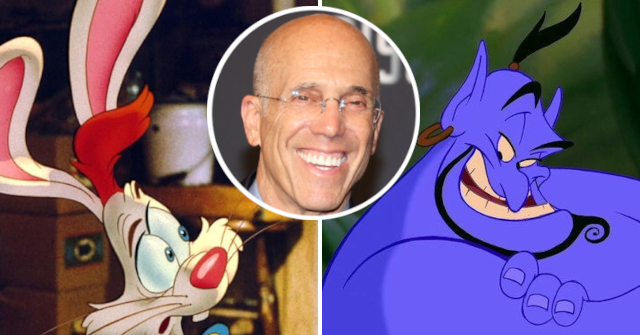
Jeffrey Katzenberg, the former Disney animation chief who went on to co-found DreamWorks and spent more than three decades as one of the most influential figures in feature animation, took to his verified X account this week with a 2,500-plus word argument in favor of adopting artificial intelligence in animation, according to Breitbart’s John Nolte.
Katzenberg’s animation resume stretches back to the 1980s and includes credits on films such as Who Framed Roger Rabbit, The Little Mermaid, Beauty and the Beast, Aladdin, The Nightmare Before Christmas, The Lion King, and the Shrek and Kung Fu Panda franchises. His argument lands in the middle of a fierce fight in Hollywood over how AI tools should be used in film and television production.
Acknowledging the Pain Behind Past Transitions
Katzenberg does not dismiss the concerns of workers who might lose jobs to the technology. Instead, he frames those job losses as the real subject behind much of the industry’s loudest alarm, writing that while he sympathizes with those at risk, the fear-mongering around AI is largely about employment.
He reaches back into history to make his case. As Katzenberg notes, composer John Philip Sousa once spoke out against the gramophone, describing it as a “substitute for human skill, intelligence, and soul.” But once Sousa’s copyrights were secured and he was paid for that mechanical music, the complaints faded. Katzenberg also points to the thousands of musicians who found steady work playing for silent films for nearly two decades, and who opposed the arrival of sound movies — not by admitting their economic self-interest, but by attacking “canned music” as a menace.
The same pattern played out inside his own career, Katzenberg says. Under his leadership, computer-animated films displaced a large but unquantified number of illustrators. He described the decision to end hand-drawn animation at DreamWorks in stark terms: “we made the difficult decision to sunset hand-drawn animation and become a fully computer-animated studio. It was the right thing to do, but it was not without pain.” That decision, he added, “cost talented people their place in an industry where they had worked their whole lives. Some made the leap to the new tools and did the finest work of their careers. Some never did.”
The Economic Case: Cutting Costs and Time
Katzenberg argues that AI-driven animation can “cut the time and cost of producing world-class animation by as much as ninety percent” — a claim with substantial implications for studios that spend years and tens of millions of dollars on a single animated feature. His broader message to the industry is that resisting AI is a losing strategy. As he put it, Hollywood needs to accept that AI is not going away. The energy the industry spends trying to make it disappear, he writes, is energy not spent deciding the terms on which it will exist — and “the terms are everything.”
He also offers a pointed formulation of what AI can and cannot supply. The technology, Katzenberg writes, needs something from artists “that they cannot build and cannot buy: creativity.” He describes that creativity as the kind that “takes a blank page and conjures a single right answer where there was none” and has held audiences for a century. Without it, Katzenberg argues, even “the most powerful reasoning engine ever invented will still be missing the only thing that makes a story worth telling.”
The former executive is equally emphatic that the artist remains indispensable. The artists who learn to use these new instruments, he predicts, “will do things the engineers never dreamed of.” He compares the moment to the earliest days of film: Edison may have invented the motion picture, but it took Chaplin, Lloyd, Keaton, and many others to make movies emotional. “Now, the canvas is about to expand yet again,” Katzenberg writes. “We should decide now that we intend to paint on it.”
What Katzenberg Leaves Out
In Breitbart’s assessment, however, Katzenberg skips over a major factor behind Hollywood’s aggressive posture toward AI — namely that many in the industry publicly denounce the technology while using it privately. The outlet argues that the real motive is preserving Hollywood’s grip on production.
According to that analysis, once the tools to tell stories become available to anyone, anywhere, at a reasonable price, Hollywood’s century-long monopoly on production erodes — a monopoly that exists primarily because of astronomically high production costs. Remove those costs through AI, the argument goes, and any artist with a good story and the visual instincts of a competent director could effectively become their own Hollywood.
The debate Katzenberg has stepped into is not confined to X posts. AI has become one of the most contested issues in entertainment labor, with unions, studios, and creatives jostling over consent, compensation, and credit for work used to train and operate AI systems. Katzenberg, whose career was built on exactly the kind of technological transition he now describes, is betting that the industry’s resistance will ultimately prove futile — and that the terms of AI’s adoption, not its existence, are what remain up for negotiation.
Source: www.breitbart.com — https://www.breitbart.com/entertainment/2026/09/24/nolte-former-disney-animation-chief-jeffrey-katzenberg-champions-ai/