
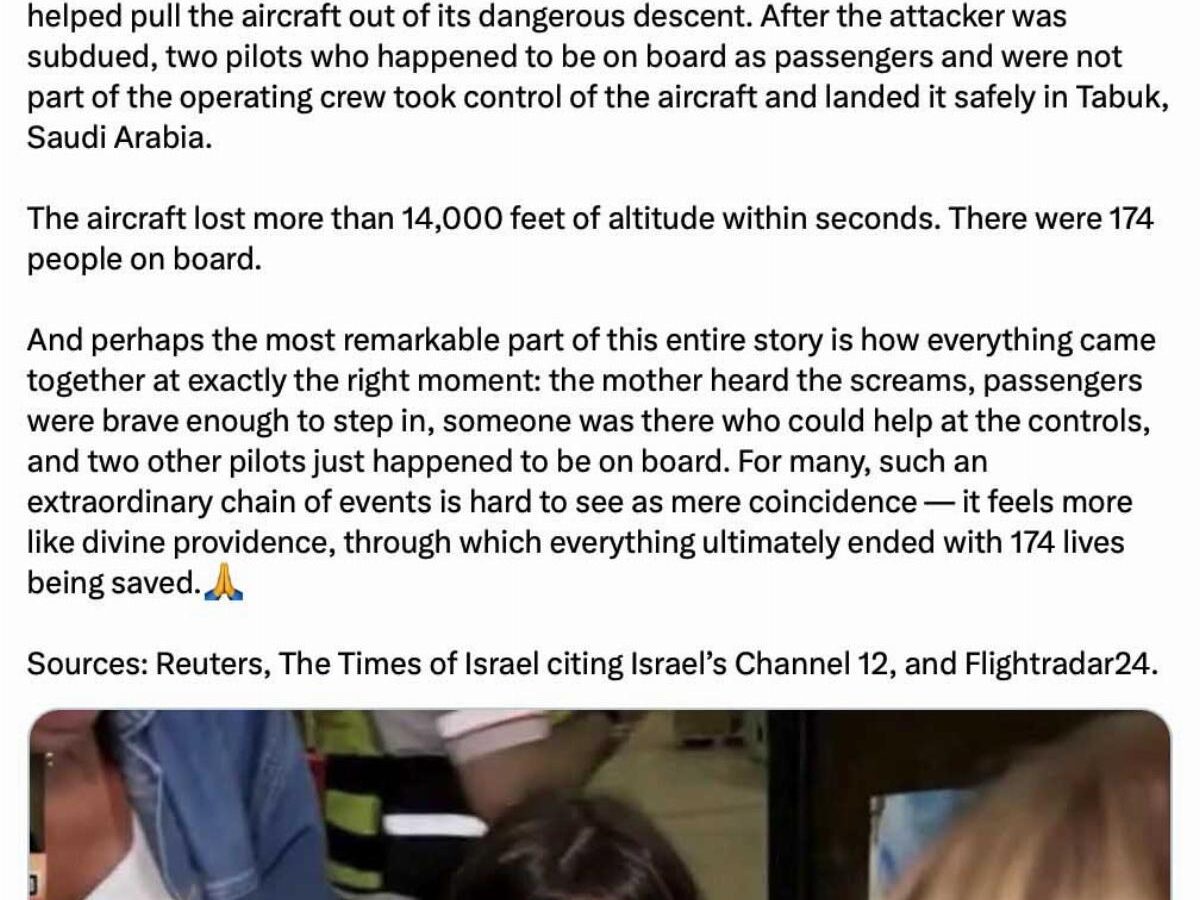
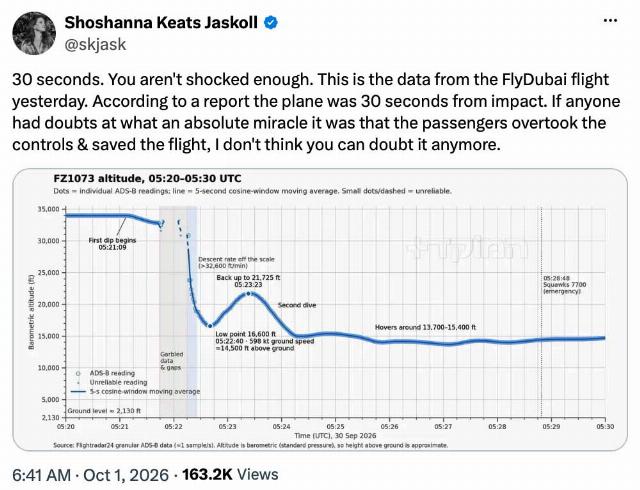
They had roughly thirty seconds to live, if the account pieced together by Israeli investigators and relayed by Israeli officials is accurate. That is the window an American Thinker opinion piece, written by Mike McDaniel and published October 3, 2026, uses to frame its central question: what does it say about Western civilization that the people who acted in those thirty seconds are treated as remarkable exceptions rather than the norm?
The essay is not a reported news story. It is a commentary piece from a conservative outlet, and its argument is both a tribute to the passengers and crew who subdued an attacker on a FlyDubai flight bound for Israel and a sustained attack on how major news organizations described what happened. McDaniel’s title — “Miracles and heroism” — signals where he lands by the end.
The media’s framing fight
McDaniel’s sharpest passages target the language used in early coverage. He cites CNN describing the event as “an internal personnel incident between pilots,” The New York Times calling it “a clash in the cockpit,” and Reuters headlining its account “A pilot brawl, then a rapid descent: Passengers recount chaos in flydubai flight.” The BBC, in McDaniel’s telling, was the worst offender: he quotes BBC News reporting that “Israel’s far right national security minister Ben-Gvir says that an Israel bound flight that landed in Saudi Arabia was due to a terrorist who wanted to crash the plane and kill Israelis.”
For McDaniel, those characterizations amount to a deliberate refusal to name the thing. He asks whether a terrorist conclusion wouldn’t be “the conclusion of any reasonable human being” pending evidence to the contrary — and then argues the evidence arrived.
According to the piece, Israeli Prime Minister Benjamin Netanyahu told Fox News that “we know that he underwent Islamist radical indoctrination,” citing information gathered during Israel’s investigation. A fellow pilot, speaking to Israeli Channel 16 journalist Yosef Yisrael, described the attacker as “someone characterized by very strange behavior, especially around religious observances that were out of step with his surroundings.” McDaniel notes the detail that the man would not shake hands with women and prayed so often that it stood out even among Muslim colleagues — a detail he treats as suggestive of radicalization rather than ordinary piety.
The same pilot was blunter with the Israeli broadcaster: “There is no other way to put it, we hired the services of a terrorist and nearly caused the deaths of 180 people. Usually only Emiratis fly to Israel. It is not clear how he got on this flight.”
How did he get in the cockpit?
That question — access — is where the commentary turns into something closer to a security critique. Israel requires that anyone entering the country hold a passport from a nation with diplomatic relations with Israel, and Oman, per the essay, does not qualify. “This is a clear breach of the agreement,” a source inside Israel’s transportation ministry told the Jerusalem Post, according to McDaniel’s account.
Doron Spielman, a spokesperson for Netanyahu’s office, told Reuters that going forward, “Every pilot that is going to be flying into Israel, we are going to know the pilots’ identities, know who they are, and do some type of security check.” McDaniel seizes on the obvious implication: how did the attacker receive a copilot assignment without help from somewhere?
He also folds in a geopolitical dimension. President Trump, he writes, suggested Thursday that Iran was behind the failed hijacking, warning that the Islamic Republic would be struck “very hard” if that were proven. “I would say the answer, based on what I’m hearing, is yes, but we’re working on it right now,” Trump said, according to the essay.
The case for the passengers
McDaniel’s admiration for the people on board is unqualified. Since 9/11, he writes, many Americans boarding a flight quietly run through the same mental checklist: what if? What will I do? Who looks like a threat? Who looks like they’d help? He admits he flies rarely but asks those questions anyway. It is hard to imagine, he argues, that a smaller share of Israelis do the same — and on this flight, they proved it.
He calls them heroes born of necessity, shaped by life in a small nation surrounded by enemies. “They fight or die,” he writes. He insists he takes nothing away from them — his complaint is about the rest of us. When a few people do what everyone should be willing and prepared to do, they stand out; that they stand out at all is the indictment.
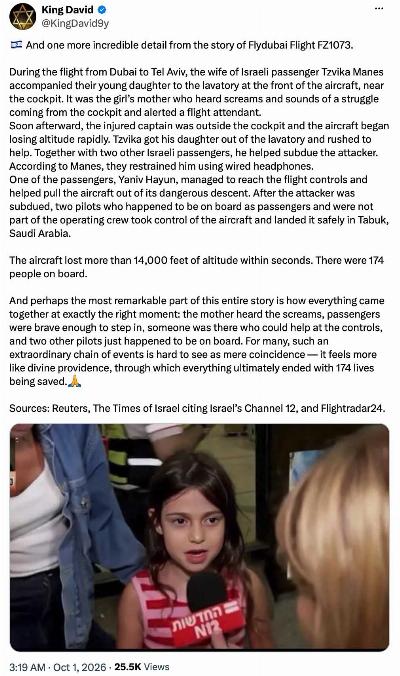
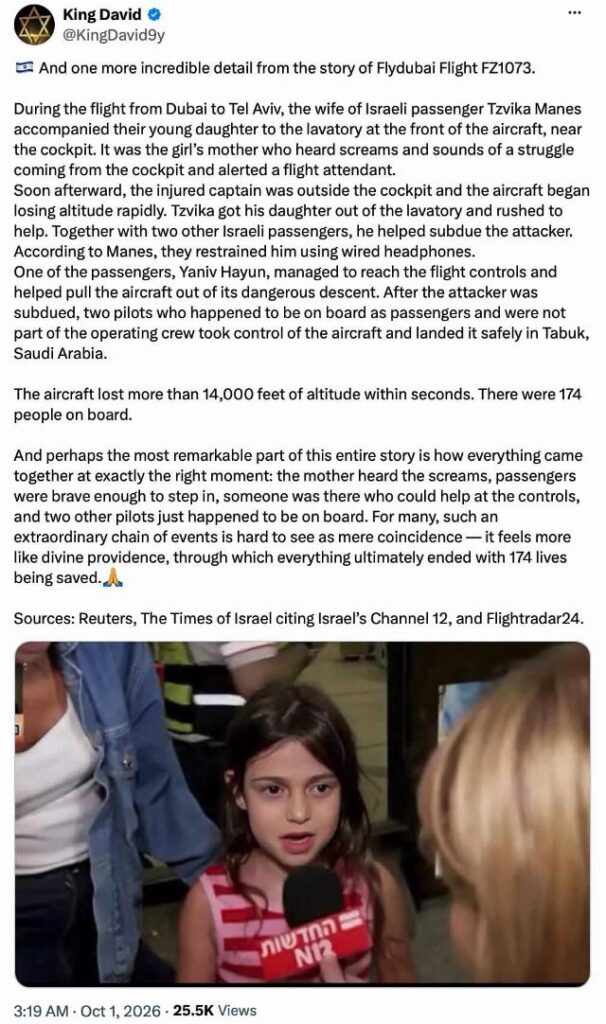
And he doesn’t limit the heroism to the men who physically subdued the attacker. He lingers on the ordinary competence that saved the aircraft: the plumber who calmly took the pilot’s seat and pulled the jet out of a dive with about thirty seconds to spare. He marvels that the airframe held together under stresses far beyond its design limits, wonders whether the plane will ever fly again, and notes the skill of a qualified crew that managed to land a 737 with essentially no rudder. The surviving passengers, he writes, were “God’s chosen people” — his phrase — and he treats their survival as divinely inspired.
The ‘minor miracle’ question
The essay opens with a rhetorical question and returns to it at the close: is there any such thing as a minor miracle? Many people, McDaniel notes, have described the passengers’ rescue that way. He doesn’t accept the modifier. The right people were on one of thousands of daily flights, doing precisely the right things at precisely the right moments. There is no degree to God’s miracles, he argues, and nothing minor about this one.
What remains is the exhortation. If Western civilization is going to survive, he writes, it needs people like those on that flight more than ever — people prepared to recognize reality and do what’s necessary. The piece ends not with a policy prescription but with a call to readiness, framed through the lens of faith and the example of passengers who had half a minute to decide who they were going to be.
The commentary reflects a broader argument on the right about how terrorism is named and covered — one that treats editorial word choices in the aftermath of an attack as consequential in their own right. Whether the early headlines McDaniel cites were caution or evasion, he has no doubt. His view is that they were a choice, made consistently, and that the people in row after row on that flight made a better one.
Source: www.americanthinker.com — https://www.americanthinker.com/blog/2026/10/miracles-and-heroism/