
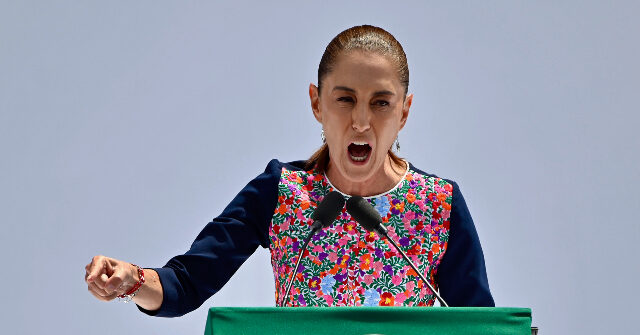
Mexico’s President Claudia Sheinbaum publicly rebuked U.S. Ambassador to Mexico Ronald Johnson and Querétaro Governor Mauricio Kuri this week after the two participated in a ceremony to lay the first stone for a new state police academy aimed at combating drug cartels and terrorist organizations. According to Breitbart News, Sheinbaum used her daily news conference to air her grievances, claiming the event was held without any invitation to the federal government and that Johnson’s visit had not been coordinated through Mexico’s foreign relations ministry.
Sheinbaum said it was her duty to “expose” the gathering and argued that Querétaro cannot establish such a school without federal permission. She also accused Johnson of acting out of line by not going through proper federal channels to attend the event and assist in coordinating the academy’s formation.
A State-Level Push Against Cartels
The event that drew Sheinbaum’s ire was the announcement of a new State Interdiction Academy in Querétaro, where state police officers are slated to receive advanced training on fighting drug cartels and terrorist organizations. After the ceremony, Ambassador Johnson issued a statement praising Querétaro for its proactive approach, calling it an example to follow.
But Sheinbaum’s version of events quickly came under scrutiny from Mexican journalists, who noted that members of Mexico’s military and the federal Attorney General’s Office had in fact attended the event. The discrepancy raised questions about the president’s claim that no federal officials were present.
The clash highlights ongoing tensions between Mexico’s federal government and U.S. officials over security cooperation, particularly in states that have taken independent action against cartel violence. Querétaro, a relatively prosperous state in central Mexico, has increasingly positioned itself as a leader in confronting organized crime — a stance that has apparently put it at odds with Sheinbaum’s administration.
Political Fallout and Diplomatic Protocol
Sheinbaum’s decision to publicly chastise a sitting U.S. ambassador is unusual and could complicate bilateral relations at a time when both countries are grappling with fentanyl trafficking, migration, and cartel-related violence. Her comments suggest a desire to assert federal control over security initiatives that she perceives as bypassing her government’s authority.
For his part, Johnson has not responded directly to Sheinbaum’s criticism, but his praise for Querétaro’s efforts signals continued U.S. support for state-level anti-cartel measures, even when they ruffle feathers in Mexico City.
The episode also underscores a broader debate within Mexico about how to combat cartels: while Sheinbaum has favored a more centralized, non-confrontational approach sometimes referred to as “abrazos, no balazos” (hugs, not bullets), some governors are pushing for more aggressive, U.S.-backed strategies. The new academy represents a tangible step in that direction, offering specialized training that could enhance state police capabilities independent of federal oversight.
As of now, it remains unclear whether Sheinbaum will take any formal action to block the academy or sanction Querétaro’s governor. But her public rebuke serves as a warning shot to both U.S. diplomats and Mexican state leaders that she intends to guard her administration’s prerogatives on national security.
The controversy also raises questions about the limits of diplomatic engagement by U.S. ambassadors in Mexico. While ambassadors routinely meet with governors and attend local events, Sheinbaum’s reaction suggests that any perceived slight to federal sovereignty will be met with pushback.
Breitbart News noted that the journalists who challenged Sheinbaum’s account pointed to the presence of military and Attorney General’s Office personnel as evidence that her claim was inaccurate. That pushback may weaken her argument and could embolden other states to pursue similar initiatives without waiting for federal approval.
For now, the academy’s future hinges on whether Sheinbaum’s government will try to assert legal authority over the project or allow it to proceed as a state-led effort. Either way, the spat has drawn attention to the fractured nature of Mexico’s security strategy and the delicate dance between federal and state authorities — with the U.S. playing an increasingly visible role.
Source: www.breitbart.com — https://www.breitbart.com/border/2026/10/06/sheinbaum-mad-after-u-s-ambassador-helps-mexican-governor-start-anti-cartel-state-police-academy/