
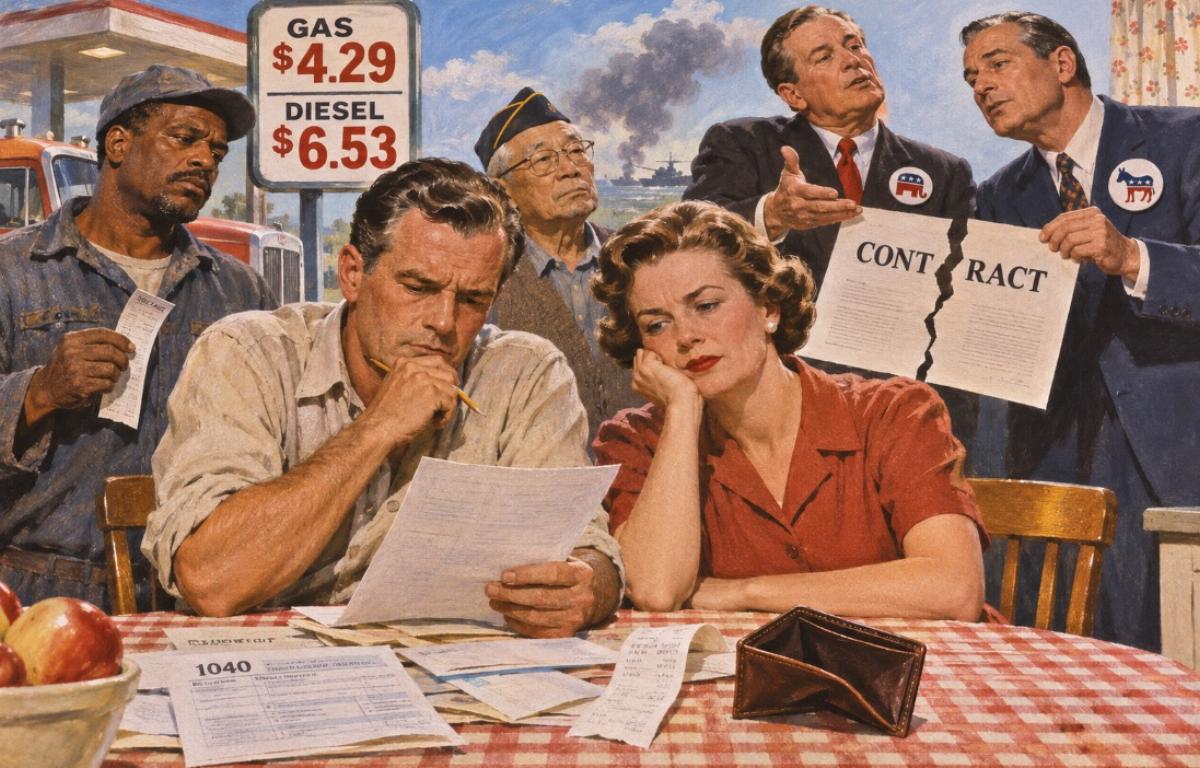
Tuesday’s election results weren’t a referendum on ideology—they were a pink slip. That’s the argument economist Raymond B. Jewell makes in a blistering post-mortem of the 2026 midterms, framing voter behavior not as a shift in political allegiance but as a rational response to a broken economic contract.
The Contractor Got Fired
Jewell, author of Unnatural Economics, compares the government to a contractor hired by taxpayers. When that contractor fails to deliver—whether through soaring diesel prices, unchecked inflation, or an unpopular war—the rational response isn’t to swear off contractors forever. It’s to hire a different one and see if they’ll do better.
Exit polls back the theory. Seventy-four percent of voters cited the Iran war as a major factor in their vote. Eighty-seven percent pointed to fuel prices. Three-quarters called the economy “not so good” or “poor.” These aren’t culture-war metrics. They’re kitchen-table concerns.
$6 Diesel and the Ballot Box
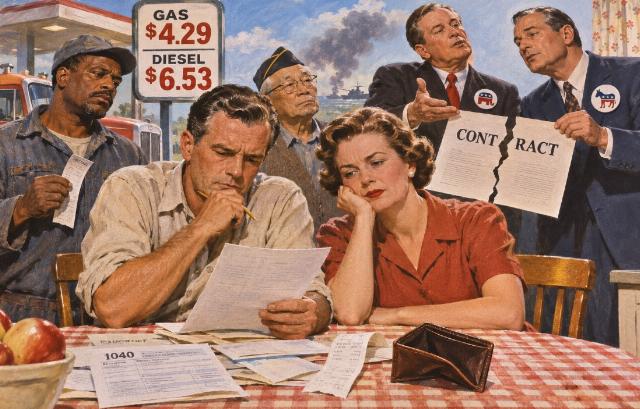
The numbers tell the story. Diesel hit $6.53 per gallon in September—the highest nominal price on record. That surge rippled through supply chains, pushing up freight costs and, eventually, grocery bills. Social Security’s 2.8% 2026 adjustment lagged behind inflation, which peaked at 4.2%. Retirees felt the squeeze immediately.
Meanwhile, the Iran conflict—unpopular from the start, with 63% of voters calling it a mistake—has cost $47 billion and counting. For households already stretched thin, the math became unavoidable. “This isn’t a cultural complaint,” Jewell writes. “It’s a math problem.”
No Mandate, Just a Warning
Democrats gained seats, but pre-election polling showed 52% of voters held negative views of the party. That disconnect, Jewell argues, proves this wasn’t an ideological realignment. It was a two-year probationary contract. “The voter is not saying, ‘I believe in the Democrat agenda,’” he writes. “The voter is saying, ‘Deliver something, or you’re next.’”
Conservatives misread the loss by treating it as a messaging failure rather than a delivery failure. The real question isn’t how policies were sold—it’s whether they worked. A trucker staring at diesel prices or a retiree comparing Social Security checks to grocery receipts isn’t weighing party platforms. They’re auditing results.
The 2028 Litmus Test
If diesel stays above $6, if inflation keeps outpacing adjustments, if spending feels disconnected from daily life, Jewell predicts another swing. “The ball bounces back,” he warns. Voters aren’t loyalists—they’re shareholders demanding a return. And right now, they’re still waiting.
Source: www.americanthinker.com — https://www.americanthinker.com/articles/2026/11/voters-didn-t-switch-parties-they-fired-the-contractor/