
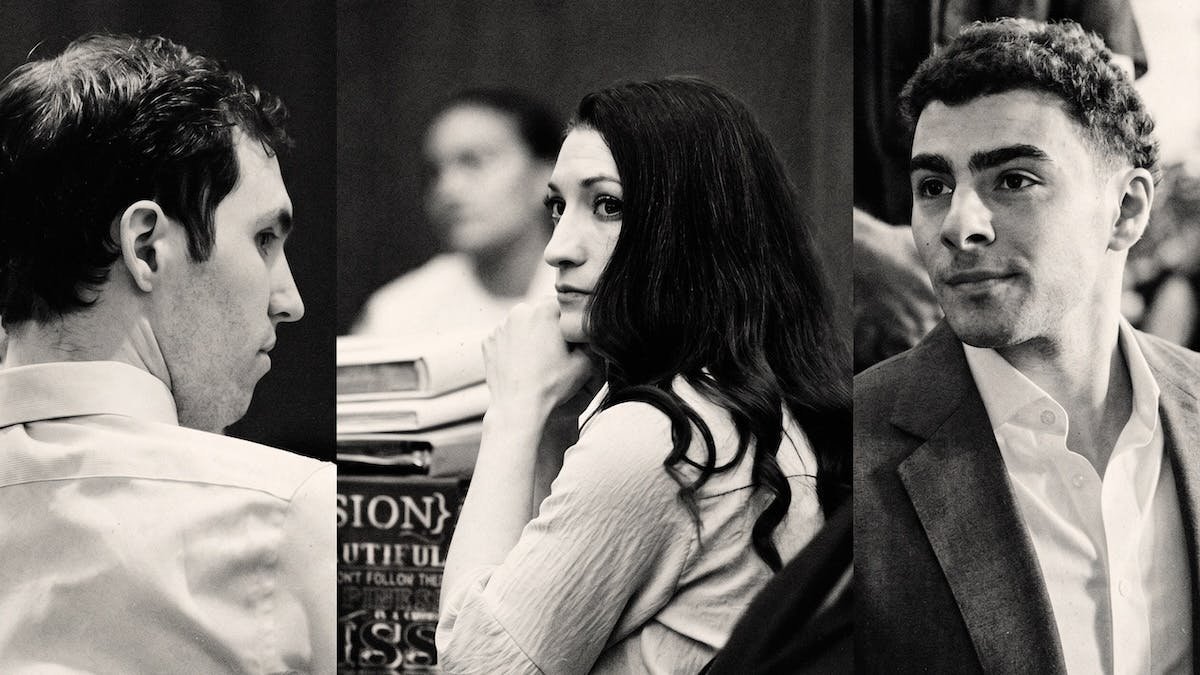
Lindsay Clancy’s trial has transfixed the nation, but something darker has emerged alongside the courtroom drama: a fan club. The Massachusetts mother has admitted to killing her three young children, yet a growing chorus of online supporters — complete with social media groups and courthouse crowds in pink — treat her less like a defendant than a cause célèbre.
Deadline-oriented news cycles and social media have supercharged what columnist Caitlin Flanagan described as an “almost exultant, fan-like celebration” of Clancy, a shift from mere compassion to something stranger. As one new essay from The Daily Wire’s Upstream section points out, Clancy is hardly alone in this phenomenon.
A Pattern of Killer Adulation
Luigi Mangione, the 28-year-old who admitted in federal court to shooting UnitedHealthcare executive Brian Thompson, now boasts a growing legion of admirers. Fans have built websites dedicated to sending him letters and reading his statements — this for a self-confessed killer who left a widow and two young fatherless boys. Meanwhile, conspiracy theorists, egged on by Candace Owens’s rapid-fire theories, have attempted to turn Tyler Robinson — the alleged killer of Charlie Kirk — into a cult hero.
And in August, when a woman wielding two knives fatally stabbed Bank of America employee Erin Piacenti in Times Square, online ghouls celebrated her death for the simple crime of working for a bank. One Hollywood director marked the occasion with a Luigi meme.
The glib online reaction to Piacenti’s murder reveals a disturbing inversion: the actual victim becomes the villain, and the killer becomes a symbol of resistance against a faceless corporate enemy. “The actual victims no longer have names. Their humanity is subsumed beneath the entity they supposedly represent.”
The Roots of Upside-Down Morality
According to the essay, written by Daniel Darling, director of the Land Center for Cultural Engagement at Southwestern Seminary, this modern phenomenon is not merely a product of internet outrage. It reflects deeper cultural shifts — beginning with what sociologist Robert Bellah called “expressive individualism.” The belief that identity is found by looking inward rather than from family, religion, or tradition has created a moral vacuum where authenticity trumps ethics.

For Clancy’s fans, the “real” Lindsay is not the woman who strangled her children in a barbaric and torturous way, but the loving and caring mother underneath the act. Blame, in this narrative, falls not on her but on the institutions that failed her: her family, the pharmaceutical industry, and a society that demanded too much of her. Clancy undeniably suffered severe mental anguish — but for her supporters, that anguish apparently absolves her of all moral culpability.
Add to that a gnostic desire to find “the real story” behind the obvious one. Even with substantial evidence against Robinson and a court order to stand trial, podcasters like Owens feed suspicion that the official narrative is a cover-up. Conspiracy thrives when trust in institutions collapses, offering believers a comforting explanation for the evil of the age. No amount of contrary evidence can pierce these personal “truths” because they shape preferred narratives — turning an alleged killer into a sympathetic pawn.
Tribalism and the Oppressor-Oppressed Frame
Tribalism, fueled by an oppressor-versus-oppressed view of justice, further excuses violence when the killer is sorted into the “right” class. Mangione’s cold-blooded shooting of a husband and father is reframed as righteous because he took on the healthcare industry, which his fans demonize as the root of all social evil. For Clancy’s followers, the system — mental-health care, pharma, marriage — contains the true villains. If the act is committed by someone in the oppressed class against someone in the oppressor class, it becomes understandable, even justified.

This logic transforms a murdered mother like Piacenti from victim to villain simply because she worked for Bank of America. “The actual victims no longer have names.” They become symbols of oppressive systems, not human beings.
Empathy, the good instinct to see ourselves in others, becomes twisted. “Any one of us could be sitting in her chair,” Clancy’s supporters say. “I am Luigi,” his rabid fans declare. Conspiracists imagine they too could be Robinson, set up by a dark cabal. As Darling argues, this reflects the erosion of a moral consensus — what he roots in America’s Judeo-Christian heritage — leaving many without fixed standards of good and evil. “Relying on the inner self and sorted by society into our clans, we make truth relative and justice preferential.”
A Call to Recoil and Resist
The essay calls for a twofold response: to recoil from the horror and to resist the upside-down morality that turns victims into villains and the accused into heroes. Cora, Dawson, Callan, Brian Thompson, Charlie Kirk, and Erin Piacenti were not symbols — they were human beings made in the image of God. “Luigi Mangione, Lindsay Clancy, Tyler Robinson, and Pamela Cisneros are morally culpable for the acts they allegedly committed, and the state should hold them accountable.”
Beyond accountability, Darling urges a turning away from the online tribal circles that nurture our baser instincts and toward the true, the good, and the beautiful. Drawing on the Gospel of John, he reminds readers that light has come into the world, and the darkness has not overcome it. Instead of communities built on grievance, spectacle, and death, he points to faith as offering belonging built around shared belief and redemption — a perspective that sees our own narratives not as central, but as part of a larger, eternal story.
Source: www.dailywire.com — https://www.dailywire.com/news/why-america-now-worships-its-cold-blooded-killers