
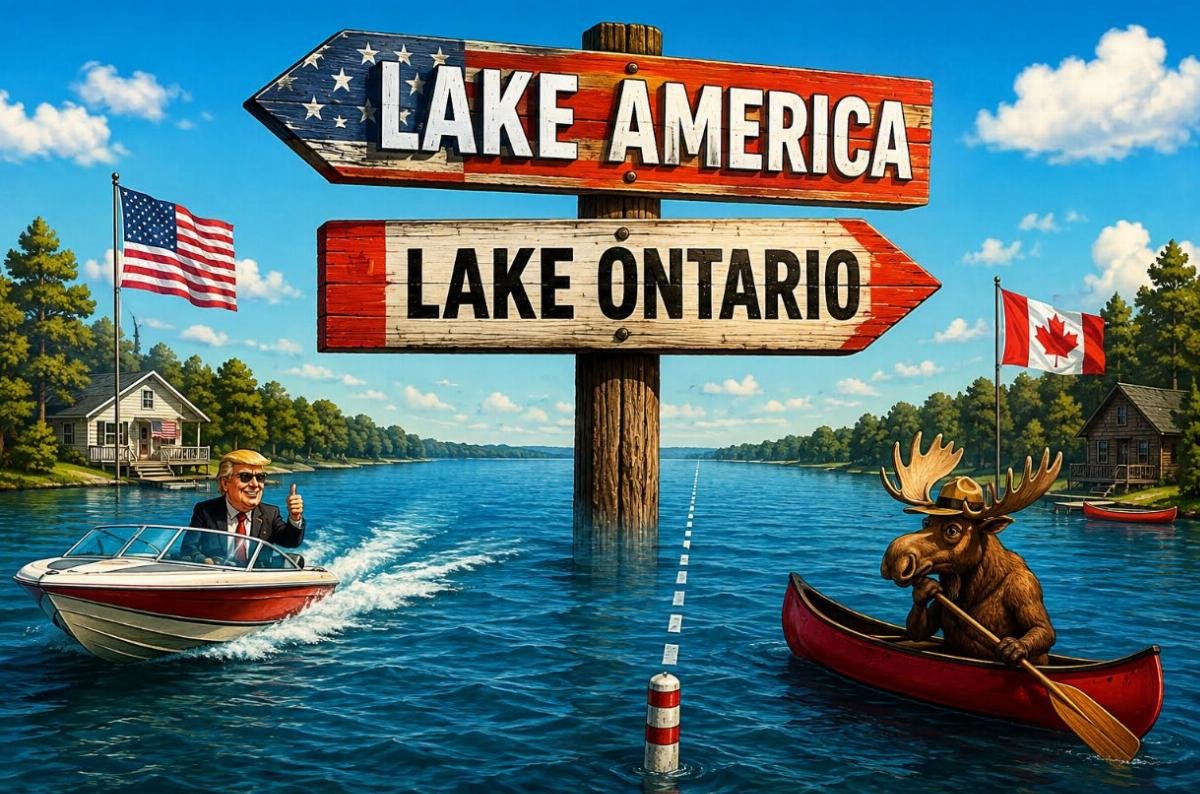
In Shakespeare’s Romeo and Juliet, Juliet wonders what’s in a name, musing that a rose by any other name would smell as sweet. Columnist Brian Joondeph suggests the same logic should apply to large bodies of water—still wet and deep regardless of what President Donald Trump calls them.
Trump recently renamed Lake Ontario to Lake America, following last year’s renaming of the Gulf of Mexico to the Gulf of America. These changes, Joondeph argues, will likely be insignificant footnotes in history, unlike the Louisiana Purchase or the acquisition of Alaska.
Yet Democrats and left-leaning media are reacting as if the United States invaded Canada, Joondeph writes in an American Thinker column. The New York Times solemnly declared, “Lake Ontario didn’t ask for this,” while The Washington Post warned of a “troubling question.” The column points out that lakes don’t talk, and they certainly didn’t pick their names in the first place.
A Tale of Two Renamings
Joondeph contrasts the current outcry with the muted coverage of a similar renaming under President Barack Obama. In 2015, Obama changed Mount McKinley to its indigenous name Denali. The Times merely reported “Mount McKinley to be renamed Denali,” and the Post noted that Obama “will rename the highest U.S. peak, dropping McKinley for Denali.” No one asked whether Denali had requested the change, and no troubling questions were raised.
The column also highlights other examples of name changes embraced by the left: Colorado’s Mount Evans was renamed Mount Blue Sky, and Denver’s Stapleton neighborhood became Central Park. The Biden administration’s Interior Department renamed hundreds of geographic features with derogatory terms, and a congressionally mandated process changed Confederate-linked military bases, such as Fort Bragg to Fort Liberty.
Trump later restored “Fort Bragg,” but this time to honor Private First-Class Roland L. Bragg, a WWII paratrooper who shared the surname of the Confederate general. Joondeph calls this “rhetorical sleight of hand.”
Not Just an American Phenomenon
Canada has its own history of geographical rebranding, Joondeph notes. The Queen Charlotte Islands became Haida Gwaii, Cape Dorset became Kinngait, and Hall Beach became Sanirajak. These changes were widely celebrated as recognizing indigenous history and cultural sensitivities.
“Apparently, geographical names are fluid, too—until Trump picks one,” Joondeph writes. He argues that the outrage is situational: when Democrats or Canadian leaders make similar changes, they are praised as thoughtful and progressive; when a Republican does it, it’s decried as small-minded and hateful.
Sports Teams, Brands, and People
Joondeph extends the argument to other name changes. The Washington Redskins became the Commanders, and the Cleveland Indians became the Guardians after their names were deemed offensive. Names of people have changed too, from Bruce Jenner to Caitlyn Jenner, and from Tim McBride to Sarah McBride. Even descriptive terms have evolved, such as “birthing people” and “chest-feeding.”
Brands underwent similar rebranding: Aunt Jemima became the Pearl Milling Company, and Uncle Ben’s became Ben’s Original. Land O’Lakes removed its indigenous woman logo. Joondeph wonders if these principles apply equally to all—asking whether Senator Elizabeth Warren, who has claimed Native American heritage, should be removed from office.
The Critics Respond
Hillary Clinton weighed in, simply declaring, “It’s Lake Ontario.” Joondeph dryly notes that she didn’t offer similar linguistic precision during her husband’s parsing of “sexual relations” in the Monica Lewinsky affair.
Trump’s renaming only affects official U.S. government usage. Canada continues to call it Lake Ontario, as is its right since the international border runs through the lake. Joondeph points out that Americans call the river on the southern border the Rio Grande, while Mexicans call it the Río Bravo del Norte. Iran calls it the Persian Gulf; some Arab states say Arabian Gulf. The water, he notes, seems “remarkably untroubled by the disagreement.”
Much Ado About Nothing?
For Joondeph, the uproar is much ado about nothing, providing critics another excuse to attack Trump. He suggests Trump is having the last laugh, with memes that are hilarious and Democratic complaints that sound like a “whiny toddler.” Canadian Prime Minister Mark Carney has bristled at U.S. officials “doing memes” and “throwing shade.”
With wars, inflation, immigration, crime, and debt facing the nation, Joondeph questions why the chattering class is so incensed over what the federal government calls half of a lake. He suggests Trump understands something they don’t—or understands them perfectly and is playing them like a fiddle.
“He changed a name, they predictably lost their minds, and he got exactly the reaction he wanted,” Joondeph writes. “Apparently, a lake by any other name is still a lake—unless Donald Trump is the one doing the naming.”
Source: www.americanthinker.com — https://www.americanthinker.com/articles/2026/09/what-s-in-a-name-trump-style/