
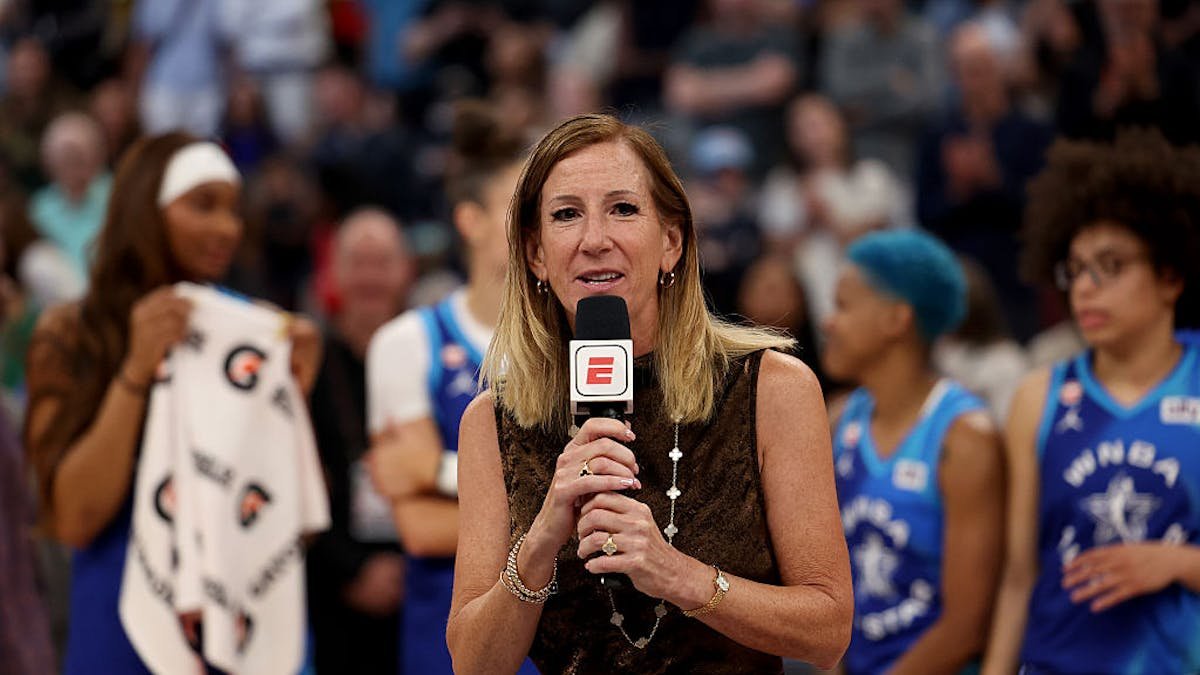
After years of dodging the thorniest questions in women’s sports, WNBA Commissioner Cathy Engelbert is calling it quits. Engelbert announced last week that she will leave her post at the end of 2026, a move that comes as the league grapples with a bitter and unresolved debate over who gets to call themselves a WNBA player.
The announcement, made via press release, did not come with a detailed explanation. Instead, Engelbert struck a positive tone, telling Howard Megdal of The IX Sports, “I just feel like we’re in a really good place from a variety of perspectives on the league.” But those who have watched the league’s recent turbulence may beg to differ. Engelbert also revealed that her five brothers had been urging her to “get out of there,” citing the relentless backlash she has faced.
Her exit marks the end of a tenure that began in 2019, when she became the first person to hold the title of WNBA commissioner. From the start, her leadership has been marked by controversy, indecision, and a knack for letting players and external pressures steer the ship.
A Pattern of Avoidance
The cracks appeared early. In 2020, during the league’s COVID bubble season in Florida, Engelbert was thrust into a political firestorm that she seemed ill-prepared to handle. Kelly Loeffler, then co-owner of the Atlanta Dream and a Republican senator from Georgia, objected to the league’s plan to feature “Black Lives Matter” messaging. Players responded by demanding Loeffler be removed as owner, and Engelbert stood by as they wore shirts supporting Loeffler’s Democratic challenger, Raphael Warnock. Loeffler eventually sold her stake.
Later that year, following the shooting of Jacob Blake, players pressured Engelbert to issue a statement of support. According to former WNBA player Layshia Clarendon, who spoke to ESPN, Engelbert only acted because players forced her to. Clarendon’s own history—a trans man who competed in the league—would later become a flashpoint in the debate over who should be allowed to play.
By 2025, players were openly fed up. Minnesota Lynx forward Napheesa Collier, who serves as vice president of the players’ union, called the league’s leadership “the worst in the world.” Nneka Ogwumike, president of the WNBPA, publicly agreed. The criticism was not just about politics; it was about basic competence.

The Caitlin Clark Problem
Nowhere has Engelbert’s weakness been more visible than in the treatment of Caitlin Clark. Since entering the league three years ago, Clark has been a target of unusually aggressive play. In her first 72 games, she drew eight flagrant fouls, far more than any other player. In June of this year, Phoenix Mercury guard Alyssa Thomas struck Clark in the throat—a move that many believed warranted at least a one-game suspension.
The WNBA did suspend Thomas for “reckless contact,” but reports suggest Engelbert initially hesitated. It allegedly took NBA Commissioner Adam Silver to step in and persuade her to take action. For a league leader, failing to protect her biggest star without external pressure is a damning indictment.
The Transgender Eligibility Quagmire
The breaking point, however, came in the league’s handling of transgender participation. When Sophie Cunningham, a Fever guard, voiced her opinion about biological men in women’s locker rooms, the reaction was explosive. Coaches and players clashed, and on the court, DiJonai Carrington was ejected after a hard foul on Cunningham that many viewed as retaliation.

The controversy escalated when former NBA players Royce White and Enes Kanter Freedom announced they were declaring for the 2027 WNBA Draft, saying they identified as women. The league, citing unnamed sources, told them they were not eligible. But the inconsistency was glaring: just five years earlier, Layshia Clarendon, a trans man, had played in the league. If a trans man could play, why couldn’t trans women?
Players and coaches were split. Some argued that anyone who identifies as a woman should be allowed to compete, a position that would seemingly make White and Freedom eligible. Others, citing safety and fairness concerns, disagreed. Engelbert’s response was to call a meeting with owners and general managers to discuss the issue. The result? Nothing. No decision. No policy. Just a kick of the can down the road.
Three weeks later, she announced her retirement.
Damage Done
For critics, Engelbert’s exit is too little, too late. Her inability to answer a simple yes-or-no question—should biological males be allowed to play in the WNBA?—has left the league in a state of chaos. The decision now falls to her successor, but the damage to the league’s credibility may already be done.
Engelbert’s tenure will be remembered for many things: the political battles she couldn’t navigate, the stars she failed to protect, and the defining question of her era that she refused to answer. As she steps away, the WNBA faces an uncertain future, with a policy vacuum that threatens to define the league for years to come.
Source: www.dailywire.com — https://www.dailywire.com/news/cathy-engelbert-is-running-away-from-the-wnba-mess-but-damage-is-already-done