
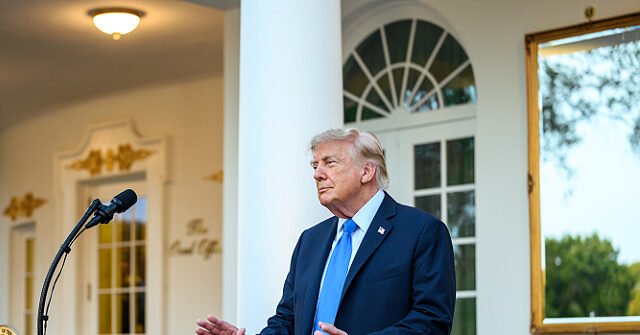
President Donald Trump used an address at the Republican Party’s midterm convention in Dallas on Wednesday to sketch out what he framed as the GOP’s core agenda heading into the next election cycle: hard borders, low taxes, an aggressive posture on crime, and dominance in energy production, according to Breitbart’s account of the speech.
The remarks, delivered at a gathering of party activists and officials in Texas, wove together familiar themes from Trump’s political repertoire while presenting them as a single, unified Republican platform. Trump told the crowd the party’s priorities amount to a straightforward set of promises — secure national borders, continued tax relief, a crackdown on crime, and a push for American energy independence and, beyond that, energy dominance.
Borders, taxes, and a pledge of ‘no crime’
Central to the address was Trump’s insistence that border security remains a defining issue for Republicans. He claimed the country currently has the strongest borders in its history, telling the audience that maintaining that posture is non-negotiable.
“We have to have strong borders. We have to continue low taxes,” Trump said, according to Breitbart. He went on to characterize his previous tax legislation as “the biggest tax decrease in the history of our country” and quickly pivoted to crime, declaring, “And no crime. We want no crime. We don’t want crime.”
The phrasing — “no crime” — was blunt even by Trump’s standards, offering no nuance about enforcement strategies or crime statistics. Instead, it served as a slogan-like summation of the law-and-order message that has anchored his political identity since his first campaign. Whether such a goal is literally attainable was not addressed; the line functioned as an aspirational promise aimed at voters who cite public safety as a top concern.
Trump also referenced Texas directly when discussing energy, acknowledging the state’s centrality to the nation’s oil and gas industry. “We’ll have American energy independence, something you know a lot about in Texas,” he said. “And even, we will have energy dominance.”
The distinction between independence and dominance appeared deliberate — independence implying self-sufficiency, dominance suggesting the United States would not merely meet its own needs but dictate terms in global energy markets. It’s a theme Trump has returned to repeatedly, and one that resonates in a state where the energy sector is both an economic engine and a cultural touchstone.
A nod to the military, veterans, and police
From there, Trump shifted to what might be called the traditional pillars of Republican coalition politics: the armed forces, veterans, and law enforcement. He pledged that Republicans would stand with all three groups, describing veterans as people the party loves and cares for, and citing a figure of 94 percent — though the source account of his remarks did not specify precisely what that number referred to.
“We will stand with our heroes in the military, our veterans,” Trump said. “We love our veterans, and we take care of our veterans — 94 percent — and our great police and law enforcement. We love our police and law enforcement.”
That portion of the speech drew on a longstanding Republican argument that Democrats have failed to adequately support military personnel, veterans’ services, and police departments — a claim Democrats dispute, often pointing to their own votes on veterans’ funding and public safety measures. Trump did not elaborate on specific policy proposals tied to those pledges during this portion of the address.
An ideological closing: ‘We will defeat communism’
Trump closed his vision for the party with a broader ideological appeal, warning of what he described as a “crazy little sick cloud” hanging over the country and vowing to defeat communism in America.
“Above all, and I think it’s so important because there is a crazy little sick cloud over our country — I really believe it’s not going anywhere — but we have to make sure because we will defeat communism in America and vote for American freedom,” he said. “We will just vote very simply for American freedom.”
The line drew a sharp contrast between what Trump portrayed as the Republican vision of freedom and what he characterized as a creeping communist influence — language that has become more prominent in his recent speeches. The phrase “vote for American freedom” appeared designed to distill the entire agenda into a single ballot-box appeal, tying border security, tax policy, crime, and energy to a broader argument about national identity.
What the speech signals
Taken as a whole, the Dallas address functioned less as a rollout of new policy than as a mission statement — an attempt to brand the Republican Party’s midterm message in Trump’s own words. The priorities he listed map closely onto the issues Republicans have emphasized in recent cycles: immigration enforcement, tax cuts, public safety, domestic energy production, and support for the military and police.
What was notable was the packaging. Rather than drilling into legislative details — no specific bills, no dollar figures beyond the tax-cut boast, no enforcement mechanisms — Trump offered a series of declarative commitments, each phrased as something Republicans will deliver. The result was a speech that read more like a set of campaign promises than a governing blueprint.
For Republicans gathered in Dallas, that may be the point. Midterm conventions are, above all, exercises in message discipline and enthusiasm-building, and Trump’s address gave attendees a compact set of themes to carry back to their districts. Whether that message translates into electoral success — or whether the vagueness of pledges like “no crime” and “energy dominance” invites scrutiny from opponents — will become clearer as the campaign unfolds.
For now, the speech offers a clear window into how Trump wants his party to be defined: strong on borders, light on taxes, tough on crime, dominant on energy, and unapologetic in its cultural and ideological framing. Those are the terms he put on the table Wednesday in Texas, and they are likely to echo through Republican messaging in the months ahead.
Source: www.breitbart.com — https://www.breitbart.com/politics/2026/09/09/trump-gop-vision-strong-borders-low-taxes-no-crime/