
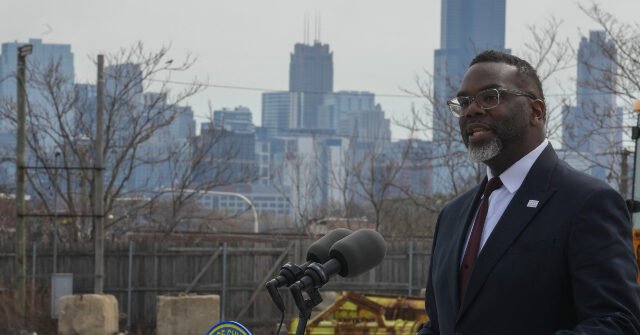
Chicago Mayor Brandon Johnson has joined New York City Mayor Zohran Mamdani in a lawsuit challenging the Trump administration’s reinstatement of the “public charge” rule, a policy that makes legal immigrants less likely to obtain green cards if they have relied on welfare programs in the past. According to Breitbart News, Johnson framed the legal action as a defense of what he described as an essential component of American life, saying that illegal and legal migrants are “an essential part of who we are.”
The public charge rule, as revived by the administration, weighs an immigrant’s prior use of means-tested benefits — including subsidized healthcare, food stamps, and public housing — against their eligibility for permanent residency. The stated purpose of the rule is to ensure that migrants entering the United States can support themselves and contribute productively rather than depend on public assistance.
Democrats have opposed the rule, arguing that migrants who are not economically self-sufficient still have a right to taxpayer-funded welfare programs. Johnson’s decision to join the suit alongside Mamdani, whom Breitbart identifies as a socialist mayor, places the two cities at the center of a broader legal and political fight over immigration policy and the scope of federal authority over benefit determinations.
Johnson Calls Rule ‘Unlawful’ and ‘Cruel’
In his message to the city, Johnson asserted that reinstating the rule “sweeps aside more than a century of settled law, as well as decades of federal guidance establishing clear limits on how public charge determinations can be made.” He further alleged that the Trump administration’s rule “dramatically and unlawfully expands the government’s authority to consider an immigrant’s use of public benefits, allowing the federal government to consider virtually any means-tested or income-based public benefits while inviting officers to make decisions that are inconsistent and discriminatory.”
Johnson went on to characterize the provision of welfare to immigrant families as a national duty. “Chicago will not stand by while the federal government forces immigrant families to choose between putting food on the table, taking their children to the doctor, or protecting their ability to remain in this country,” he said in his statement.
“This rule is not only cruel, it is unlawful, and it threatens the health and safety of our entire city,” Johnson continued. “More than half a million Chicagoans were born outside the United States. They are our neighbors and an essential part of who we are. Chicago has fought these attacks before, and, alongside New York and cities across the country, we will fight them again. We will use every tool available to protect our immigrant communities and defend their right to live with dignity and without fear.”
The mayor’s statement did not draw a distinction between legal and illegal migrants, a framing that has been a consistent feature of his administration’s approach from city hall. Breitbart notes, citing WLS-TV, that Johnson has spent more than $639.6 million in taxpayer funds on services for illegal immigrants since taking office three years ago.
Welfare Use Data Cited by Critics
Critics of the lawsuit point to research from the Center for Immigration Studies, which found that between 2021 and 2025, roughly 47 percent of immigrant-headed households in the United States were enrolled in one or more traditional forms of welfare. By comparison, 28 percent of households headed by American citizens relied on one or more traditional welfare programs — a gap of 19 percentage points between the two groups.
Those figures have been central to the argument advanced by supporters of the public charge rule, who contend that the policy is designed to prevent the immigration system from becoming a pathway to long-term benefit dependency. The rule’s defenders say it is not intended to punish immigrants who fall on temporary hard times, but rather to ensure that admissions decisions account for the likelihood that an applicant will become primarily reliant on government support.
The legal challenge from Chicago and New York represents the latest front in a years-long back-and-forth over the public charge standard, which has shifted depending on which party controls the White House. The Trump administration’s revival of the rule marks a return to stricter enforcement after the previous administration had narrowed its scope.
Johnson’s decision to align Chicago with New York in the suit also reflects the broader strategy among Democratic-led cities to use litigation to resist federal immigration policies. The two mayors have positioned their cities as sanctuaries not only for undocumented residents but for immigrants who rely on public benefits — a stance that has drawn both praise from immigration advocates and sharp criticism from those who argue that local taxpayers should not bear the cost of policies that federal law is designed to limit.
A Question of National Identity
At the heart of the dispute is a disagreement over the meaning of the public charge principle itself. Supporters of the rule contend that it has deep historical roots and is intended to protect both immigrants and the communities they join by ensuring that newcomers are positioned to succeed economically. Opponents, including Johnson and Mamdani, argue that the rule gives federal officers sweeping discretion that can be applied inconsistently and in ways that they say are discriminatory.
Johnson’s statement that migrants represent “an essential part of who we are” goes further than a procedural objection to the rule. It asserts that the presence of immigrants — regardless of legal status — is constitutive of American identity, and that their access to welfare should be treated as beyond question. That position is likely to intensify the debate in Chicago and nationally as the lawsuit moves forward.
The case now proceeds through the federal courts, where the two cities will argue that the administration exceeded its statutory authority in reinstating the rule. The outcome could determine not only how public charge determinations are made in the coming years but also how much leeway cities have to shield their immigrant populations from federal policy changes they oppose.
For now, Johnson’s message to Chicagoans leaves little ambiguity about where he stands, and his alignment with Mamdani signals that the fight over immigration and welfare is set to remain a defining feature of Democratic municipal politics.
Source: www.breitbart.com — https://www.breitbart.com/politics/2026/09/15/chicagos-dem-mayor-johnson-says-illegals-are-an-essential-part-of-who-we-are/