
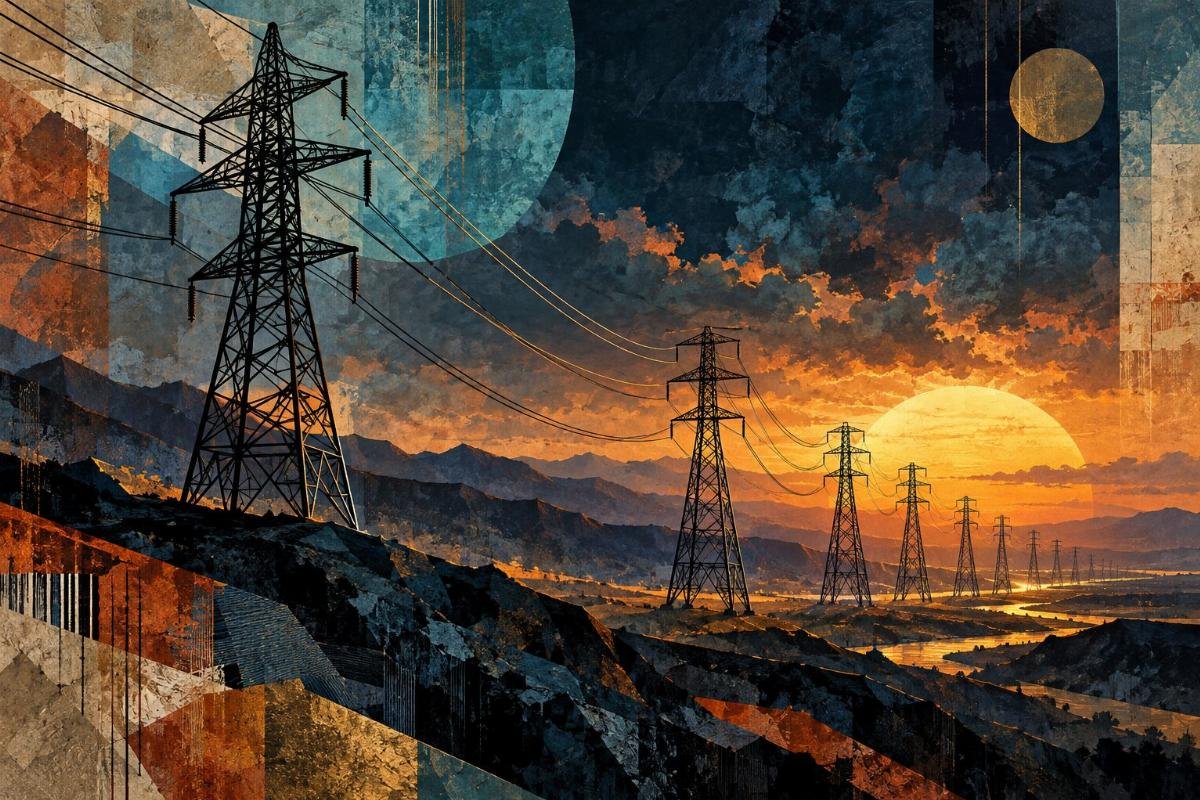
The electricity demands of artificial intelligence are colliding with the people who live where the power lines have to go. In a commentary for American Thinker, Janet Levy argues that the sprint to expand high-voltage transmission — particularly 765 kilovolt (kV) lines — is proceeding well ahead of any serious accounting of what those lines do to human health, animal populations, farmland, and the wallets of the rural residents who host them.
The backdrop is demand. Levy cites a Department of Energy study estimating that by 2030, data centers alone will require 400 terawatt-hours of electricity — roughly 10% of total U.S. end-use consumption in 2023. Meeting that load means more transmission, and the industry’s preferred tool is the 765 kV line, the highest-voltage class in routine civilian use and, by Levy’s account, the strongest source of electromagnetic fields the public encounters in daily life.
The health question that hasn’t been settled
Levy does not claim the science is closed — she claims the opposite, and treats that as the problem. Early research flagged elevated risks of cancer, cardiovascular disease, and developmental disorders from EMF exposure, findings later judged unsubstantiated. But she notes that both the National Institute of Environmental Health Sciences and the World Health Organization still call for exposure limits and more research. She also points to a 2008 paper in the British Columbia Medical Journal and other research cited by the National Cancer Institute linking childhood leukemia to living near power lines.
Her argument is less that EMFs are proven dangerous than that the absence of a definitive answer is being treated as permission to build first and study later. She faults the lack of any comprehensive federal framework for assessing grid expansion’s effects on human health, animal health, or the environment — and notes that no serious appraisal has been made of how the projects reshape local economies through property values, land use, livestock operations, and agricultural output.
The ecological case she assembles is broad. EMF exposure, she writes, can alter behavior, disrupt hormonal systems, and reduce reproduction in livestock, fish, and bees, while degrading biodiversity and aiding the spread of invasive species. Land clearing for lines and maintenance destroys habitat and displaces animals. The work itself causes erosion, changes soil structure, and suppresses aeration and microbial activity on both forest and farmland. Then there is the noise: the hum from substations, transformers, and lines — the last caused by corona discharge, which also releases toxic gases.
Why 765 kV, and why the industry’s math is contested
The attraction of 765 kV is efficiency. Levy lays out the pitch: more power moved on fewer lines, roughly half the transmission losses of lower-voltage systems, and a smaller overall footprint. But she cites experts who call the industry’s “6X” claim — that one 765 kV line can carry as much power as three double-circuit 345 kV lines — a matter of hype. The missing qualifier, she writes, is that the comparison depends on cable configuration and equipment heating limits.
Whatever the engineering merits, the buildout is real and large. Projects are moving forward in Texas, Virginia, and the Midwest, including Wisconsin, Ohio, and Minnesota.
The biggest is Texas’s Permian Basin Reliability Plan, which would add 4,000 miles of line to move power from East Texas to data centers and the oil industry — twice the length of the 2,000-mile network operated by American Electric Power, the nation’s largest. In the Upper Midwest, PowerOn Midwest — launched by Great River Energy, ITC Midwest, and Xcel Energy — would be the region’s first 765 kV project. Virginia’s buildout would cross nine central counties to serve northern data centers while integrating renewable and nuclear supply. And Grid Growth West in western Ohio would string 190 to 220 miles of new 765 kV and 345 kV lines for data centers and industry.
Opposition with deep roots
The resistance Levy describes is not abstract environmental advocacy. It is landowners, many of them multi-generational farm families, organized around what the lines would do to their property.
In southern Wisconsin, the nonprofit citizens’ coalition No 765 Line has raised objections to the 190-mile BECI project, questioning its effects on property, agriculture, and health. In Ohio, opponents have raised a less common concern alongside farming impacts: that high pylons and cables could interfere with the low-altitude military flight training conducted regularly in the area. Darke County recently passed a resolution opposing the project on agricultural grounds, and its commissioners have taken the matter to state and federal officials.
In Texas, some 2,600 residents, mostly farmers, are fighting the Hillje-Blue Lacy project, a 155-mile, 765 kV line tied directly to the Permian Basin plan. Levy highlights a concern specific to the region’s arid and semi-arid terrain: water. A segment running from Howard to Solstice would cross 5.5 miles of the Edwards Aquifer Recharge zone, and the 2.5 million people who depend on that aquifer worry that runoff could be contaminated by herbicides used to control vegetation along the right-of-way.
The bill, as opponents count it
Developers say the projects will achieve economies of scale and deliver meaningful savings to consumers. Levy counters with outside estimates. The Texas Public Policy Foundation puts the lifetime cost of the state’s 765 kV projects at $100 billion, with consumer bills rising 7 to 8 percent annually. The nonprofit American Stewards of Liberty estimates the projects would cost Texas residents $8.2 billion in property devaluation and land condemnation.
Levy’s closing ask is procedural rather than absolutist. She calls on federal and state governments to reassess the risks, insists that public hearings not degenerate into formalities where genuine concerns are brushed aside, and — most pointedly — urges health and environmental research institutes to commission studies that would deliver clarity either way on whether the benefits justify the risks.
That framing matters. The piece does not declare the projects doomed or the science settled. It argues that tens of billions of dollars in investment, decades of infrastructure, and thousands of miles of countryside are being committed on the assumption that any problems can be handled after the fact — and that the cost of being wrong would fall hardest on the environment and on the people living under the lines.
Source: www.americanthinker.com — https://www.americanthinker.com/articles/2026/09/is-high-voltage-grid-expansion-worth-the-cost-and-the-problems/