
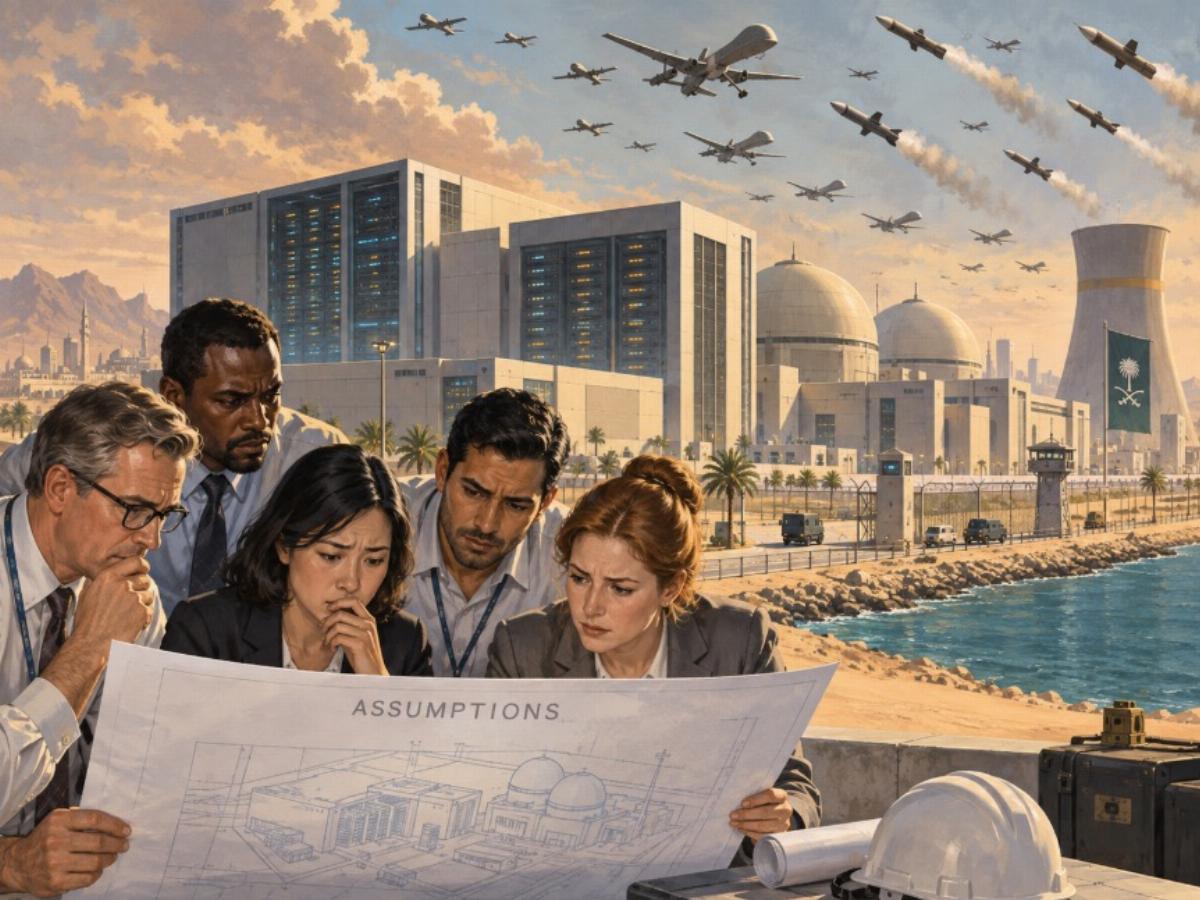
When Iranian missile and drone attacks badly damaged Amazon Web Services data centers in Bahrain and the United Arab Emirates earlier this year, cloud customers across the Middle East found themselves seriously inconvenienced. But in a recent essay for American Thinker, John L. Smith suggests the more interesting question is the one nobody asked when the buildings went up: what did the planners assume would never happen?
Smith’s piece, published September 17, 2026, uses the AWS damage as a starting point for a broader argument about the assumptions buried inside modern infrastructure — and about how often those assumptions turn out to be wrong.
The guesses nobody audits
Data centers are hardly the only facilities designed around a set of threat calculations. Smith points out that there are more than 400 operating commercial nuclear reactors in more than 30 countries, plus hundreds of smaller research reactors. Each of those designs incorporates judgments about what could go wrong: earthquakes, floods, aircraft crashes, terrorism. Each also involves judgments about what is too remote, too extreme, or simply impossible to design against.
The question Smith raises is not whether engineers are careless. It is that the list of dismissed threats is invisible, rarely revisited, and historically unreliable. The categories that get waved away are precisely the categories that later surprise us.
The AWS episode makes that concrete. According to Smith’s account, the facilities were built at some point when regional stability was treated as a reasonable working assumption. Iranian strikes on Bahrain and the UAE changed the working assumption. The hindsight is free; the foresight was somebody’s job, and it missed.
Julian Simon and the long argument with Malthus
Smith pivots from engineering risk to a broader intellectual target: the recurring habit of predicting catastrophe from trends.
He invokes Julian Simon, the economist who was vilified by population-control advocates and environmental pessimists for rejecting the Malthusian premise that more people necessarily means greater catastrophe. Simon’s counterargument was that human beings are themselves the world’s greatest resource. More people consume more, yes — but more people also produce more minds, more invention, more specialization, and more substitutions for resources that appear to be running out.
That was Simon’s “ultimate resource.” And his larger claim, as Smith frames it, was that history does not travel in a straight line toward exhaustion. Plagues, famines, wars, and other catastrophes have repeatedly cut populations down, yet growing populations have also generated extraordinary innovation and progress. The catastrophe was always coming, and it kept not arriving on schedule.
Smith notes the present-day version of that mistake: many developed countries now face fertility rates well below replacement level. Even China, once the world’s most aggressive practitioner of population control, now frets about too few births rather than too many and is trying to persuade its citizens to have more children — a reversal that would have seemed unthinkable to the people who built the one-child policy.
At the far edge of the pessimist camp, Smith places the Voluntary Human Extinction Movement, which advocates that people stop reproducing until humanity disappears. It is a fringe position, but it is the logical terminus of the Malthusian instinct: if people are the problem, the solution is fewer people.
The AI power crunch meets an old problem
From there Smith turns to the current energy debate. Artificial intelligence, cloud computing, and enormous data centers demand staggering amounts of electricity, and the argument for more nuclear power has become a common answer. The source author doesn’t dispute the logic. He asks what happens when an increasingly complex civilization depends on increasingly concentrated infrastructure — and when nations and individuals still seek to blow things up.
A nuclear facility, Smith writes, is not simply another target. Even an unsuccessful attack can generate enormous fear. A successful attack on critical systems could produce consequences far worse than the physical damage.
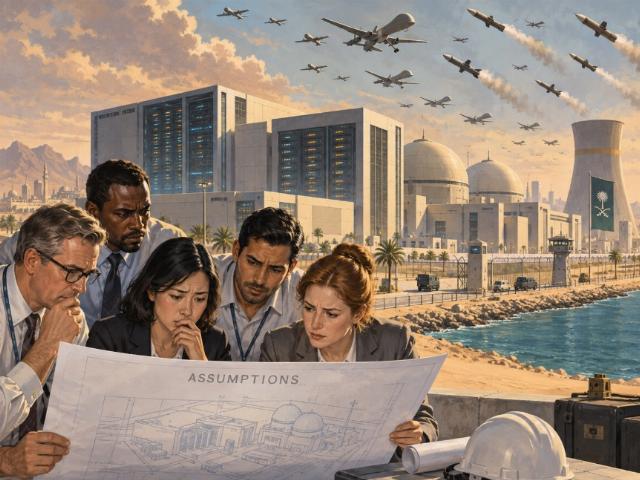
That is the hinge of the essay. Human ingenuity keeps solving problems. Human beings also keep creating them: terror, war, anger, revenge. Smith points to a persistent and seemingly unfixable impulse — the willingness to say that if you will not give us what we demand, we will destroy you, even if destroying you destroys us too.
The result is a widening asymmetry. Our technology grows more sophisticated, our infrastructure more interconnected, our dependence on it more complete. Human nature has not advanced at anything like the same speed. The engineering gets better; the people operating and attacking it do not.
An uncomfortable kind of optimism
It is worth being precise about what Smith is and isn’t arguing. He is not calling for a halt to nuclear power, data center construction, or technological development. He is not predicting that the worst will happen. His target is the confidence with which we treat certain risks as settled and others as nonexistent.
That is a harder position to hold than either pure optimism or pure doom. The Simon argument Smith spends much of the essay defending is fundamentally optimistic: people find a way. But the AWS example, and the reactor threat calculations, are there to remind readers that the finding-a-way happens after the surprise, not before it. Someone’s dismissed risk is eventually someone else’s emergency.
The essay closes on a note that may read as a non-sequitur until you notice the through-line. Smith writes that the ability to speak our minds is now more crucial than ever to the republic we cherish. The connection is that open debate is itself a risk-assessment mechanism. Systems that suppress dissent also suppress the warnings — the awkward questions about regional stability, the threat models that seem paranoid until they aren’t.
None of this resolves the practical question. Every reactor, every data center, every piece of concentrated infrastructure has to be designed around some set of assumed threats, and no designer can plan for everything. The uncomfortable implication of Smith’s piece is that our track record at guessing which threats belong on the list is not good — and that the price of a bad guess rises as the infrastructure gets bigger, more centralized, and more essential.
The cloud outage in the Gulf was recoverable. Smith’s point is that we should not assume the next bad guess will be.
Source: www.americanthinker.com — https://www.americanthinker.com/blog/2026/09/what-about-bad-guesses/
Source: www.americanthinker.com
Related coverage
- Ilhan Omar Under Federal Investigation as Critics Decry ‘Anti-American’ Rhetoric
- Pete Buttigieg Proposes Adding Six Supreme Court Justices, Sparking Court-Packing Debate
- Former Intel Officer Fires Back at Anthropic CEO: We’ve Been Fighting ‘Super Intelligence’ for Decades
- Hellner: Russia’s Top 1% Own Up to 56% of Wealth While Cuban Wages Hit $16 a Month