
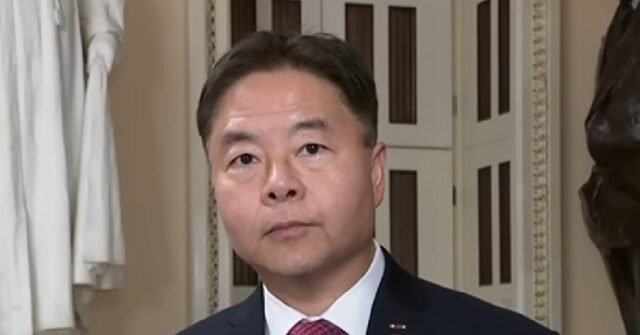
Rep. Ted Lieu (D-CA) pushed back Wednesday on Sen. Bernie Sanders’ call for a moratorium on superintelligent AI, arguing that attempts to outlaw technology have almost universally failed, according to comments made during an appearance on CNN News Central.
Asked by co-host Boris Sanchez why policymakers shouldn’t go as far as Sanders has suggested — a “semi-permanent ban on superintelligence” — Lieu pointed to historical precedent rather than endorsing the Vermont independent’s approach.
“If you look at human society, no society has actually ever been able to ban technology,” Lieu said, per Breitbart’s account of the segment. He noted one partial exception: Japan’s years-long success in keeping firearms out of the country, which he said eventually gave way. “As we all know, eventually, the Japanese also relented.”
A Different Prescription: Regulate, Don’t Prohibit
Instead of a ban, Lieu advocated for a regulatory framework aimed at preventing catastrophic outcomes while keeping advanced AI development on track. He emphasized that current AI companies retain the ability to shut down their systems, and said the goal should be ensuring that capability persists even as models become more capable.
“We want to make sure that they can continue to train their models, no matter how smart they get, to continue to listen to humans and to be able to obey shutdown orders,” he said.
The congressman framed the alternative in stark terms, warning that assuming superintelligent systems could never be turned off would leave humanity with no practical recourse. “If you have a view that, look, these companies are going to create super-intelligent things that can never be turned off, then we might as well just go to Bora Bora and wait for the apocalypse,” Lieu said.
Sanders’ Push for an AI Moratorium
Lieu’s comments come amid a broader Democratic debate over how aggressively to regulate artificial intelligence. Sanders has been among the most vocal advocates for halting the development of superintelligent systems, arguing that the risks of unchecked AI advancement outweigh the potential benefits.
The tension between the two positions reflects a wider divide within the party and among tech policy experts: whether to attempt to stop certain AI capabilities outright or to build guardrails that allow development to continue under oversight.
Lieu, who has been active on technology policy during his time in Congress, has generally favored the latter approach. His argument on CNN rested on the premise that prohibitions tend to fail or drive activity underground, making regulation a more durable strategy.
The Japan Example
Lieu’s reference to Japan’s gun restrictions has historical grounding. For centuries during the Tokugawa shogunate, Japan severely limited firearms, a policy that kept gun ownership extremely low and is often cited by gun-control advocates and researchers. The restriction was eventually abandoned as Japan modernized in the 19th century, and the country later adopted different firearm laws.
Lieu used that history to illustrate a broader point: even the most successful technology ban in human history was ultimately temporary. By extension, he suggested, efforts to prohibit AI development would face similar pressures.
Whether that analogy holds for superintelligent AI remains a subject of intense disagreement among researchers, ethicists, and policymakers. Some argue that AI poses existential risks unlike any prior technology, justifying extraordinary measures. Others, like Lieu, contend that prohibition is impractical and that the focus should instead be on ensuring systems remain controllable.
The exchange on CNN News Central highlights how the AI regulation debate is increasingly playing out in mainstream political forums, with elected officials being pressed to stake out clear positions on questions that were until recently confined to academic and industry circles.
Source: www.breitbart.com — https://www.breitbart.com/clips/2026/09/17/dem-rep-lieu-on-sanders-ai-ban-tech-bans-dont-work-just-like-how-people-couldnt-ban-guns/