
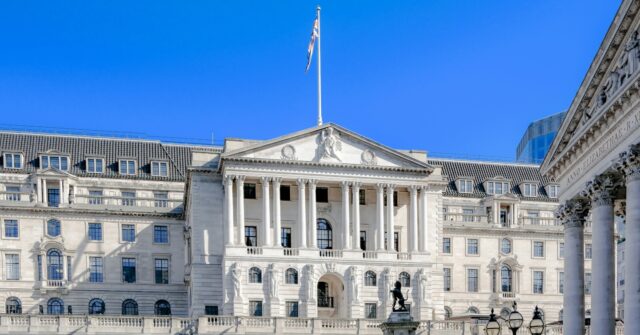
The Labour government has appointed Paul Nowak, general secretary of the Trades Union Congress, to the Bank of England’s Court of Directors, a move that immediately drew accusations of cronyism and questions about the integrity of the central bank’s apolitical appointment process.
The appointment, first reported by Breitbart London, places one of Britain’s most prominent labor leaders onto the Bank’s oversight board, filling the seat previously held by Frances O’Grady, another former TUC general secretary. The Court of Directors does not set interest rates; its role is to oversee the Bank’s strategy, governance, budget and risk framework, and to ensure the institution carries out its statutory functions.
A ‘Fair and Open Competition’?
In a press release announcing the appointment, the Bank of England stated that the selection had followed “a fair and open competition in line with the Governance Code on Public Appointments,” and that Nowak had confirmed he had not engaged in any party political activity over the past five years.
That assertion was met with swift skepticism from Reform UK, whose figures pointed to Nowak’s recent public profile as evidence that the vetting process may have been misled. Reform UK spokesman Robert Jenrick suggested that Nowak must have been “misleading” the Bank during the selection process, given his frequent appearances in the headlines for political pronouncements in recent months, according to The Daily Telegraph.
Social media users were quick to highlight Nowak’s activism against Nigel Farage’s Reform UK party, as well as his calls for higher taxes and his stance on Brexit — all of which surfaced in public discourse within days of the appointment being announced. Critics argued that such a record sits uneasily with the Bank’s requirement that appointees remain free of party political activity.
‘Cronyism in Plain Sight’
Fellow Reform parliamentarian Richard Tice was blunter in his assessment. “This is staggering,” Tice said of the appointment. “Our socialist Chancellor has dished out a big Bank of England finance job to a socialist union boss who knows nothing about finance. Clearly, trade union donations not only buy your way into government policymaking, but also onto the Bank of England’s board. This is cronyism in plain sight.”
The reactions underscore a broader political fight over the direction of Britain’s central bank and the influence of organized labor within the Labour government. The Court of Directors is meant to be a non-partisan body, and the swap of one TUC leader for another — O’Grady to Nowak — has fueled complaints that the seat is being treated as a union entitlement rather than a position requiring apolitical financial expertise.
An Ongoing Political Battle
Nowak’s appointment comes amid heightened scrutiny of Labour’s ties to trade unions, which are major donors to the party and have historically held significant sway over its policy agenda. Reform UK, which has positioned itself as a challenger to both Labour and the Conservatives, has seized on the appointment as a case study in what it describes as the government rewarding its allies.
The Bank of England has not commented beyond its initial statement. The appointment is effective immediately, with Nowak taking the seat last occupied by O’Grady, whose term as TUC general secretary ended in 2023.
For its part, the Treasury has yet to respond publicly to the cronyism allegations, leaving the Bank’s press release as the primary defense of the process. Whether the controversy gains further traction may depend on whether additional details emerge about Nowak’s political activities during the five-year window he certified as free of party political engagement.
The episode also raises questions about the Governance Code on Public Appointments, which is designed to ensure that public appointees are selected on merit and not on political affiliation. If Nowak’s recent activism is as extensive as critics claim, the Bank’s reliance on self-certification could become a point of contention in future appointments.
For now, the appointment stands, and the debate over the politicization of the Bank of England’s oversight board is likely to continue as Labour presses ahead with its economic agenda.
Source: www.breitbart.com — https://www.breitbart.com/europe/2026/09/17/uk-labour-govt-appoints-top-trade-union-boss-to-bank-of-england-board/
Source: www.breitbart.com
Related coverage
- AOC Claims Trump Administration ‘Attacking Women’s Ability to Get an Education’ While Stumping for El-Sayed in Michigan
- Clinton Foundation Seeks Unpaid Intern—With ‘Discretion’ Requirement That Writes Its Own Punchline
- GOP’s Self-Inflicted Wounds: Bad Candidates Lead to Costly Defeats
- Atheist Site Defends Talarico’s Pastor Over ‘Reimagined Scriptures’ as Undercover Video Fuels Firestorm