

Nearly a quarter-century after the towers fell, the health fallout from Ground Zero remains one of the most closely watched — and least settled — chapters of the 9/11 story. A new essay in American Thinker by Bill Ponton wades into that fight, taking aim not at the suffering of responders but at how the numbers describing it are interpreted. His conclusion, laid out in a piece published September 18, 2026: the raw count of 9/11-linked cancers may look alarming, but once you break the diagnoses down by type and compare them against ordinary population data, the case for an excess cancer burden among responders weakens considerably.
Ponton is not a newcomer to this argument. He notes that in a prior American Thinker piece, he had written that mortality studies do not show the 9/11-exposed population dying at higher rates than New York or U.S. populations generally. The question he takes up now is narrower but sharper: what about cancer diagnoses specifically? A separate American Thinker article, “The Smoke of September 11,” had highlighted that roughly 48,500 people have been diagnosed with cancers linked to the dust and toxins at Ground Zero. Ponton’s response is essentially: a large number means little on its own.
What the certified list actually shows
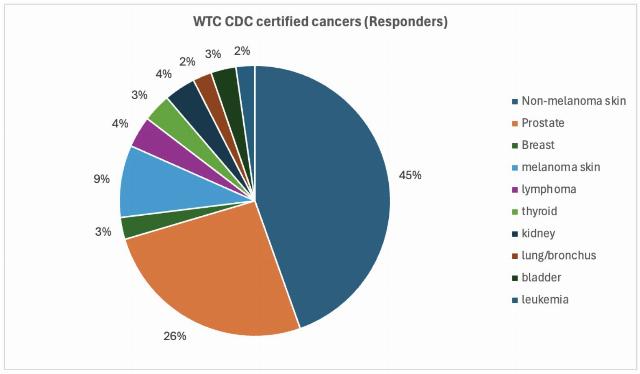
To make that number meaningful, Ponton argues, you have to know whether it represents a larger share of the exposed population than cancer diagnoses do in the general public. Just as important, he says, is understanding which cancers the Centers for Disease Control and Prevention has actually certified as 9/11-related, and what proportion of the total each represents. That data, he writes, is available on page 22 of the World Trade Center Health Program External Quarterly Program Summary — and he has compiled it into a chart.

What that breakdown reveals is what Ponton calls odd. If the primary exposure route was inhaling a toxic dust cloud, one would reasonably expect lung or bronchial cancer to be the dominant diagnosis. Instead, lung and bronchial cancers account for just 2 percent of certified cases. The overwhelming category — 45 percent of the total — is non-melanoma skin cancer, the basal cell and squamous cell carcinomas typically associated with sun exposure and overwhelmingly diagnosed in people over 50.
Ponton offers his own experience as an illustration, describing a recent dermatologist visit at which he was diagnosed with non-melanoma skin cancer. The dermatologist, he writes, showed no alarm and remarked that all of her older patients have it. The anecdote is meant to make a broader point: this is a condition so common with age that finding high raw counts in an aging population is not by itself evidence of environmental harm.
Doing the math on responders
From there, Ponton turns to the responder cohort specifically. The New York City Department of Health, he notes, estimates that more than 91,000 responders were exposed at Ground Zero and related sites. According to the World Trade Center Health Program summary, he writes, there were 11,900 CDC-certified non-melanoma skin cancer cases among responders — a prevalence of about 13 percent within that group.

To judge whether 13 percent is high, he looks at age. A published study of WTC responders found their average age on September 11, 2001, was 37.8 years, which puts the cohort at an estimated average age of roughly 62.8 today. For a comparison group, Ponton reaches for a less familiar dataset: the Olmsted County, Minnesota study of skin cancer incidence between 2000 and 2010. He calculates a cumulative incidence of non-melanoma skin cancer by age 63 at about 11.7 percent in that population — a figure that includes the same cancer types generally excluded from the national registries used to produce the American Cancer Society’s lifetime cancer probabilities.
Thirteen percent versus 11.7 percent. Ponton’s reading is that these are, in practical terms, the same number.
He runs a similar check on lung cancer. The certified lung cancer incidence among responders comes to about 0.80 percent (roughly 800 cases out of 91,000), which he compares with the American Cancer Society’s cumulative lung cancer incidence in men by age 63 of 0.97 percent. Again, the gap is small enough — and points in a direction that doesn’t favor the alarm — that Ponton concludes the claim of excess non-melanoma skin cancer or lung cancer among WTC responders does not survive scrutiny.
What the piece is — and isn’t — saying
It is worth being clear about the scope of the argument. Ponton is not claiming that no responders got sick, nor that the dust was harmless. His earlier piece, by his own account, focused on mortality studies and found no elevated death rates; this piece extends that skepticism to cancer incidence using certified case counts and age-matched population baselines. The core move is methodological: raw totals of certified cancers are not evidence of excess risk unless the rate among the exposed exceeds what you’d expect in a comparable group of the same age.
Whether that argument holds depends on choices a reader can evaluate directly. The comparison baseline for skin cancer comes from a single Minnesota county cohort rather than a national registry, because those registries exclude the very cancer types that dominate the 9/11-certified list. The responder age estimate is derived by adding 25 years to a 2001 average. And the lung cancer comparison is made against a male-specific rate from the American Cancer Society.
Those are legitimate analytical choices, but they are choices — and they matter in a debate where each side can point to numbers that support its case. The 48,500 figure from “The Smoke of September 11” is real. So is the fact that nearly half of certified cancers are a skin condition that is routine in the over-50 population. Ponton’s contribution is to put those two facts side by side and ask which one the policy conversation should be built on.
For a program that has certified benefits for tens of thousands of people and continues to shape how the country remembers 9/11’s aftermath, the question of what the diagnosis data actually demonstrate is not academic. Ponton’s answer is that the data, properly framed, do not show what the headlines suggest they show. Readers who want to check the underlying tables can find them on page 22 of the WTC Health Program’s quarterly summary — the same page Ponton used to build his case.
Source: www.americanthinker.com — https://www.americanthinker.com/blog/2026/09/smoke-gets-in-your-eyes/
Source: www.americanthinker.com
Related coverage
- American Thinker Argues Western Governments Are on a Collision Course With Their Own Citizens
- Texas Governor’s Shocking 2026 Loss Sparks Election Doubts — Even From a Skeptic
- Berlin Doubles Growth Forecast to 1.3% — While German Industry Sheds a Fifth of Its Output
- Shapiro accused of politicizing Pa. measles deaths for national stage