
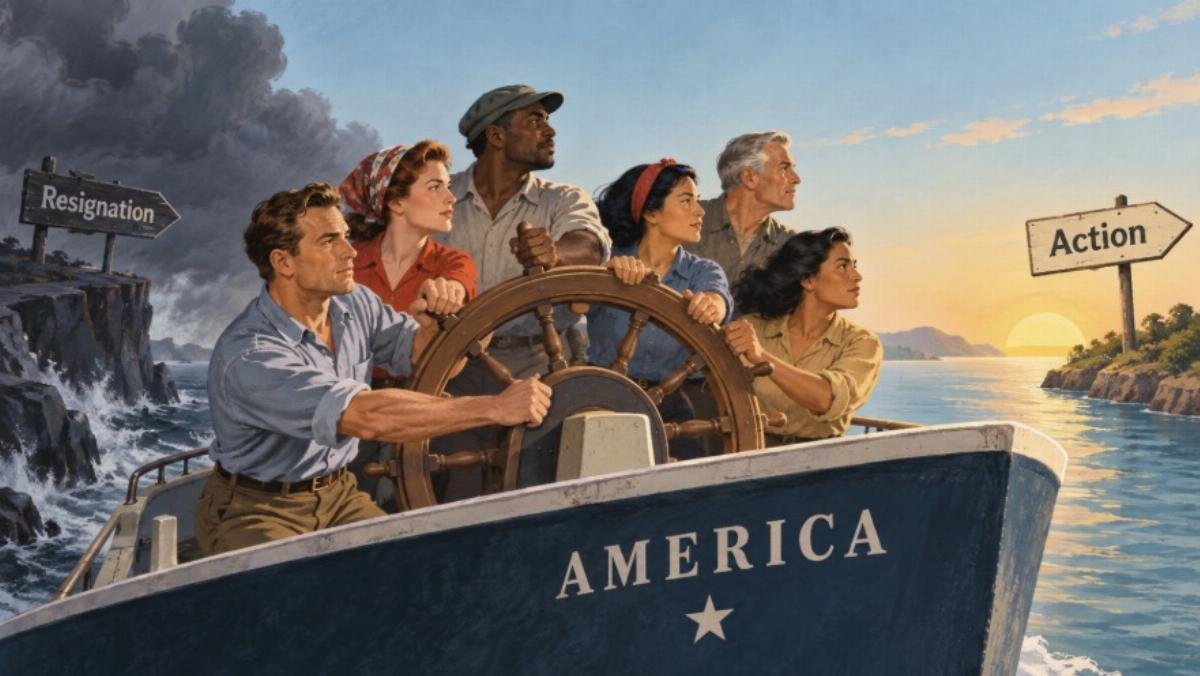
There is a particular kind of pessimism circulating on the American right these days, and Allan J. Feifer has had enough of it. In an essay published September 20, 2026, in American Thinker, the businessman and writer lays out what he calls “the case against surrender” — a direct challenge to the increasingly common conservative conviction that the country’s political trajectory is already settled, and that nothing anyone does will change it.
Feifer’s argument begins with an admission that he is not immune to the mood he is criticizing. He reads the comments on his own pieces, hears from friends, and encounters people who talk about America’s future as though the verdict has already come in. They point to demographics, universities, the media, social media, shifting cultural attitudes and declining institutions. They look at election results and conclude that the country they knew is slipping away. Feifer concedes that their certainty “sometimes makes me question my own optimism.”
But he has come to a different conclusion, and he states it plainly: the assumption that America’s political future is predetermined is, in his view, “one of the single most dangerous ideas in American life.”
The conveyor-belt fallacy
His central objection is to a metaphor — or rather, to a way of thinking that treats politics like mechanics. Countries, he writes, do not move along a conveyor belt in some preordained manner. Political systems change because people make decisions. Institutions endure because people defend them, and they can be reformed or destroyed depending on what citizens choose to do. Nations eventually decline, in his telling, when enough people accept decline as inevitable and stop believing they can change course.
Feifer reaches for historical examples to make the point. The abolitionists, he notes, could not know with certainty that they would eventually end slavery, though they believed they would. The civil-rights movement could not know it would succeed. America confronted the Soviet Union without knowing how — or even whether — the Cold War would end. What all of them had in common, he argues, is that they acted without the sure certainty of victory, because they believed their actions mattered. That, for Feifer, is the essential takeaway, and the thing he fears is being forgotten.

What worries him is less any coordinated campaign than the effect of the fatalism itself, regardless of who may be pushing it. Whether or not anyone is consciously promoting the narrative, he writes, the result is the same: people become discouraged, disengaged, and eventually passive. Once they believe the outcome is fixed, they stop participating, stop organizing, stop persuading, stop voting, and stop raising their children to think of citizenship as carrying responsibilities. Then, having withdrawn from the fight, they point to the political change that follows as proof they were right all along.
That, Feifer says flatly, “isn’t realism.” It is surrender dressed up as sophistication — and, in his words, a horrible misunderstanding of what life requires of the individual.
Why he stays
The essay is also an answer to a question Feifer poses to himself: why is he still a Republican? He is careful to rule out the easy answers. It is not because he thinks Republicans are always right — they aren’t. It is not nostalgia for an America that is not coming back. And it is not simply a dislike of Democrats, though he writes that plenty about today’s Democratic Party repulses him.
Instead, he frames his affiliation as an outgrowth of a deeper belief in individual agency. He describes political identity in America as something most people absorb rather than choose — inherited from parents, picked up from friends, or acquired in college in a way that resembles a sorority more than a reasoned conviction, and rarely revisited afterward. His own conclusion, he says, rests on the conviction that Americans still have — and must have — agency, at a moment when he sees that individualism giving way to a belief in collective destiny or a nihilistic end.
From there he lists the commitments that keep him in the party: that human beings are responsible for the world they inherit; that institutions matter but are made by people and can be reformed by them; that borders matter because a sovereign country must decide who may enter; that laws matter because government without law becomes power without restraint; that individual responsibility matters because free societies cannot survive indefinitely if citizens see themselves as powerless victims of forces beyond their control; and that constitutional government matters because concentrated power, whoever holds it, eventually becomes tyrannical.
He is explicit that none of this amounts to a claim that the GOP has a monopoly on patriotism or good ideas, or that every Republican politician deserves his confidence. The conservative tradition, in his account, remains the political home most compatible with his view that individuals and communities — not distant institutions, bureaucracies or political elites — should retain meaningful control over their own lives. He puts it as an imperfect and inconsistent fit, not a perfect one.
The real threat, and the case for acting anyway
Feifer argues that the greatest danger to the country is not Democrats or Republicans, progressives or conservatives, since parties merely reflect moments in time. The greater threat is a citizenry that concludes choice itself no longer matters. A country, he writes, can survive a bad election, political conflict, foolish leadership, even serious institutional failure. What it cannot survive indefinitely is widely held resignation.
When people tell him America is finished, he hears something else: exhaustion. They have, in his phrasing, confused their frustration with prophecy and mistaken a difficult political moment for an irreversible historical process. He is candid about what he does not know — what America will look like twenty years from now — and notes that no one else knows either. Demographic projections are not destiny, political trends are not laws of physics, and elections are not historical decrees. The future stays contingent on what millions of people actually decide to do. That uncertainty, he insists, is not a reason for despair but the reason to act.
He draws a distinction that functions as the essay’s thesis: there is a difference between believing America will certainly survive and believing America can survive. He chooses the second. He allows that he might be wrong, and that the pessimists might eventually be proven right. But if the country does decline, he writes, he does not intend to spend the preceding years explaining why the decline was inevitable and checking out in response. He would rather fight for a future he cannot guarantee than surrender to one he is told cannot be changed — an optimist who fights rather than a pessimist who has already thrown in the towel. And, he adds, there are millions of people like him. Don’t count them out.
Whether that constitutes a strategy or simply a disposition is left open. Feifer does not offer a policy program or a map of the institutions he thinks conservatives should reclaim. What he offers is an argument about the psychology of political defeat — that the belief in inevitability is self-fulfilling, and that the first act of surrender is deciding the contest is already over. It is a message aimed less at the party than at the people who have stopped expecting anything from it.
Source: www.americanthinker.com — https://www.americanthinker.com/articles/2026/09/the-case-against-surrender/