
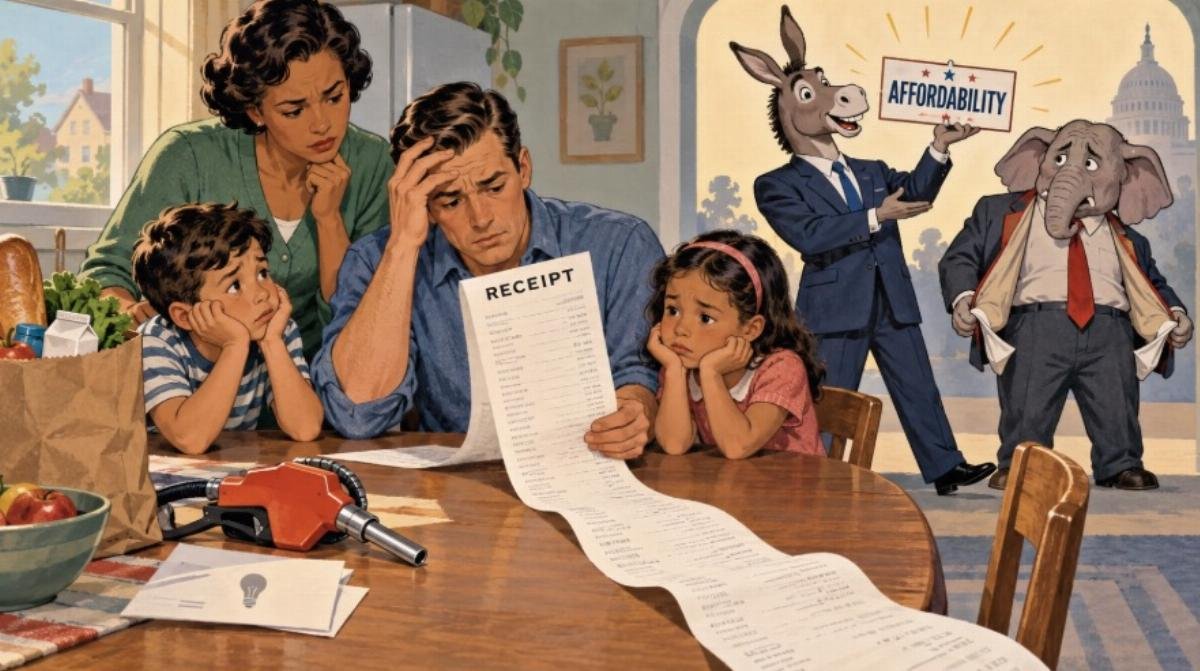
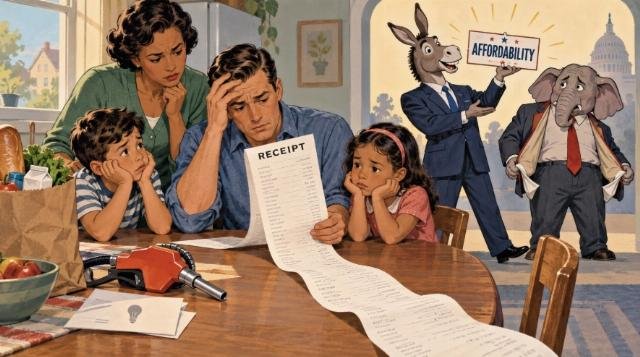
Republicans built their modern identity around tax cuts, growth, and limited government. Yet heading into this fall’s midterm elections, they find themselves on the defensive about grocery bills and gas pumps — while Democrats, the party that signed off on trillions in federal spending as prices climbed, now market themselves as the guardians of affordability.
That reversal is the central argument of a new American Thinker editorial by Jerry McGlothlin, who contends that the political landscape has not simply shifted but turned “inside out,” and that Republicans have been “dropping the ball” on the one issue voters care about most.
The polling problem for the GOP
McGlothlin points to a Reuters/Ipsos poll finding that 47 percent of registered voters describe the cost of living as the single most important factor shaping their midterm vote. An Economist/YouGov survey, he notes, gave Democrats a narrow 41-to-37 percent edge on handling the economy — a result he calls stunning given the past five years of price increases.
His framing of the blame is not absolute. McGlothlin concedes that no single bill caused every increase, and he lists several drivers of post-pandemic inflation: broken supply chains, pent-up demand, easy money, and expansive fiscal policy. But he argues prices did not rise in a vacuum, and that they climbed rapidly during the Biden-Harris years. Voters, in his view, are entitled to remember that history — and to scrutinize the bill arriving now.
He cites Consumer Price Index figures still up 3.4 percent in the twelve months ending in August, with energy jumping 16.3 percent, gasoline up 27.4 percent, food up 2.7 percent, and shelter up 3 percent.
The editorial’s harder edge is aimed at his own side. Republicans, McGlothlin writes, inherited an elevated price level but not a pass. Decisions now being made on tariffs, spending, energy, and foreign policy can still push household costs up or down, and voters will render a verdict on a single day. “History can explain a high bill,” he writes. “It cannot pay it.”
A working-class realignment
The column also documents a deeper partisan reshuffling that has accompanied the economic debate. Democrats still draw support from union households and lower-income voters, but McGlothlin notes that voters without college degrees now lean Republican, while college graduates have become a Democratic base.
He cites a 2026 Pew survey in which 67 percent of Republicans said “working class” described them very or extremely well, compared with 55 percent of Democrats. Among blue-collar workers, the gap was even wider: 82 percent to 72 percent.
The old country-club party, he writes, now houses more people who describe themselves as working class, while the party of organized labor increasingly lives on campus and in the professional class. Trade policy flipped along with the voters. For decades Republicans preached open markets; under President Trump, McGlothlin argues, they became the party of tariffs, industrial policy, and economic nationalism. Democrats, meanwhile, “suddenly discovered consumer prices” even as their own administrations kept tariffs in place and handed out industrial subsidies.
He resists calling this a mere costume change. The same American, he suggests, can want lower taxes, a tariff protecting a factory, Social Security left untouched, and a government willing to confront corporate power. The old ideological packages no longer fit the electorate.
When the tax-cut party sounds like Bernie Sanders
Perhaps the clearest sign of the inversion, in McGlothlin’s telling, is the policy swap. He points to President Trump floating a $5,000 “dividend” for every adult if Republicans hold Congress — a payout he calculates would exceed $1 trillion. That, he writes, is the kind of check Democrats used to run on and Republicans used to denounce as inflationary. “When the party of tax cuts starts sounding like Bernie Sanders,” he writes, “the midterms are not merely competitive. They are inside out.”
McGlothlin’s explanation for why affordability cuts through everything else is that it is personal. Families do not live inside GDP reports, he notes; they live at the supermarket, the pharmacy, the insurance office, the utility meter, and the closing table.
His prescriptions for Republicans are concrete. On energy, he urges the party to open what America still controls — production, pipelines, and permits — and to stop layering extra costs onto the weekly grocery cart while the strategic competition with China continues. He writes that the GOP must lower gas prices “as if the party’s life depends on it.” On housing and power, he points to permitting reform sitting in Congress and argues lawmakers should sign whatever actually cuts the price of a kilowatt-hour. And on messaging, he advises talking to voters like adults: they can hold two thoughts at once — that Biden-Harris spending lit the fuse, and that the party holding the White House now owns this month’s statement. Deny the second, he warns, and November will punish the first.
The column’s rhetoric hardens at the close. Democrats, McGlothlin writes, cannot “spend like sailors and then spray the word ‘affordability’ over the wreckage,” and he criticizes administrations of both parties for letting China play by different rules. Yet he returns to the same conclusion: entrusting the current Democratic Party to fix affordability, in his words, makes about as much sense as hiring foxes to patch the chicken coop at night.
Whether or not one shares that verdict, the underlying observation is difficult to dismiss. The party of lower taxes is arguing about grocery bills while the party of federal spending campaigns on them — and with weeks rather than years left before voters decide, McGlothlin’s warning to Republicans is that the receipt, not the history lesson, will be what voters carry into the booth.
Source: www.americanthinker.com — https://www.americanthinker.com/blog/2026/09/the-inside-out-midterms-how-affordability-scrambled-the-parties/