
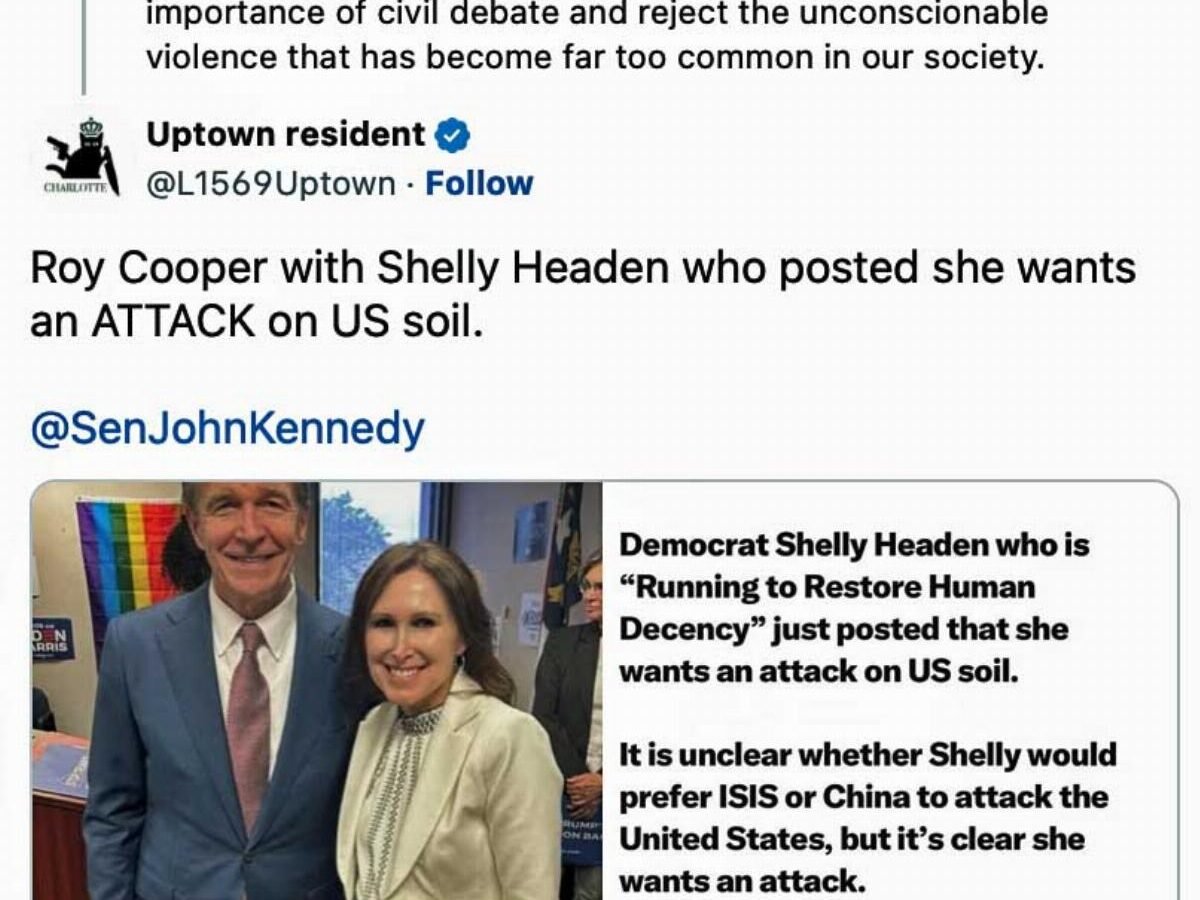
A candidate for the North Carolina state legislature has shut down her social media accounts after a pair of posts drew national attention — one written at the site of the Dachau concentration camp, the other calling for what American Thinker described as an apparent terror attack on American soil.
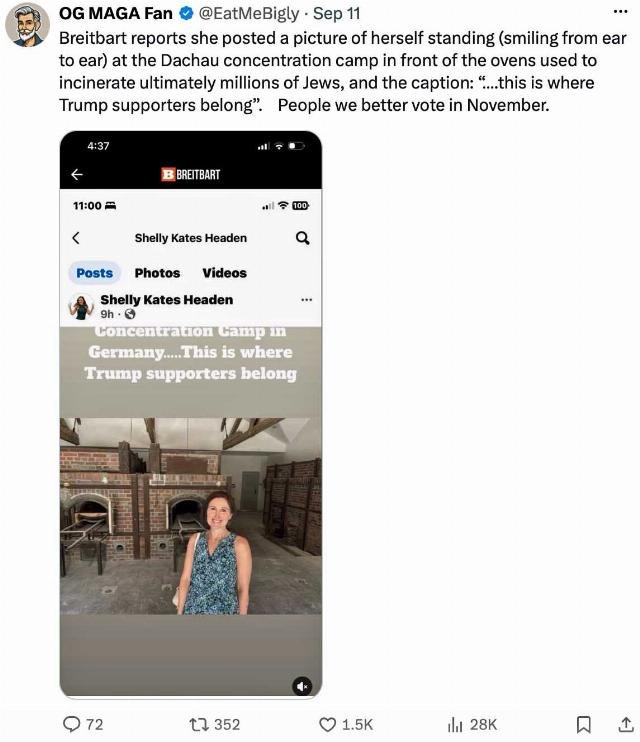
Writing in American Thinker, Mike McDaniel reports that Shelly Headen, a Democrat running for the North Carolina state legislature, recently closed her social media accounts amid the fallout. According to the account, Headen was visiting Dachau, the Nazi concentration camp whose memorial records that 41,500 people were murdered there. In photographs reportedly posted to social media, Headen is seen smiling while standing in front of what appear to be the camp’s crematorium ovens, where the SS burned the bodies of prisoners who died or were killed.
In the post accompanying those images, Headen is said to have written that those ovens are where Trump supporters belong. Six million Jews were murdered during the Holocaust.
The Second Post, One Day Earlier
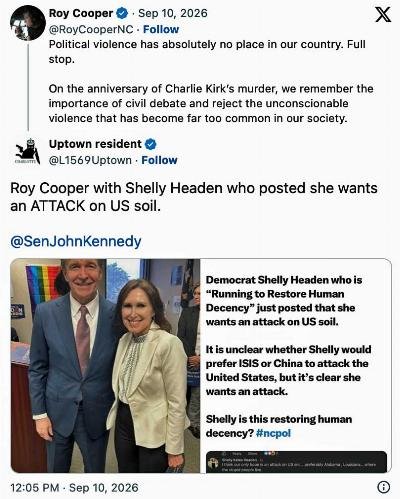
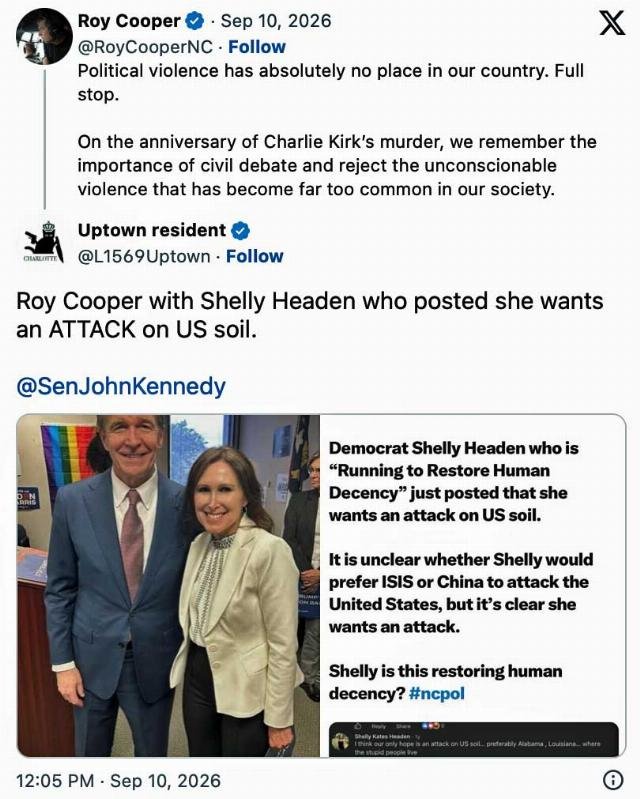
The Dachau material was not the only controversy. A day earlier, American Thinker reports, Headen’s comments surfaced calling for an apparent terror attack on United States soil. In those remarks, she is said to have written, “I think our only hope is an attack on US soil… preferably Alabama, Louisiana… where the stupid people are.”
Together, the two episodes form the core of the case McDaniel builds: that Democratic candidates at every level are no longer willing — or able — to hide views he characterizes as openly hostile to ordinary Americans.
Reaction From North Carolina Democrats, and One Notable Silence
The response from within Headen’s own party has been uneven. McDaniel notes that some North Carolina Democrats have pulled their support for Headen. Others have kept their distance without fully breaking. Former Democratic Governor Roy Cooper, photographed posing with Headen, has not personally distanced himself from her, though a Cooper spokesman said the former governor condemns political violence and that people ought to “speak responsibly” — a response McDaniel treats as insufficient.
More notable, in McDaniel’s telling, is the silence from North Carolina Governor Josh Stein. Stein, who is Jewish, has not made any public comments about the matter and has not responded to at least two separate media inquiries directed to his office, according to the piece.
An Argument About Believability
The Dachau and Alabama comments are not simply the occasion for McDaniel’s column — they are its evidence. His central claim is about credibility. Republicans, he argues, struggle to run against contemporary Democrats because the rhetoric is so extreme that voters — including Republicans — refuse to believe it is real. Even when video exists of Democrats saying such things, he writes, it is easy to dismiss as faked or AI-generated. Who actually says things like that, he asks. Who runs for Congress hating the country that way?
His answer is: plenty. McDaniel describes the contemporary Democratic Party as indistinguishable from communism, and frames Headen not as an outlier but as a product of what he calls the party’s accepted status quo. He asks how many Democrats were upset at the failure of three Trump assassination attempts, how many routinely call for the blood of Trump, other Republicans, and ordinary Americans, how many with “hate doesn’t live here” signs in their yards spew vicious hatred online, how many call for the deaths of police officers, and how many make clear they want what he terms Normal Americans — largely, though not exclusively, Republicans — dead.
He also concedes a degree of uncertainty about Headen as an individual. “I don’t know Shelly Headen,” he writes, allowing that she may be a decent person who fell in with very bad company. But he treats the question of what could have possessed her as essentially rhetorical, answering it with the claim that such posts reflect the party’s baseline rather than a deviation from it.
From Rhetoric to Intent
The column’s most sweeping assertion is that this rhetoric is not merely rhetorical. McDaniel argues that those making such statements are serious — that they want much of America dead in order to establish a one-party, utopian communist state, and that they believe they will succeed where Lenin, Stalin, Mao, and Pol Pot failed. On this reading, Democratic efforts to disarm Americans are not about policy preference but about clearing the way for rule by force, with armed and capable Americans standing in the way.
He then offers a theory of how the violence would actually arrive. Most of those screaming for the blood of Americans, he writes, are cowards who will not start a revolution themselves; they expect others to do it and will join once it begins. Mobs, he argues, provide the anonymity that lets people commit acts — including murder — they would never commit alone. Candidates like Headen, in this account, must appeal to those elements in order to earn the support of the party machine.
McDaniel concludes by insisting that this is a change from the recent past. Not long ago, he writes, no sane Democrat would say or do such things; now it is virtually a minimum requirement for candidates at every level. His closing line is a warning as much as an argument: they really do want us dead, and we had better take them at their word.
What Is Documented, and What Is Argument
The column blends reported detail with political argument, and the distinction matters. The documented particulars are the posts attributed to Headen, the photograph of her with Cooper, the statement from a Cooper spokesman, and the non-response from Stein’s office — all as reported by American Thinker. The broader claims — that the Democratic Party as a whole shares these views, that its officeholders intend mass violence, and that disarmament is a prelude to one-party rule — are McDaniel’s interpretation of those particulars, and are stated as such rather than as findings.
McDaniel’s biography, appended to the column, lists him as a USAF veteran, retired police officer, firearm instructor, and teacher, and points readers to his personal blog. The piece does not include any response from Headen herself beyond the fact that she has shut down her social media accounts, nor does it indicate whether she has been asked for comment or plans to remain in the race.
Source: www.americanthinker.com — https://www.americanthinker.com/blog/2026/09/a-nc-democrat-and-the-rest-really-do-want-us-dead/