

In a column published September 21 on American Thinker, writer Christopher Chantrill argues that the entry of women into what he calls the “Public Square” has degraded a space he says men built to replace dueling and war with sports and parliamentary debate — and he contends that liberal women are inadvertently solving the problem by making liberals go extinct.
The piece opens by framing itself around three recent cultural flashpoints: the Lindsay Clancy verdict, the “Sydney Sweeney Pile-On,” and what Chantrill calls the “Sophie Cunningham Point-ology.” He does not elaborate on the second and third references beyond naming them. The essay carries an explicit warning to “liberal lady friends” that they “may not feel ‘safe'” reading it and “will certainly experience it as ‘unwelcome.'”
The Simmel Thesis
Chantrill anchors his argument in the work of German sociologist Georg Simmel, whom he credits with raising the underlying question more than a century ago. According to Chantrill, Simmel rejected the idea that centuries of oppression powered the feminist movement. Instead, Simmel argued that new household technologies reduced domestic labor for those who could afford them, and the resulting leisure produced unease and frustration among middle-class women, pushing them toward activity outside the home.
Chantrill says he first wrote about this 18 years ago, quoting his earlier formulation that Simmel expected the public sphere for women to be initially defined by rules “created by men and for men,” but that women would eventually reshape the public square to suit “a more feminine sensibility.”
His own contribution to the discussion is a distinction between what he calls a male “Culture of Insult” and a female “Culture of Complaint.” He traces the former to men’s historical effort to dial down conflict — from war to sports, and from duels at sunrise to debate on the floor of the House of Commons. As a supporting aside, he notes that, according to Google, King Edward II outlawed swords in the House of Commons on October 30, 1313, and that it took roughly 500 years for men to replace duels with sports in the 19th century.
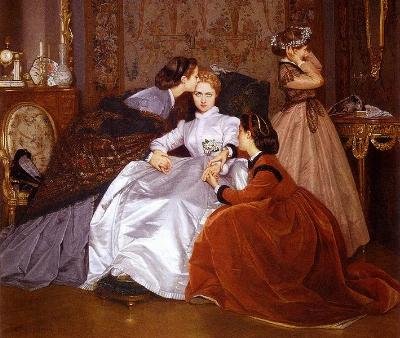
Women, he writes, do not have a Culture of Insult. He points to Southern women’s “Bless Her Heart” and British women’s “God love ‘er” as evidence, and says women instead have a Culture of Complaint. When women entered the male-designed public square, he argues, they instinctively began pushing that Culture of Complaint to replace the male Culture of Insult.
Clancy Verdict as Case Study
Chantrill treats the Clancy jury as Exhibit A. He characterizes the verdict as amounting to a complaint that Lindsay Clancy lacked adequate access to mental health treatment, and argues that women who reason this way have a problem with the entirety of law and criminal procedure, which he describes as male-created and based on rules rather than feelings.
From there he escalates: “Houston We Have a Problem.” In an era of “girlbosses and female superheroes and 27 genders,” he writes, the true nature of woman has been deliberately obscured. He frames his mission as tunneling back into the past to rediscover it.
He concedes the biological basics — that woman is there to have babies and keep them alive, and that man protects woman from rape and pillage — but insists “there is more to the story.”
Reading the 19th-Century Novelists
The bulk of Chantrill’s essay is devoted to a literary argument. He says he has read 19th-century women novelists for as long as he can remember, but only recently realized that, under the covers, they were secretly constructing a narrative about the nature of woman.
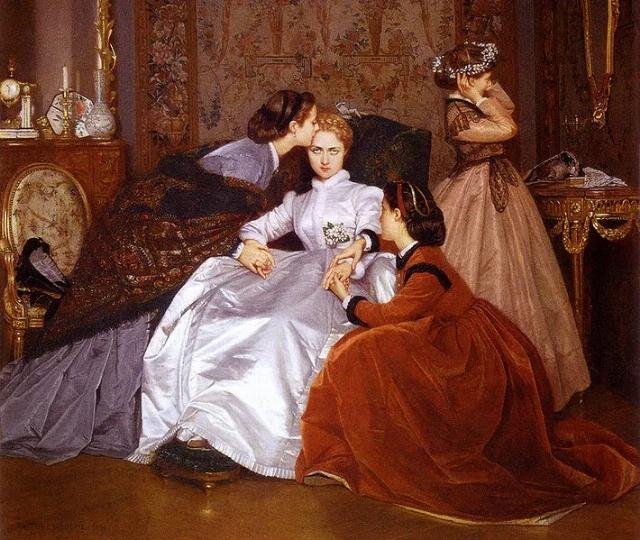
He begins with Jane Austen. In Pride and Prejudice, Mrs. Bennet is always complaining about her “nerves,” and Chantrill wonders what Austen meant by that. He observes that Lady Catherine de Bourgh is mistress of all she surveys — except Lizzie Bennet — and concludes that, men aside, “the whole Austen world is run by the women,” with Col. Brandon as the emergency glass-break exception.
Next is George Eliot’s Adam Bede. He points to Mrs. Poyser as another mistress of all she surveys, noting that experts agree she is based on Eliot’s mother. Then there is Adam Bede’s widowed mother, Lizbeth, whom he calls a complainer, quoting Eliot’s line that “like all complaining women, she complained in the expectation of being soothed, and when Adam said nothing, she was only prompted to complain more bitterly.” Chantrill asks, wryly, what the best way would have been to soothe the liberal women on the Clancy jury.
Elizabeth Gaskell’s Cranford comes next. Chantrill quotes a Google AI summary describing the novel as using gentle satire to critique the insular, rigid, and often absurd culture of a female-dominated Victorian village — then rejects it outright: “Nope: you are too woke, you Google girls.” In his reading, Gaskell is conducting a scholarly investigation into what a woman-only society would look like.
The Extinction Argument
Returning to the present, Chantrill asks how the problem of women “wrecking the male-invented public square” — which he credits with lowering the rate of death-by-duel among men — might be fixed.
His answer is that liberal women are already fixing it themselves. He writes that they are making liberals go extinct through girlboss careers, delayed childbearing, no-fault divorce, and “abortion up until a second after the Clancy Moment.” He closes with a pointer to an earlier piece of his, “Women in the Public Square in Brief.”
The column is the latest entry in a long-running argument Chantrill has made on the subject, and it lands in a broader conservative conversation about gender, the family, and the terms of women’s participation in public life. Whether it functions as a provocation, a diagnosis, or a rhetorical grenade depends on the reader — but as a piece of opinion writing, it is unambiguous about which side of the culture war it is throwing from.
Source: www.americanthinker.com — https://www.americanthinker.com/articles/2026/09/a-discussion-about-the-true-nature-of-woman/