
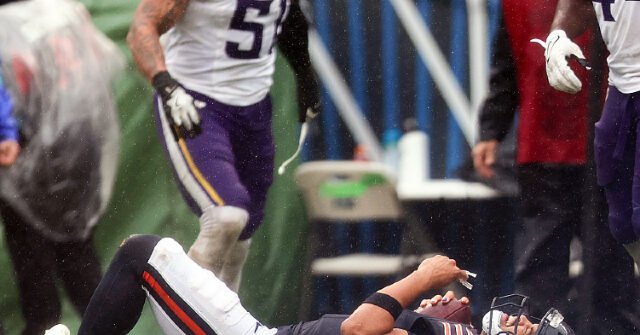
Chicago Bears quarterback Caleb Williams left Sunday’s game against a divisional opponent in a manner that suggested something far worse than what the team’s fans would eventually learn. According to Breitbart Sports, the third-year pro collapsed onto the rain-soaked grass at Soldier Field, screaming and clutching his hamstring as medical staff rushed onto the field.
The scene played out in front of a home crowd that had watched Williams race downfield moments earlier in an effort to help break a low-scoring stalemate. Within minutes, he had been placed on a cart and wheeled toward the tunnel, a towel pulled over his head to hide his face. Just before he disappeared from view, he yanked the towel away and raised a thumb to the crowd.
A diagnosis that changed the tone
The dramatic exit gave way to a few hours of genuine uncertainty for a fanbase that has spent years waiting on a franchise quarterback to stay healthy and stay on the field. That waiting ended when Pro Football Talk’s Mike Florio reported the outcome: Williams would be fine. Per the report cited by Breitbart, the injury was a Grade 1 hamstring strain — the mildest classification on the scale, generally associated with minimal tissue damage and a short recovery window.
The mismatch between the visual and the diagnosis is where the story turned. Almost immediately, fans and former athletes took to social media to mock Williams, comparing the sequence to the kind of theatrical injury stoppages familiar to viewers of international soccer.
One fan, quoted by Breitbart, invoked the beaches of Normandy to describe how Williams looked while going down, then noted the reported grade of the injury in the same breath. Another dismissed the possibility that a Grade 1 strain could produce the leg-dragging exit viewers had just watched, adding a blunter assessment of Williams himself. A third simply asked whether the quarterback was, in effect, a drama queen.
Why the reaction landed so hard
There is an obvious and fair counterpoint: a Grade 1 hamstring strain still hurts. Players describe the sensation as a sudden pull or grab in the back of the thigh, and the instinct to go down is not manufactured. Williams has been an athlete his entire life, which cuts both ways in the court of public opinion — he has almost certainly felt this specific injury before, and critics argue that familiarity should have produced something closer to a limp than a scene.
Context matters too. Williams is coming off a season in which he validated the hype that followed him as the No. 1 overall pick, and the Bears enter this year with expectations that hinge almost entirely on his availability. Any injury scare, however minor, carries outsized weight for a team that has cycled through quarterback uncertainty for most of the past decade. That is precisely why the stadium went quiet and why the hours between the cart ride and Florio’s report felt so long to the people in the stands.
But the speed with which the reaction curdled into ridicule also reflects something about how modern fans consume these moments. Every grimace is captured in high definition. Every cart ride is clipped, slowed down, and replayed within minutes. When the diagnosis arrives and it is a Grade 1 rather than something season-ending, the gap between the reaction and the injury becomes the story — and the player absorbs the blowback.
The Bears have not yet indicated how much time, if any, Williams will miss. A Grade 1 strain frequently allows a player to return within a week or two, though teams typically manage hamstring injuries conservatively because of the risk of aggravation. Chicago’s coaching staff will face the usual calculation: rush back a franchise quarterback in a competitive divisional race, or hold him out and absorb the short-term cost.
The reputational tax
What Williams cannot easily manage is the narrative. The Breitbart piece was blunt in its framing, arguing that the reaction was disproportionate to what was later described as a trivial injury and warning that the quarterback risks damaging the standing he built with a strong previous season. Whether or not that criticism is fair, the clip of him screaming on wet grass and then emerging from a cart with a thumbs-up is now part of his public file.
It joins a long tradition of sports debates about which injuries deserve which reactions — a conversation that tends to be louder, harsher, and more immediate than it was before social media compressed the distance between the moment and the verdict. Williams, for his part, has not publicly addressed the criticism. The Bears have not commented on the fan reaction either.
For now, the practical takeaway is the one that matters most to Chicago: the quarterback reportedly avoided serious injury. The secondary takeaway is that a fanbase already conditioned to expect the worst got a scare it will remember, and gave the player a piece of its mind for the way he delivered it.
Source: www.breitbart.com — https://www.breitbart.com/sports/2026/09/21/fans-blast-bears-caleb-williams-for-screaming-over-reportedly-minor-hamstring-injury-what-a-joke/