
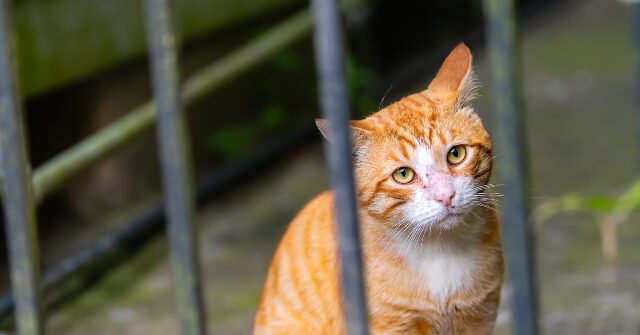
A veteran mail carrier in Stuart, Florida, faces criminal charges after authorities discovered more than 100 cats and small dogs confined in cages throughout her sweltering home, in what local law enforcement is calling one of the worst animal hoarding cases they have ever encountered.
Gail Giustino, 77, was arrested July 20 following a weeks-long investigation that began when authorities received complaints that the postal worker had been trapping cats she encountered along her mail route and bringing them to her residence, according to Martin County Sheriff John Budensiek.
When deputies and animal control officers executed a search warrant at Giustino’s home, they found conditions so severe that crews were required to wear hazmat suits during the animal rescue operation. The house had no air conditioning or ventilation, creating dangerously high temperatures amid Florida’s summer heat.
Dire Conditions Inside the Residence
“When we cracked the door…the stench was unreal,” Sheriff Budensiek told reporters. “The air was stifling hot.” He described finding approximately a foot of animal waste accumulated in some areas of the home, with some caged cats trapped in feces that had hardened to a concrete-like consistency.
Sarah Fisher, spokeswoman for the Humane Society of Treasure Coast, told Fox News Digital that rescue workers had to physically break apart solidified bricks of feces that had formed around some cats’ legs just to allow the animals to move.
Sheriff Budensiek characterized the situation as an “animal jail,” explaining that Giustino “never walks the pets. She never brings them outside of the house. They’ve been confined to that animal jail really for however long she’s been hoarding these pets.”
History of Animal Violations
This was not Giustino’s first encounter with authorities over animal welfare concerns. Court records show she was issued more than 40 citations in 2015 for improper care or treatment of animals, though that case was ultimately dismissed.
When animal control officers initially attempted to work with Giustino on the recent complaints, she refused to cooperate, prompting authorities to obtain the search warrant that led to her arrest and the rescue operation.
Charges and Release
While prosecutors could have pursued up to 160 counts of animal cruelty based on the number of animals involved, Giustino was charged with one misdemeanor count of animal cruelty and one misdemeanor count of confinement of animals without sufficient exercise. She was released on a $50,000 bond.
Sheriff Budensiek suggested the elderly woman may have believed she was helping the animals, even as her actions caused them harm. “I think the woman believed she was doing the right thing but not going about it in the right way,” he said, adding that the primary purpose of the arrest was to rescue the animals from the dangerous conditions.
Reuniting Pets with Owners
Humane Society workers have been caring for the rescued animals as they recover from their ordeal. Staff members have also been working to identify and reunite pets with their rightful owners.
Among the success stories is Linh Nguyen, who was reunited with her cat Patchy, who had disappeared from her yard in January. Nguyen said she had prayed for her pet’s return, telling God, “If You do a miracle and bring my cat home, I will tell everyone it is You.”
When Nguyen heard about the animal rescue and visited the Humane Society, she found Patchy among the recovered pets. “This is a pure miracle,” she said, describing how her cat meowed loudly upon recognizing her.
Mental Health and Animal Hoarding
Sheriff Budensiek stated that officials hope to connect Giustino with appropriate mental health resources to prevent similar incidents in the future.
According to the American Society for the Prevention of Cruelty to Animals, animal hoarding represents a complex issue involving mental health, animal welfare, and public safety. The organization defines animal hoarding as “an inability to provide even minimal standards of nutrition, sanitation, shelter and veterinary care—often resulting in over-breeding of animals, animal starvation, illness and even death.”
The ASPCA notes that in some cases, individuals who hoard animals genuinely believe they are helping the creatures and deny their inability to provide adequate care, a pattern that appears consistent with the Martin County case.
The rescued animals remain under the care of the Humane Society of Treasure Coast as they continue their recovery and as officials work to locate additional owners who may have lost pets in the area over recent months.
Source: www.breitbart.com — https://www.breitbart.com/crime/2026/08/01/watch-florida-sheriff-mail-carrier-trapped-100-cats-dogs-on-route-and-hoarded-them-in-animal-jail/