
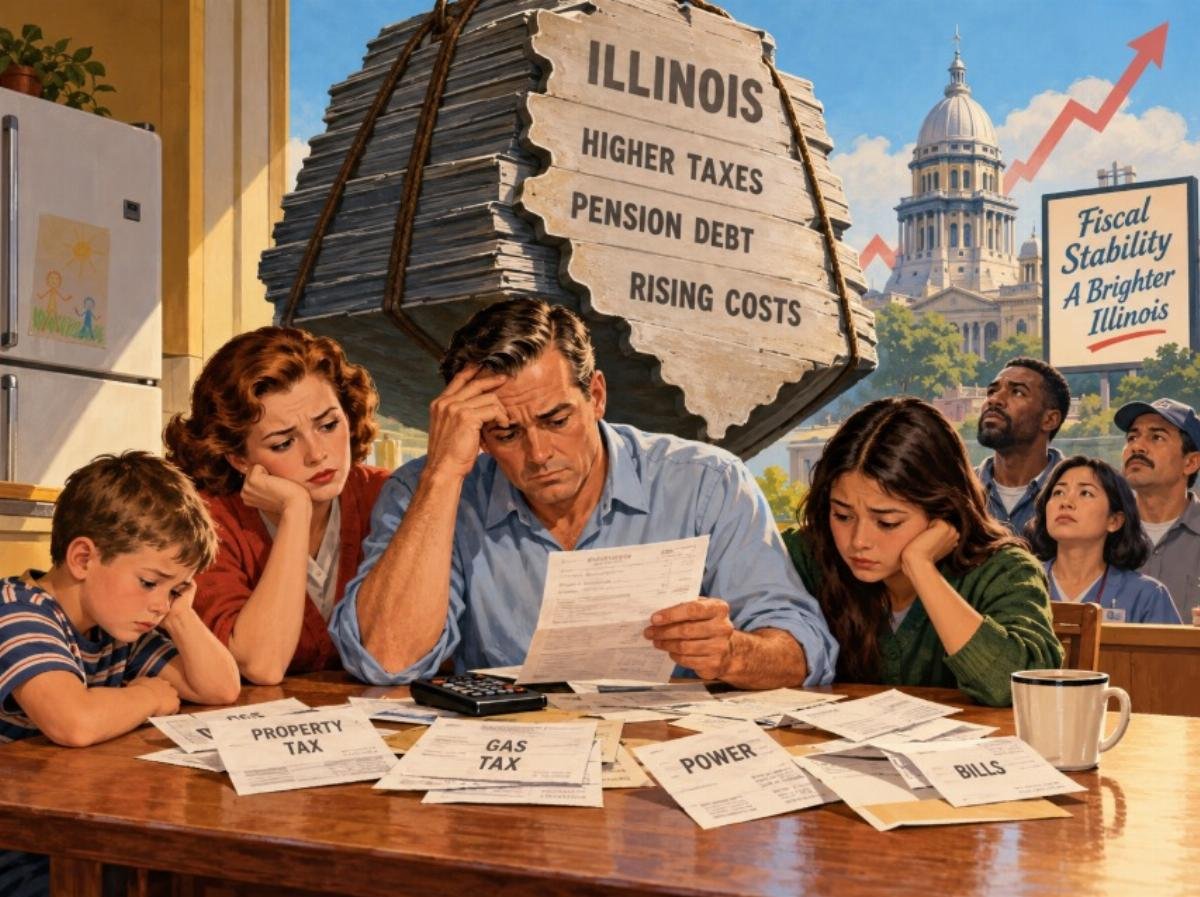
Illinois Democrats have total control of state government, and the state’s governor — now running for a third term and eyeing a national profile — has been telling anyone who will listen that the numbers are strong. According to an American Thinker commentary by Jack Hellner, the governor’s ads tout repeated credit rating upgrades from Moody’s and other agencies, which cite balanced budgets and financial stability as the reason for their improved outlook.
Hellner’s central argument is that those ratings, and the balance they purport to reflect, do not tell the whole story — and he builds his case around the numbers the ratings agencies themselves have published.
The pension problem neither side disputes
Start with the figure that rarely makes it into a campaign ad. Illinois, according to the commentary, holds the most underfunded pension system of any state in the country. In fiscal year 2018 — the year the current governor was first elected — the state estimated its pension shortfall at $133.5 billion, using assumptions Hellner describes as generous. By the end of fiscal year 2025, Illinois’ own estimate had grown to $143.5 billion. Moody’s, meanwhile, put the figure at $251 billion.
Hellner frames the gap between those two numbers as the heart of the debate. Illinois, he concedes, does technically pass an operating budget that balances. But he asks whether running up an additional $10 billion in unfunded liabilities over eight years — and carrying total pension obligations that could reach a quarter of a trillion dollars — can honestly be called sound fiscal management.
He offers a comparison meant to underscore the point: at the end of 2018, the S&P 500 closed at 2,506.85. By the time he wrote the piece, it sat at 7,764 — a 210% gain over eight years. Illinois’ pension hole, he notes, got deeper anyway.
Spending and taxes
The commentary then moves to the state budget itself. In fiscal year 2018, Illinois spent $38.5 billion. By fiscal 2026, that number reached $55.2 billion — a 43% increase, against overall inflation of 33% over the same period. For Hellner, that spread between spending growth and inflation is evidence that taxpayer concerns have not been the priority in Springfield.
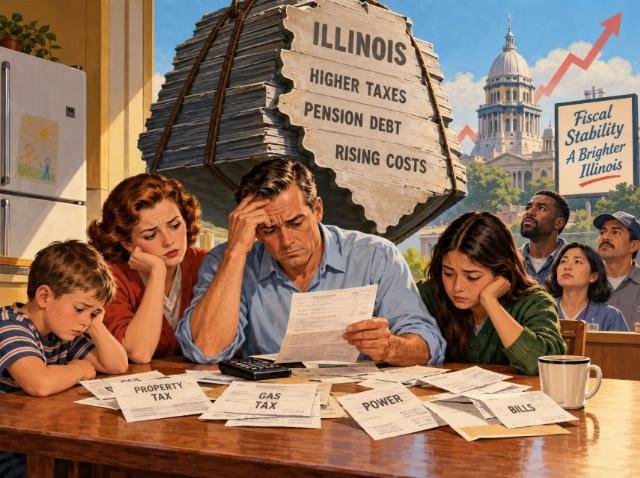
He also points to the volume of new taxes and fees enacted since the governor took office in 2019: somewhere between 57 and 63 distinct increases, he writes, citing figures he says came from a Gemini search. Collectively, he estimates those increases add $1,400 to $1,700 per year to the average household budget.
The motor fuel tax gets particular attention. Gasoline taxes were 19 cents per gallon in 2018; today they are 48.3 cents. Diesel went from 21.5 cents to 55.8 cents, and Hellner notes that further increases are already scheduled. These are regressive taxes, he argues, meaning they fall hardest on lower-income households. Illinois is also one of only ten states that applies its sales tax to gasoline — another regressive levy, in his telling.
That regressivity is the crux of his rhetorical challenge to Democrats nationally, who have made affordability a central theme. Most tax increases, unlike tariffs, cannot be avoided or negotiated around, he writes. They are permanent, and they hit the poor and middle class disproportionately.
Business climate and energy
The broader economic picture in the commentary is not flattering either. California, New York, and Illinois are the states losing the most businesses, Hellner writes. Illinois has the third-highest business taxes in the country at 9.5%, behind only New Jersey and Minnesota, and the second-highest property taxes. Recent U.S. Census Bureau and Tax Foundation data, he notes, place the state tied for the highest effective property tax rate at 1.88%, level with New Jersey.
He also criticizes the state’s energy policy, arguing that Illinois is decommissioning coal-fired power plants at a moment when more power is needed — a decision he attributes to what he calls the radical green agenda.
A warning about credit ratings
Perhaps the most pointed section of the piece is its skepticism toward the ratings agencies themselves. Hellner reminds readers that those same agencies handed AAA ratings to pools stuffed with junk mortgages in 2007 and 2008 — ratings that helped fuel the financial collapse and trillions in losses. The people responsible, he writes, never faced consequences and are still being paid to rate state and municipal bonds. That history, in his view, is reason enough to treat Illinois’ upgrades with caution rather than pride.
The national argument
Hellner then widens the lens from Springfield to Washington, making a partisan case that Democrats as a whole have a record at odds with their affordability messaging.
He notes that every Democrat voted for the Affordable Care Act in 2009, which he says drove health insurance prices sharply higher. He argues that near-universal Democratic support for green energy policies imposes heavy costs on households and businesses. He points to 2017, when every Democrat voted against cutting individual tax rates and against lowering the corporate rate from 34% to 22%. And he cites 2025, when, he writes, every Democrat in office voted against keeping individual rates unchanged and against new tax cuts for tips, overtime, and Social Security.
On fraud, Hellner contends that the Trump administration is uncovering widespread abuse across government programs — abuse he characterizes as an effective tax on the American people. He criticizes most of the media for what he sees as insufficient coverage of fraud arrests, and faults Obama, Biden, and other Democrats for a lack of interest in protecting taxpayer dollars.
The choice he presents to voters this year and in 2028 is deliberately stark: Democrats who favor bigger government, more regulation, dependency, and higher taxes, or a party he says offers more people the chance to rise through capitalism.
Whether readers accept that framing or not, the underlying figures Hellner cites — the pension gap, the budget growth, the fuel tax rates — are drawn from public sources and state estimates, and they form the factual backbone of his argument that Illinois’ stability narrative deserves more scrutiny than a campaign ad provides.
Source: www.americanthinker.com — https://www.americanthinker.com/blog/2026/09/illinois-s-democrat-created-affordability-problem/