
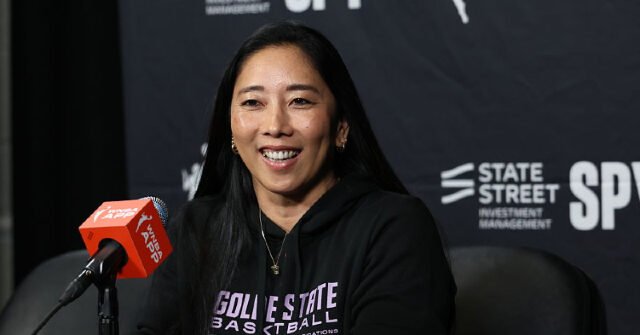
Golden State Valkyries head coach Natalie Nakase has become the latest WNBA coach to publicly support the inclusion of transgender women in women’s sports, sparking sharp criticism from tennis legend Martina Navratilova and others who argue such policies disadvantage female athletes.
Speaking during a press availability session on Sunday, Nakase framed her position around concepts of belonging and authenticity. “For me, sports is about belonging. It’s about inclusivity. It’s about allowing everyone to be their authentic self,” she said.
The Japanese American coach connected her stance to her own experiences facing discrimination. “I’m big on that because I have been criticized for my height, for my ethnicity. I’ve been in those ‘you shouldn’t belong here,’ [moments], and for me I don’t want that space, especially Golden State, to ever feel like that,” Nakase explained.
She made her position explicit, stating: “I’m all about women, little girls deserving to play, and that includes trans women. So, I’m all about inclusivity.”
According to the reporting, Nakase joins three other WNBA coaches who have previously expressed support for such inclusivity policies in women’s basketball.
Navratilova Pushes Back
The comments quickly drew a response from Martina Navratilova, the nine-time Wimbledon champion who, despite identifying as politically liberal, has been a vocal advocate for maintaining sex-based categories in women’s sports.
Taking to social media on Monday, Navratilova challenged the logical foundation of Nakase’s argument. “How is including males on women’s team inclusive for the female athlete who lost that spot to a male? The ignorance is astounding,” she wrote.
Navratilova’s criticism highlighted what she sees as a fundamental contradiction in arguments for inclusion: that adding male-bodied athletes to women’s teams necessarily excludes the female athletes who would otherwise occupy those roster spots.
The Broader Debate
The exchange reflects the ongoing national debate over transgender participation in women’s sports, which has become one of the most contentious issues at the intersection of athletics, gender identity, and competitive fairness.
Supporters of allowing transgender women to compete argue that sports should be welcoming spaces for all individuals and that excluding transgender athletes amounts to discrimination. They often frame the issue in terms of human rights and the importance of affirming gender identity.
Critics, including many female athletes and advocates for women’s sports, contend that biological differences between males and females — particularly advantages in strength, speed, and size that persist even after hormone therapy — create inherent unfairness when male-bodied athletes compete against women. They argue that protecting women’s sports as a distinct category is essential for maintaining competitive equity and opportunities for female athletes.
The controversy has played out across multiple sports and levels of competition, from youth leagues to professional athletics, with various governing bodies adopting different policies. Some organizations have implemented hormone level requirements, while others have imposed outright bans or maintained open eligibility.
The WNBA itself has not been at the center of major transgender eligibility controversies compared to some other sports, but the public statements from multiple coaches indicate the league is grappling with how to position itself on the issue.
Fan reaction to Nakase’s comments, according to the reporting, was substantial, though the specific nature of that reaction was not detailed. The debate continues to generate passionate responses from people across the political spectrum, with no consensus emerging on how to balance competing concerns about inclusion, fairness, and the future of women’s sports.
Source: www.breitbart.com — https://www.breitbart.com/sports/2026/08/03/wnba-coach-natalie-nakase-supports-allowing-trans-athletes-womens-sports/