
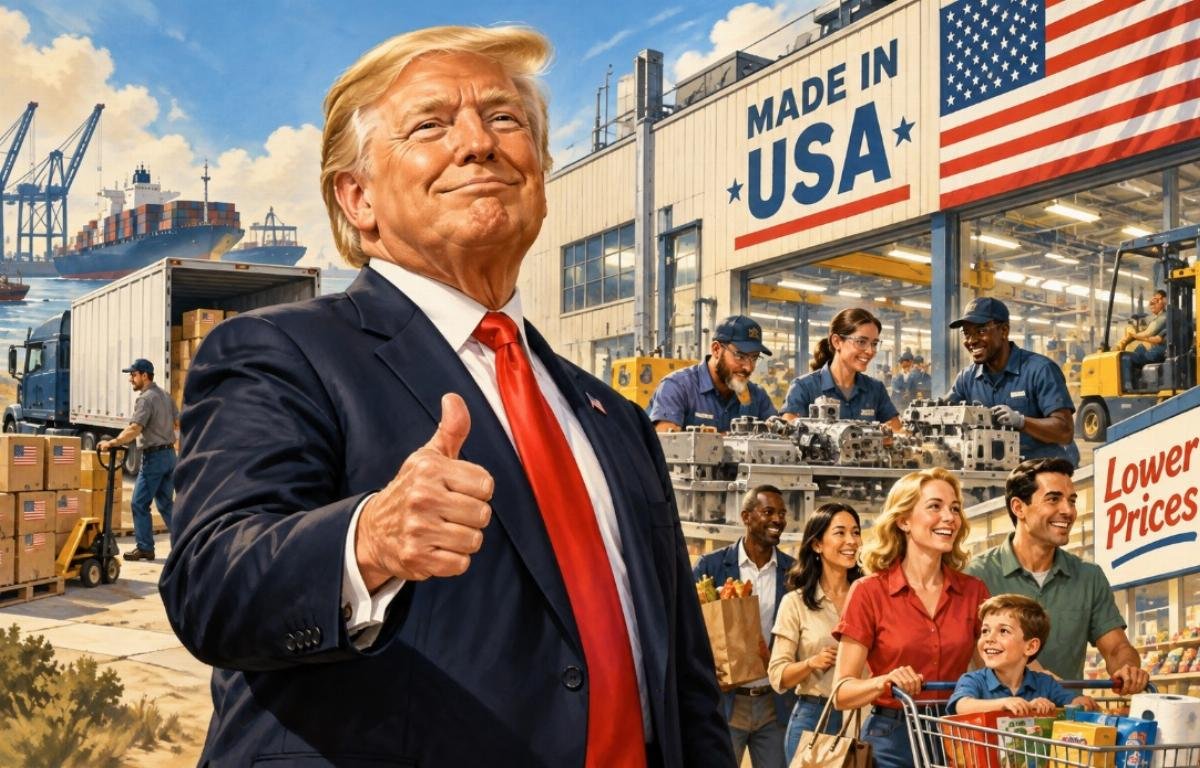
The tariff debate has been conducted for years largely in the register of catastrophe: prices would spike, supply chains would seize, a recession would follow. Writing in American Thinker, Andrea Widburg makes the case that the predicted disaster never arrived, and that the policy has instead produced a mix of trade concessions, new manufacturing commitments, federal revenue, and — more recently — actual price relief for American shoppers.
Widburg’s argument is worth taking seriously on its own terms, because it is unusually specific. She has supported Trump’s tariffs from the start, but she draws a distinction that matters for how the policy should be judged: these were not classic protectionist tariffs designed to shelter a favored domestic industry regardless of what consumers paid. They were, in her framing, a negotiating instrument aimed at countries that had been exploiting open access to the American market. The choice offered to trading partners was straightforward — lower your own barriers, or pay ours. Companies in those countries had a third option: build here.
The Deal Ledger and the Revenue Numbers
The concrete evidence Widburg marshals falls into a few buckets. First, trade agreements. She notes that the Office of the United States Trade Representative now lists trade deals or frameworks with roughly twenty trading partners or partner groups, all of them favorable to U.S. manufacturers, and she characterizes the outcomes as ranging from decent to exceptionally good. Thailand, she writes, eliminated tariffs on 99 percent of American goods; Vietnam removed tariffs on most American goods. Canada, in her telling, “had a nervous breakdown and has gone all kinds of crazy.”
Second, corporate behavior. At least a couple of dozen major companies have announced new or expanded U.S. manufacturing investments during the tariff push, according to the piece. That is the mechanism tariff advocates have always pointed to: rather than simply paying the duty, firms relocate production and the investment lands domestically.
Third — and this is where the numbers get striking — the revenue. As of August 31, 2026, the U.S. had collected roughly $292.5 billion in tariffs. Set against about $125.2 billion in tariff refunds, the net figure comes to approximately $167.3 billion. For comparison, customs-duty revenue in 2024 totaled just $76.4 billion. That is not a marginal shift in the federal government’s intake from trade.
The Doom That Didn’t Arrive
Widburg is careful to note that the refunds were never part of the original design — they followed a Supreme Court decision invalidating some of Trump’s tariffs. But she treats that development less as a defeat than as a windfall that got redirected into consumer prices.
The forecast failure is the part of her argument that leans hardest on hostile sources, which makes it rhetorically effective. Brookings, which she correctly identifies as left-leaning, conceded in May that “for the most part, the tariff impacts have been muted in the U.S.” By the end of July, the Washington Post — “still-left-leaning (although less so than before),” as she puts it — published a guest editorial asserting that “Trump’s tariffs aren’t crushing global trade” and had not produced a recession. U.S. imports rose.
That last detail deserves emphasis, because it cuts against the simplest version of the anti-tariff case. If tariffs were strangling commerce, imports should have contracted. They did not.
Where the Refunds Are Going
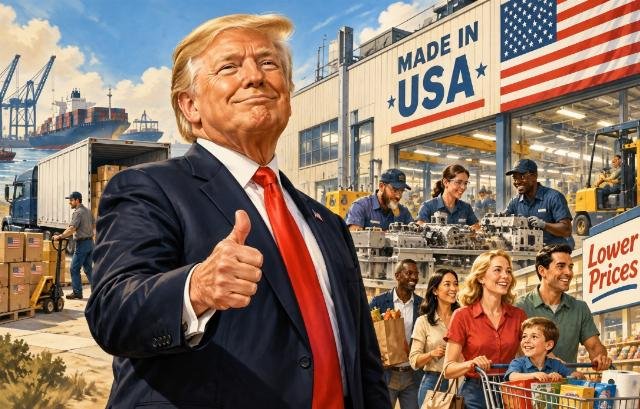
The consumer-facing payoff is where the piece lands, and it is the most tangible claim in the column. Walmart, Widburg reports, promised by August to lower prices using some of the nearly $3 billion in tariff refunds it received after the Supreme Court invalidated certain tariffs. Over the preceding quarter, the retailer had already logged more than 11,000 price rollbacks — and shareholders benefited too, since the refunds gave earnings a meaningful boost.
Now Costco enters the picture. The warehouse club received $184 million in tariff refunds and said it would use most of that money to lower prices for its members. For a company whose entire value proposition rests on per-unit savings, that is a natural place to put an unexpected cash inflow — and for shoppers, it is the rare instance of a trade-policy story with a price tag they can actually see at the register.
The broader case Widburg builds is that the outcome has matched the prediction: foreign countries lowered trade barriers, manufacturers increased their American investments, tariffs generated substantial federal revenue, and the recession and runaway inflation that many economic experts warned about never materialized. On those specific measures, she argues, Trump’s critics underestimated both the strategy and the economy’s capacity to absorb it.
What the Argument Doesn’t Resolve
It is worth being precise about what this column does and does not establish. Widburg is making a scorecard argument — here are the promised outcomes, here is what happened — and on the items she lists, the record she cites is favorable. She is not attempting a general equilibrium analysis, nor does she address which domestic industries might have borne costs that don’t show up in aggregate import figures or retailer refund announcements. Tariff policy always distributes gains and losses unevenly, and a column of this length isn’t built to trace them.
What it does do is push back on a specific style of prediction. The confident forecasts of contraction, recession, and a consumer squeeze were offered as near-certainties, and the evidence she assembles — muted impacts acknowledged even by Brookings, a Washington Post editorial conceding global trade wasn’t crushed, rising imports, and now two of America’s largest retailers cutting prices with refund money — suggests those forecasts were wrong or at least premature.
The refund mechanism itself is an irony worth noting. A Supreme Court ruling against part of the tariff program ended up routing money back to consumers through the retailers they already shop at. That wasn’t the plan. But Widburg’s point is that the larger plan worked: leverage produced concessions, investment followed, revenue accumulated, and the worst predictions didn’t come true. Whether that settles the tariff debate is doubtful — few debates of this size ever get settled — but it does raise the bar for the next round of alarm.
Source: www.americanthinker.com — https://www.americanthinker.com/blog/2026/09/the-bennies-flowing-to-americans-from-trump-s-tariffs/