
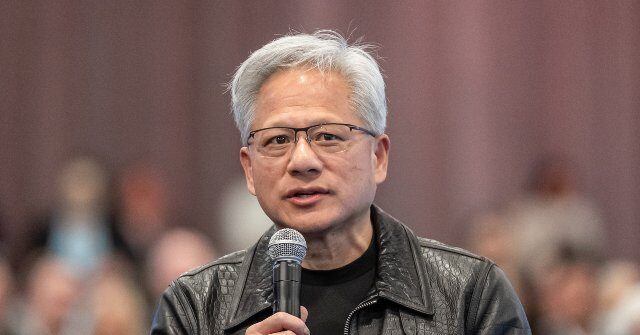
Nvidia CEO Jensen Huang has a message for students sweating over long division: it may not matter anymore. In comments that have stirred debate among educators and tech watchers, Huang argued that in an age of artificial intelligence, learning basic math is no longer the essential skill it once was.
The claim drew a skeptical response from Breitbart Editor-in-Chief Alex Marlow, who devoted a segment of “The Alex Marlow Show” to the Nvidia chief’s argument. Marlow said he believes the time he spent drilling math as a young student helped build the pattern-recognition abilities he relies on today — a skill he suggested is not so easily outsourced to a machine.
What Huang actually said
According to Breitbart’s coverage, Huang’s position is that the rise of AI tools changes the calculus for what students need to master. If a computer can handle the computation, the thinking goes, human effort is better spent elsewhere. It is a notable claim coming from the head of the world’s most valuable chipmaker, a company whose hardware underpins much of the AI boom.
The argument is not entirely new. It echoes a long-running debate over whether automation makes certain foundational skills obsolete — a question that has been raised about everything from handwriting to mental arithmetic to learning a foreign language. What gives Huang’s version its weight is timing: he runs the company supplying the engines of the AI revolution, and his views carry influence in boardrooms, classrooms, and policy circles alike.
Marlow’s counterargument
Marlow did not accept the premise. He said he would like to think the hours he spent doing and practicing math while growing up helped prepare him for the pattern recognition he uses now. It’s a personal rebuttal to a broad claim, but it captures a widely shared intuition: that math education is not merely about getting the right answer, but about training the mind to see structure, spot anomalies, and reason through unfamiliar problems.
That intuition has supporters beyond talk radio. Employers in fields from engineering to finance to the trades often describe mathematical reasoning as a durable skill that transfers across jobs and technologies. Whether AI erases the need for it — or raises the premium on the humans who can direct and check the machines — remains an open question.
A debate that isn’t going away
The exchange arrives as schools, universities, and employers grapple with how quickly to adapt curricula and hiring practices to AI. Some institutions have doubled down on math and computer science fundamentals, reasoning that understanding how models work requires understanding the math beneath them. Others have leaned into teaching students to use AI tools effectively, treating rote calculation as less central.
Huang’s comments sit at the center of that split. If basic math no longer matters, the logic implies a major reallocation of classroom time and educational priorities. If it still does — as Marlow and many parents and teachers suspect — then the AI era may demand more mathematical literacy, not less, simply to evaluate what the technology produces.
For now, the debate is more rhetorical than resolved. Nvidia has not outlined a specific education policy, and Huang’s remarks were made in the context of a broader conversation about AI’s role in society rather than as a formal prescription for school systems. But the reaction illustrates how quickly a casual claim from a tech leader can become a flashpoint in the culture war over education.
Marlow’s show, which airs weekdays from noon to 1 p.m. Eastern on Salem Radio Network stations and again at 9 p.m. Eastern on the Salem TV news channel, frequently features commentary on technology, media, and education. His podcast is released weekdays at 9 p.m. Eastern.
What neither side disputes is that AI is reshaping the workplace. The question Huang raises — and Marlow resists — is whether the next generation should still be taught to do the math themselves, or whether it is enough to know how to ask the machine.
Source: www.breitbart.com — https://www.breitbart.com/clips/2026/09/29/nvidias-jensen-huang-says-students-learning-basic-math-doesnt-matter-in-age-of-a-i/