
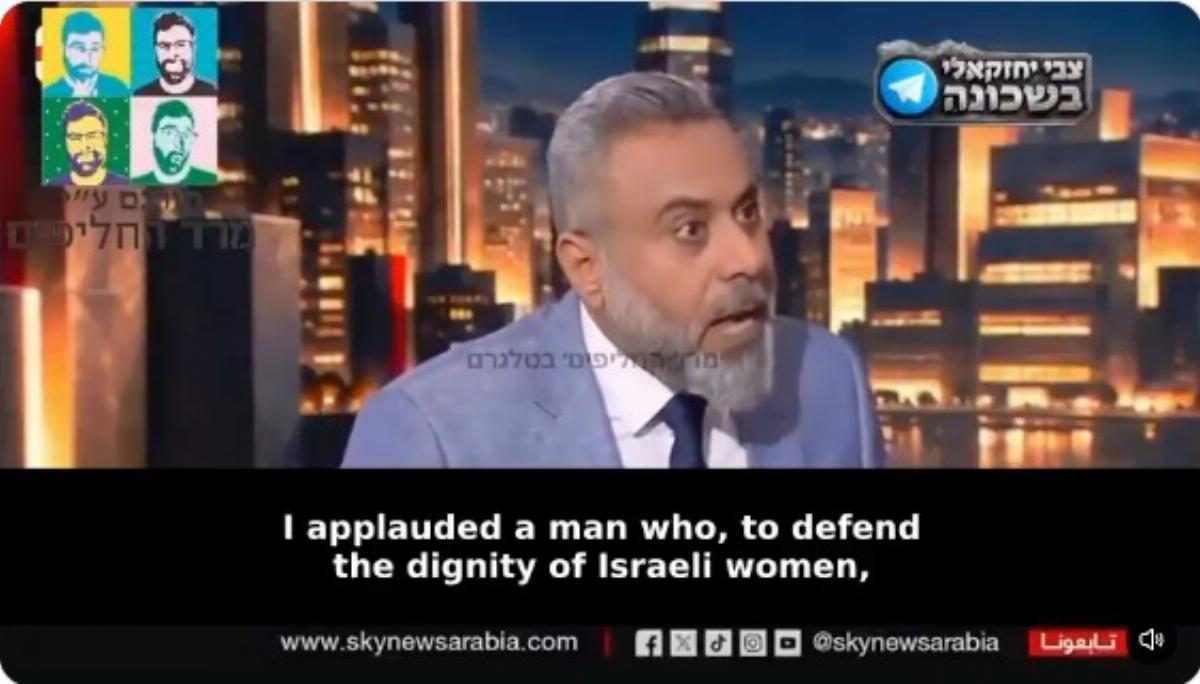
An Iraqi man living in the United Kingdom has become an unlikely viral voice for a contentious argument: that Benjamin Netanyahu is a model of national defense, and that the Arab world’s outrage over Palestinian suffering is a convenient distraction from its own failures.
The exchange, flagged by American Thinker and circulated widely on social media, features Raith Al-Tamimi, described as an Iraqi expatriate, in a heated back-and-forth with a female host over Netanyahu’s record and the broader Arab-Israeli conflict. What began as a question about Netanyahu’s United Nations speech quickly escalated into a sweeping indictment of Arab governance and the Palestinian cause itself.
A Defense of Netanyahu, and a Challenge to the Host
According to the transcript circulating online, the host opened by asking Al-Tamimi whether he had heard Netanyahu’s speech at the UN. His response was immediate and unsparing.
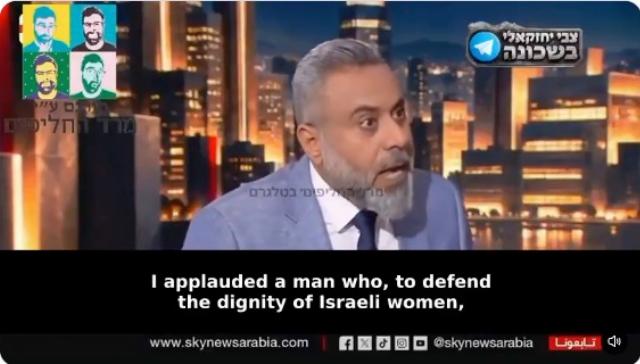
“Every leader who makes a mark on history has to commit war crimes,” Al-Tamimi said, according to the subtitled exchange. He then turned the premise around, asking the host to name anyone who defends his people the way Netanyahu does. He said he applauded a leader willing to “stand up to the whole world for his people,” and who would go to extraordinary lengths to defend the dignity of Israeli women.
The host pushed back, asking about the dignity of Palestinian women and children. Al-Tamimi’s answer drew a sharp line of responsibility: that is Mahmoud Abbas’s job, he said, not Netanyahu’s. It is the Palestinians’ responsibility.
He then broadened the argument, asking why the protection of Palestinian women should fall to the entire world while the leaders of Morocco, Saudi Arabia, and Iraq are each responsible for the women of their own nations. “Moroccan women are the responsibility of the King of Morocco,” he said. “The Saudi king is responsible for Saudi women. Iraq’s government is responsible for Iraqi women.”
When the host noted that Israeli women had been taken captive, Al-Tamimi asked who had defended them. He answered his own question: let the Palestinians defend their women. He added that the Palestinian leadership had gotten them into this mess.
The ‘Imaginary Country’ Argument
Perhaps the most provocative moment came when Al-Tamimi rejected the framework of occupation altogether. “What occupation?” he asked. He defined occupation as a condition in which a country exists and its land is occupied, then challenged the host to name the country in question.
“An imaginary country that exists in our minds, to fuel the wars in our countries,” he said. He added that he and other Arabs have no interest in Netanyahu, Mahmoud Abbas, or Yahya Sinwar, and that the dysfunction is an internal Arab and Islamic reality.
As the segment wound down, the host said they would end on that passionate note. Al-Tamimi pressed further: “Madam, they have killed us. They massacre us daily in the name of this ‘cause.’”
Where the Writer Agrees—and Disagrees
The American Thinker essay accompanying the video praises Al-Tamimi’s willingness to say publicly what many in the Arab world supposedly think privately but dare not voice. The piece suggests that many Arabic speakers hearing him may know he is right but stay silent out of fear of being killed or becoming social outcasts—which, the writer notes, for many amounts to a form of death.
But the essay also draws a line. Its author explicitly disagrees with Al-Tamimi’s concession that Netanyahu has committed “war crimes,” writing that Israel has not done so and that its war has been conducted with “the most exquisite sensibility for enemy civilians in the history of human warfare.” That is a contested characterization; international human rights groups and various governments have levelled war crimes allegations against Israeli operations in Gaza, claims Israel firmly rejects.
The essay also endorses Al-Tamimi’s broader claim that “there are no Palestinians” and that the Arab world uses the Palestinian cause as a “crutch” to distract from its own failings. That position, presented as a matter of opinion in the commentary, is rejected by Palestinians and by most of the international community, which recognizes Palestinian national identity and aspirations.
Why This Clip Is Circulating
The clip is being shared less for its legal or historical claims than for its raw rhetorical force. A self-described Iraqi exile telling a British television host that Arab leaders—not Israel—are the ones failing Arab women is a message that cuts against the standard framing of the debate. It also fits a broader trend of dissident Arab voices gaining traction in Western media, often with an emphasis on internal reform and accountability.
For its part, the American Thinker commentary frames the exchange as evidence of the importance of free speech. It closes by arguing that the ability to speak one’s mind is crucial now more than ever.
Whether viewers see Al-Tamimi as a brave truth-teller or a provocative contrarian, the video has done what few UN speeches can: it has forced a conversation about who, exactly, is responsible for the wellbeing of Arab women—and why that question is so rarely asked out loud.
Source: www.americanthinker.com — https://www.americanthinker.com/blog/2026/09/an-iraqi-gives-an-impassioned-defense-of-benjamin-netanyahu/
Source: www.americanthinker.com
Related coverage
- American Thinker Says Nikole Hannah-Jones ‘Sacrificed’ Her 16-Year-Old Daughter to Activism Over School Choice
- Labour Minister Calls Traditional England a ‘Far-Right Fantasy’ That ‘Never Really Existed’
- Conservative Pundit Admits GOP Missteps: ‘We Were Wrong’ About Trump’s Appeal
- Turley Predicted It: American Thinker Argues Political Violence Is Rising — and Lawmakers Are Fueling It