
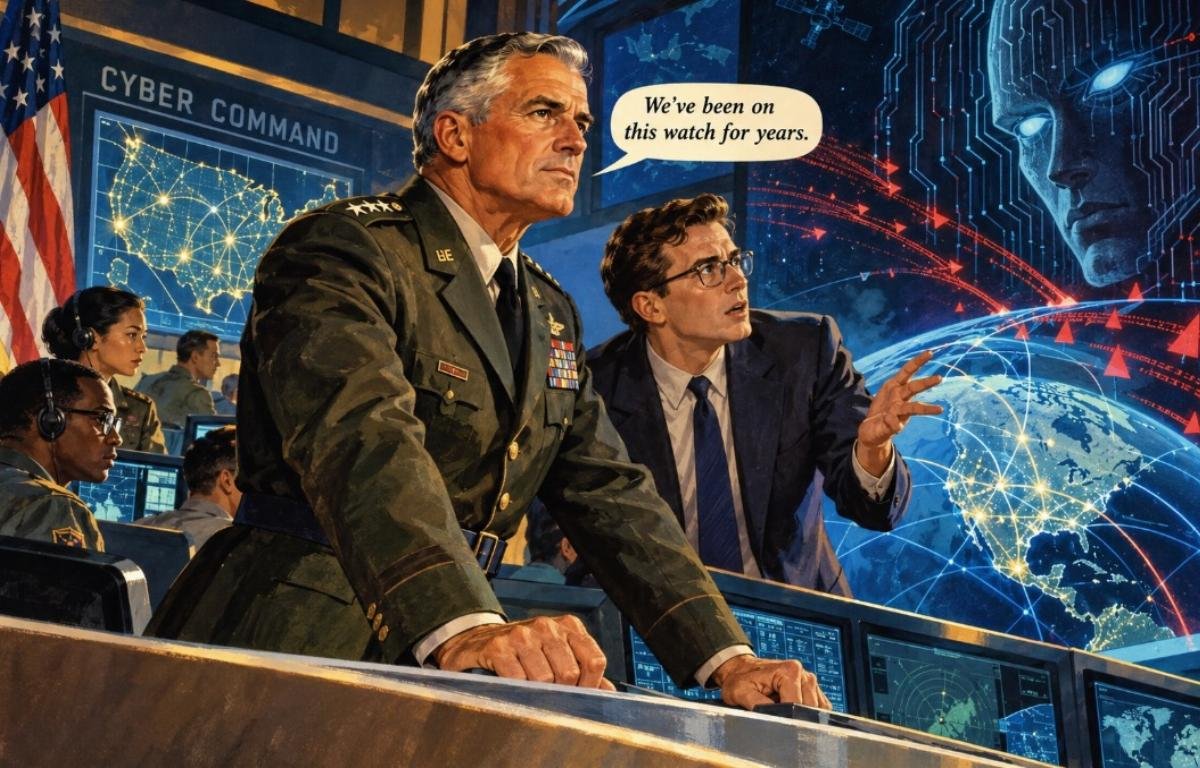
When Anthropic CEO Dario Amodei warns that America is dangerously unprepared for the arrival of artificial superintelligence, he is making billions integrating his own programs into the intelligence community while telling that same community it never saw the threat coming. That, at least, is the argument Ed Timperlake makes in a new piece for American Thinker — and as a former member of both the intelligence and law-enforcement communities, he says he’s in a position to know better.
Timperlake’s central claim is simple: the idea that the United States is flat-footed in the face of superintelligence and warfare is wrong. The national security apparatus, he argues, has been thinking about this problem for decades — long before the phrase “artificial intelligence” dominated headlines and long before Amodei’s company became a household name in Washington.
A rebrand that makes an old point
Timperlake credits President Trump with a branding move that, in his telling, clarifies rather than obscures. At a September 29 White House event alongside technology leaders including Elon Musk, Mark Zuckerberg, and Amodei himself, Trump announced he would formally replace the government’s use of “Artificial Intelligence” with “Super Intelligence.” Asked about regulation and guardrails, Trump pointed to what he called “tremendous self-regulation,” adding that “the self-regulation is very important.”
For Timperlake, the terminology shift is fitting because it makes explicit something he says has always been true: America has been defending against destructive, clever human superintelligence for far longer than it has been defending against machine-based systems. Whether the threat is a runaway algorithm or a malicious human mind, he writes, it makes little difference. Superintelligence “just puts the threat of cyberwar on steroids” — and the people paying for Anthropic’s products already understand that.
The civil servants nobody notices
The heart of Timperlake’s complaint is about credit. What has gone largely unnoticed, he writes, is that very smart civil servants and military members — some of them, in his phrasing, possessing human superintelligence themselves — have metaphorically stood guard on America’s ramparts for nothing more than a civil-service or military salary. The “Masters of the Universe,” the phrase Tom Wolfe coined for Americans making enormous sums of money, and today’s superintelligence mavens profiting from fearmongering, should have known their customer base better, he argues.
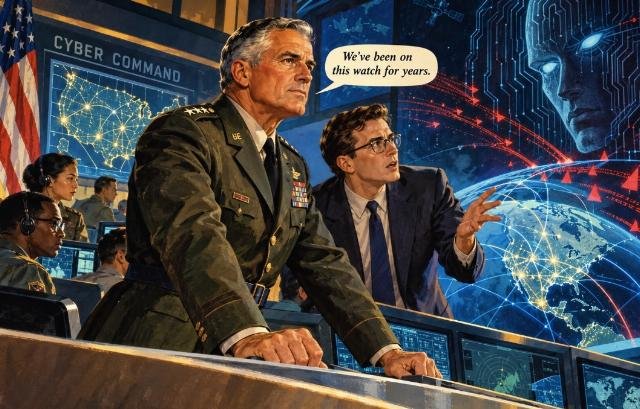
It is not an abstract grievance. Timperlake points to the stand-up of U.S. Cyber Command as evidence that the government anticipated the progression from malicious human minds trying to cripple America to machine-based superintelligence — the latter, in his framing, merely an extension of the threat rather than a rupture from it.
He ties the thread back to his own first contribution to American Thinker in 2009, in which he wrote that cyberwar was already a fact of life in 21st-century conflict and that actual and potential enemies of America had moved into full combat. In that piece, he noted real-world engagements in Georgia and Estonia and credited the Russians with skill, describing a melding of conventional military might with state-sponsored criminal cyber syndicates as ominous and powerful. He also described Chinese attacks in U.S. cyberspace as well known even to casual email and Google users, suggesting that if the dollar value of information reportedly carted off were tallied, the figure could run into the billions or even a trillion — and that the Founding Fathers, were they to visit, would have called them acts of war.
Cyber Command and the doctrine behind it
Timperlake reminds readers that the Pentagon was standing up a new major combat command to be headed by Lieutenant General Keith Alexander, then running the National Security Agency, who would be promoted to four stars and serve as the first commanding general of Cyber Command at Fort Meade, Maryland.
He laid out the division of labor as he saw it: law enforcement and investigation assigned to the Department of Homeland Security and the FBI, and war fighting assigned to Cyber Command — a split he described euphemistically as Dot.Gov and Dot.Com cyberspace on one side and Dot.Mil warriors defending the country from foreign attack on the other.
Part of his enthusiasm in that earlier piece was demographic. Air Force cyber doctrine, he wrote, had an extremely attractive feature that the new command could build on: a military fighting force that would interest eighteen-year-old men and women, some of whom were already among the most computer-savvy individuals in the world. These young Americans, who really enjoyed Wired Magazine, had reached adulthood with an instinctive know-how about computers, for good or ill — perfect warriors for what he called this brave new world.
He reaches further back for an analogy, invoking Andrew Jackson, the general and later president who augmented his regulars at the Battle of New Orleans with frontier sharpshooters and pirates. The redcoats, in his telling, did not know what hit them.
The humility argument
Amodei, Timperlake concedes, is a brilliant example of the very point he made in 2009 — a perfect warrior in the effort to protect America against foreign and domestic threats alike. But brilliance, he suggests, is not the same as perspective. A little humility in honoring the insights, forward-looking human superintelligence, and creativity of his customer base would make Amodei’s warnings about future superintelligence calamity more well-rounded, more inclusive, and therefore more credible.
It is a pointed critique from a publication that frames itself around open argument, and Timperlake closes on that note, writing that the ability to speak our minds is now more crucial than ever to the republic. Whether or not one accepts his framing of Amodei’s motives, the underlying question he raises is a fair one: when the people building the technology warn that no one is ready for it, whose job is it to have been ready — and who, exactly, gets to claim they were?
Source: www.americanthinker.com — https://www.americanthinker.com/blog/2026/09/the-u-s-has-been-thinking-about-cyberwar-for-decades/