

Freedom, the Rev. Lou Veiga writes in an essay for American Thinker, sometimes arrives on the wind. Sometimes it arrives gently. Sometimes it arrives at 180 miles per hour.
Veiga, a Houston pastor and amateur naturalist, uses his piece to braid together two escapes from communism separated by forty-five years, a continent, and every conceivable difference in weather: a homemade hot-air balloon lifting two East German families over the border in 1979, and Hurricane Milton hurling Caribbean flamingos across the Florida Straits in 2024.
He opens with his own departure. In December 1960, Veiga’s family took off from Havana in a twin-engine propeller plane as Fidel Castro’s grip on Cuba tightened. He was five years old. The winds, he recalls, were favorable. They landed in Miami.
The night the weather cooperated
The centerpiece of Veiga’s essay is the September 16, 1979 escape of the Strelzyk and Wetzel families. Peter and Doris Strelzyk and their two sons, along with Günter and Petra Wetzel and their young son, spent more than a year and a half sewing fabric, calculating lift, scavenging nylon, and hiding the whole project from the Stasi, East Germany’s secret police.
It was not a smooth operation. Veiga recounts that earlier attempts failed: one balloon, soaked by fog and water, sagged and collapsed back onto East German soil; another was too small to carry both families. When the Stasi discovered the remnants of a balloon in the woods, the families’ window for escape began to close.
Then the weather turned. On the night of September 16, conditions over Oberlemnitz lined up: clear enough skies, winds strong enough and blowing in the right direction, and cold enough air to give the burner the lift it needed. Around 2:00 a.m., the balloon rose and drifted silently toward the border.
They flew for roughly thirty minutes before the propane ran low and the balloon came down in a forest near Naila, in Bavaria, West Germany, at about 3:00 a.m. They did not know whether they had made it. Only when Bavarian police arrived did they learn they had crossed the border.
“The weather had carried them out — not by storm, but by stillness,” Veiga writes. “A quiet night sky was their escape route.”
Forty-five years later, a different kind of wind
The second escape in Veiga’s essay came not through stillness but through violence. In October 2024, Hurricane Milton, a Category 5 storm with 180 mph winds and a minimum pressure of 895 millibars, tore across the Caribbean and Florida. Veiga describes it as one of the strongest Atlantic storms ever recorded.
Per his account, Milton formed from a tropical wave off Africa on September 14, 2024, intensified rapidly in the western Caribbean, struck Cuba with destructive winds, and made landfall in Florida on October 9 near Siesta Key as a Category 3 hurricane. It devastated Cuba and Florida alike.
In the middle of that chaos, Veiga writes, something remarkable happened. The hurricane’s immense circulation scooped up birds from Cuban wetlands and carried them across the 90-mile Florida Straits, scattering them into new habitats. Among them were flocks of Caribbean flamingos, Phoenicopterus ruber. Milton deposited them across Florida and beyond.
Veiga notes that under ordinary conditions the flamingo’s lanky build and weight would likely keep it from reaching Florida from Cuba under its own power, and that wild flamingos had not been sighted in Florida for about a century. Now they are back, and Miami-Dade County has given them a welcome of sorts by naming the American Flamingo its official county bird.

In both cases, Veiga argues, the same force was at work: the wind as an escape vehicle, whether it was the cold stillness of a September night or the spiraling violence of a Category 5 hurricane.
One story, two species
Veiga is candid that he relates to both the Germans and the flamingos, having left Cuba as a child himself. His conclusion is less a policy argument than a piece of natural theology: “One truth is clear — all of nature groans to be free.”
He closes on a wry note, wishing more people enjoyed escape stories and hoping many eventually will — “weather permitting.”
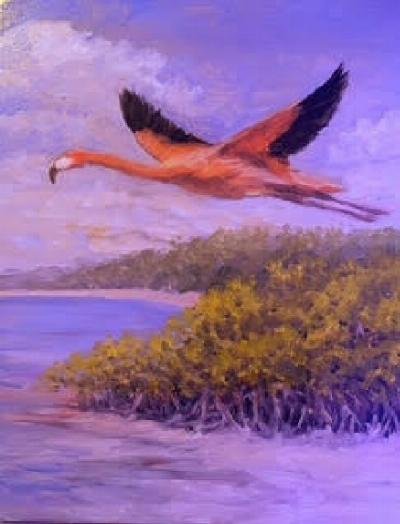
The essay accompanies a painting by the author himself, “American Flamingo,” an 8-by-10 oil on cradled birch panel dated 2026. Veiga is pastor of Covenant Presbyterian Church in Houston and a former director of development and recruiting at Greenville Presbyterian Theological Seminary in South Carolina, and describes himself as an amateur naturalist with lifelong interests in aquaculture and Florida and Caribbean landscapes.
The piece sits in American Thinker’s culture and communism section, and its sensibility is less partisan than elegiac. Its two subjects — a family in a cloth balloon and a flock of flamingos riding a hurricane — are not offered as political symbols so much as evidence for a claim about the natural world. Veiga does not argue that the Strelzyks and Wetzels were lucky, or that the flamingos were fortunate; he argues that the wind itself, whether gentle or catastrophic, has a way of delivering the captive to somewhere else.
It is an unusual pairing for a political essay: a Cold War escape narrative and a 2024 weather event, joined by the observation that in one case the weather was quiet and in the other it was not, and that either way it carried the passengers out.
Veiga’s final line — “weather permitting” — is a joke, but it is also the essay’s thesis in miniature. The same conditions that can be counted on to ruin a picnic are, on the right night, the thing that gets you over the border. Ask the Strelzyks. Ask the flamingos.
Source: www.americanthinker.com — https://www.americanthinker.com/blog/2026/10/weather-dependent-escapees-from-communism/