

When news first broke of a mid-air crisis aboard a Dubai-to-Tel Aviv flight, the story had all the ingredients of an international sensation: a brutal stabbing in the cockpit, a plane plunging thousands of feet in seconds, and a quick-thinking plumber who happened to have watched enough aviation disaster documentaries to know how to pull a Boeing 737 out of a dive. Yet according to American Thinker, the mainstream media’s response was not banner headlines and urgent analysis but a collective shrug — and, in the outlet’s telling, a deliberate effort to obscure what really happened.
Writing for American Thinker, Andrea Widburg argues that the incident — which she describes as an attempted hijacking by an Omani co-pilot — was downplayed by major news organizations because acknowledging the full picture would cut against a preferred narrative. Her October 1 piece is less a news report than a sustained critique of how the story was framed, and it raises uncomfortable questions about how quickly the press assigns neutral language to acts of apparent terror.

The Facts as American Thinker Presents Them
According to the account in American Thinker, the flight carried 174 passengers, including 150 Israelis, a detail the outlet ties to the warming ties between Israel and the United Arab Emirates since the Abraham Accords. Roughly two hours into the journey, the plane suddenly dropped between 14,000 and 18,000 feet in just 30 seconds. That plunge, the outlet reports, followed a violent attack in the cockpit: the Omani co-pilot stabbed the pilot, Smit Machchhar of India, leaving him bloodied and with life-threatening injuries, in an apparent bid to seize control of the aircraft.
Despite his wounds, Machchhar managed to send an alert and unlock the cabin door, allowing passengers and crew to rush the cockpit. American Thinker credits Yaniv Hayun, a 50-year-old plumber traveling with his family, as the central hero. Hayun was first through the door, grappling with the co-pilot and dragging him out, where other passengers subdued him. With the plane still diving, Hayun grabbed the controls and pushed back on them, halting the descent. He had never flown a plane, the outlet notes, but he later explained that he knew what to do because he was a fan of Air Crash Investigation, a Canadian television series.

The outlet also highlights the role of other pilots on board who helped land the aircraft safely in Saudi Arabia, and it praises Boeing’s 737 for withstanding significant tail damage during the catastrophic descent. Meanwhile, passengers organized to tend to Machchhar, who was bleeding heavily. He is reported to be alive and recovering in Dubai.
How the Media Covered It — and Why American Thinker Objects
The crux of Widburg’s complaint is not that the press ignored the event entirely but that it used language that stripped the incident of its moral clarity. She points to early headlines and reports that described the cockpit violence as an “altercation,” a “mutual fight,” or a “brawl.” She also takes aim at framing that declared the co-pilot’s motive unknown — a stance she finds absurd given that Oman’s population is roughly 95 percent Muslim and the flight was carrying a large number of Israelis.
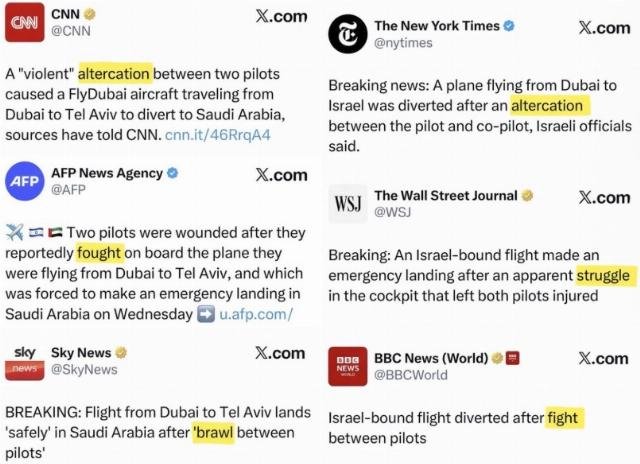
Widburg singles out The New York Times for particular criticism. After being called out for the “altercation” characterization, she writes, the Times went into “full damage control mode,” defending itself by saying it is not made up of “activists and partisans.” To Widburg, that defense rings hollow. The facts, she insists, were available almost immediately — they emerged the moment passengers disembarked. Even if the motive remained unclear, the basic sequence was not: a co-pilot launched a murderous attack on the pilot and sent the plane plummeting toward the ground.
She dismisses the idea that this was a story still unfolding, with details too murky for firm characterization. In her view, the press had enough to describe an act of terror and instead chose euphemism.
The Broader Argument About Media Credibility
American Thinker’s piece widens its scope beyond this single flight. Widburg argues that partisan media is not inherently a problem — robust debate between outlets with different viewpoints is part of a healthy republic. What she calls unsustainable is a media that does not merely offer a slant but outright lies, and she contends those lies “invariably involve Trump, Democrats, and Israel.”
She invokes the Trump administration’s efforts to bar CNN, Politico, and MSNOW from press briefings, framing those moves not as ideological censorship but as a response to dishonesty. The outlet compares such alleged media frauds to termites eating away at a house from within, eroding the nation’s foundations.
The column closes with a call to protect free expression, which American Thinker presents as essential to the republic, alongside a donation appeal to support its staff and mission. Whether readers share Widburg’s conclusions or not, her central factual claim — that the language used in early coverage differed sharply from the severity of what occurred in that cockpit — is one that media critics across the spectrum have raised before: the gap between neutral terminology and the reality of violence can shape public understanding long before all the facts are known. For American Thinker, that gap was not an accident but a choice.
Source: www.americanthinker.com — https://www.americanthinker.com/blog/2026/10/the-mainstream-media-scramble-to-hide-an-attempted-hijacking/