

Nearly half of American three-year-olds now use a tablet, iPad, or Kindle, according to a 2025 survey of more than 24,000 parents cited by the Institute for Family Studies in a new analysis republished by The Daily Wire. Many of those devices are used with few or no restrictions. And a growing body of research suggests that heavy early screen exposure is tracking with measurable delays in the verbal milestones that typically mark a child’s third year—especially the ability to tell a story.
Writing for IFS, research associate Isabella Dini and research fellow Grant Bailey examined data from the National Survey of Children’s Health covering 16,045 children from 2020 to 2024. They looked at three specific language markers among three-year-olds: whether a child can speak in three-word sentences, whether they ask “who,” “what,” “when,” and “where” questions, and whether they can tell a story with a beginning, middle, and end. Then they broke the results down by how many hours parents said their kids spent in front of screens on a typical weekday outside of schoolwork.
A Steep Drop-Off in Verbal Milestones
The pattern across all three outcomes runs in the same direction: more screen time, fewer children hitting the milestone.
Among three-year-olds with less than an hour of daily screen time, 95% can ask questions. Among those with four or more hours, that figure falls to 82%. In practical terms, the authors calculate that heavily screened three-year-olds are about 3.5 times as likely to have missed that milestone as kids with minimal screen exposure.

The storytelling gap is wider still. While 83% of children with under an hour of daily screen time can narrate a story with a beginning, middle, and end, only 56% of those with four or more hours can do the same. The researchers found a five-percentage-point decline in storytelling ability for each additional hour of screen time.
That is a remarkably steep gradient for a skill the Centers for Disease Control and Prevention lists as an expected milestone by age five.
Is Screen Time Really the Culprit?
Dini and Bailey acknowledge the obvious question: could something else—income, family structure, parental education—explain the gap? To test that, they controlled for race, sex, family structure, household income, and parental education. Screen time remained a strong predictor of each verbal outcome.
Three or more hours of daily screen time was significantly associated with lower rates of both three-word sentences and question-asking. One or more hours daily was significantly associated with lower storytelling ability. Socioeconomic factors explained roughly a quarter of the relationship between screen time and verbal development—meaning most of the association persisted independent of those variables.

The link also survived an adjustment for parental engagement. Even after accounting for how often a parent reads to a child, the pattern held. In fact, the authors report that three or more hours of daily screen time was as predictive of lower storytelling ability as being read to less than four days a week.
Storytelling, the authors suggest, may be the most sensitive of the three measures because it is the most advanced. It requires imagination and narrative sequencing—capacities that passive screen time may blunt more than it does basic vocabulary.
The researchers are careful to note a key limitation: the NSCH data are cross-sectional, so the analysis cannot prove that screen time causes delayed verbal development. The authors describe the relationship as correlational while pointing to a growing body of research linking heavier screen use to poorer cognitive and language outcomes. Whether the relationship is causal, they write, remains unclear.
Not All Screen Time Is Equal
The analysis also draws distinctions that complicate any blanket warning. Educational screen content, as opposed to violent media, has been associated with higher executive function among young children—though screen exposure overall still correlates with lower executive function. Co-viewing with a parent appears to have protective effects compared with solo viewing. Still, the authors emphasize that young children learn best through face-to-face interaction rather than through a screen.
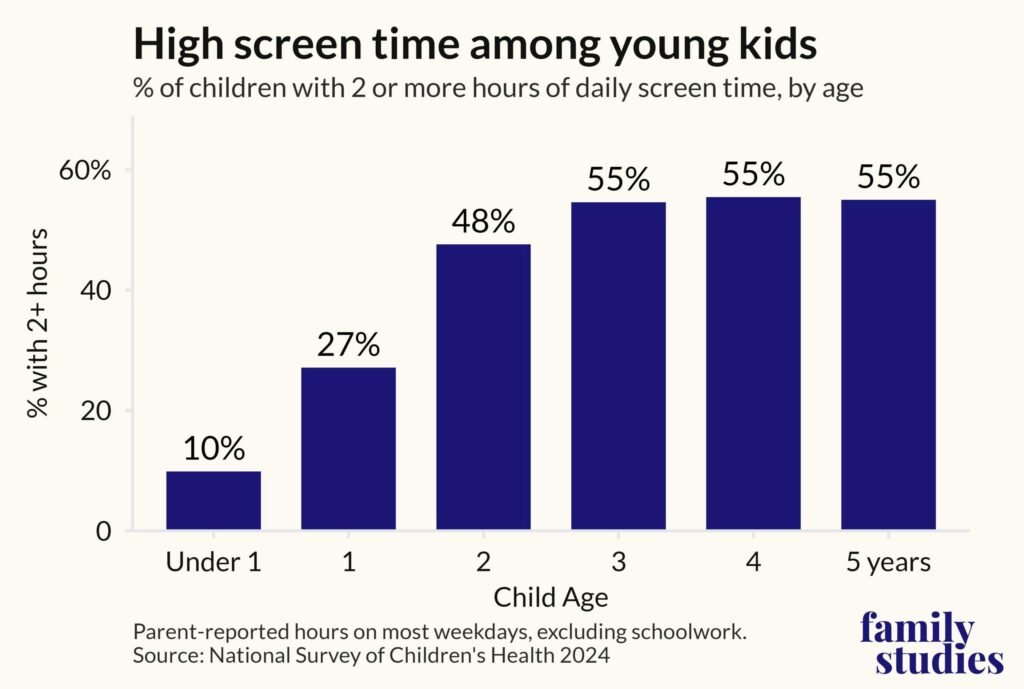
Those nuances matter because the ability to follow the recommendations is not evenly distributed. The American Academy of Pediatrics advises no screens before 18 months and under one hour of high-quality daily screen time for children ages two to five. According to the 2024 NSCH data cited in the analysis, most American families are not meeting those benchmarks. More than half of children between three and five are reported to get two or more hours of daily weekday screen time.
Who Carries the Heaviest Screen Load
The burden falls unevenly. Children living with single parents are more than twice as likely to log four or more hours of daily screen time as children growing up with married parents. Three-year-olds from working-class families—where neither parent holds a college degree—are 86% more likely to use screens at least four hours a day than those with a college-educated parent.
Dini and Bailey frame this as a matter of time and resources rather than parental preference. Avoiding screens in favor of more constructive activities, they write, requires free time that many single parents and working-class families do not have. Families living paycheck to paycheck, in their telling, may lean on screens as a last resort rather than a first choice.
The authors argue that these disparities point to a need for broader support: modeling strategies to limit screen time at home, passing laws that give parents more control over their children’s tech use, and building home environments where limited technology use is actually feasible. Screens, they concede, are here to stay. The question they raise is who gets to decide what place those screens occupy in a child’s earliest years.
The analysis was originally published by the Institute for Family Studies under the title “More Screen Time, Less Storytelling” and republished by The Daily Wire with permission.
Source: www.dailywire.com — https://www.dailywire.com/news/why-todays-toddlers-are-struggling-to-tell-stories