
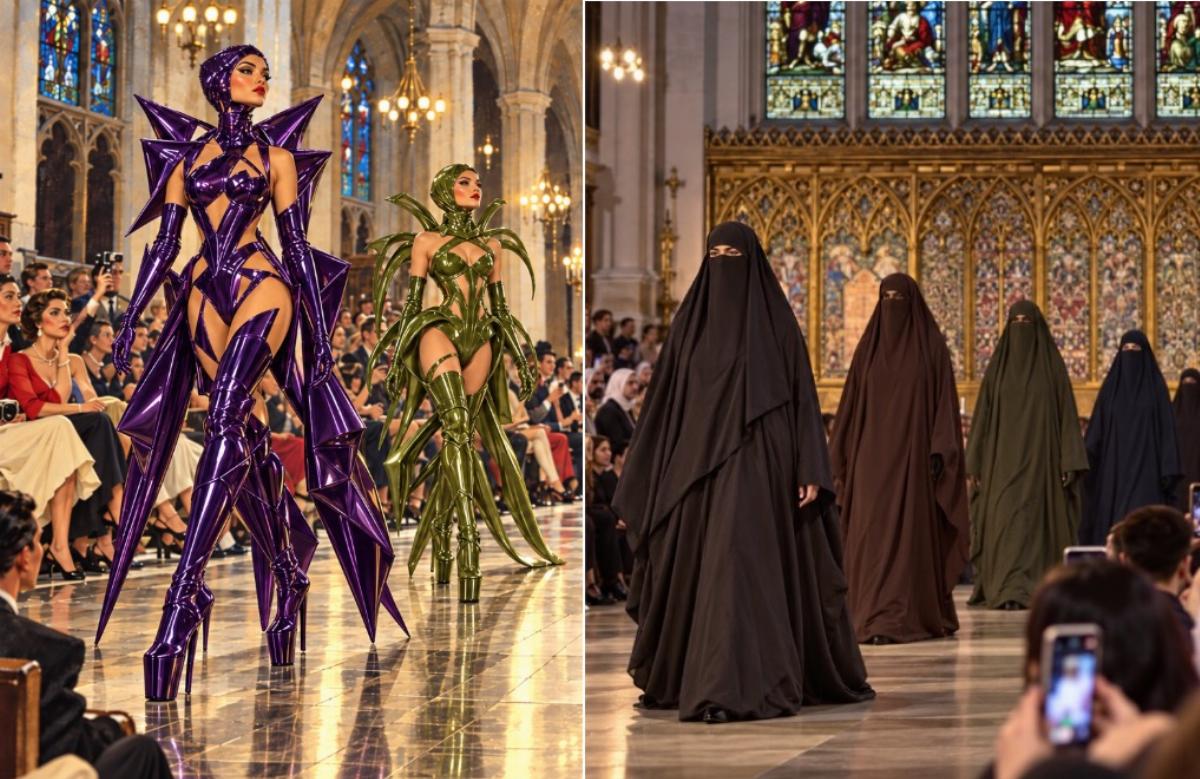
Andrew Breitbart’s old aphorism — that politics is downstream from culture — is doing a lot of work in a new American Thinker essay by Andrea Widburg, which argues that Europe’s fashion weeks have abandoned any pretense of elegance and descended into what she calls a “grotesque celebration of debauchery, Satanism, and of all things, Islam.”
Widburg’s piece, published October 3, 2026, is less a report on the shows than a cultural lament, tracing a line from postwar Parisian couture to what she describes as the current nadir of Western taste. Her conclusion is blunt: the fashion establishment has become “so decadent and disgusting that it’s impossible to imagine them sinking even lower.”
A Story of Decline, Told in Decades
The essay opens with a brief history lesson. Paris, Widburg notes, has been the West’s fashion capital for centuries — even in the 18th century, wealthy women looked to the city for their wardrobes. By the late 19th century, she writes, hundreds of American heiresses traveled to Paris to buy clothes, then continued to London in search of poor, titled husbands whose decaying estates needed their cash. Without that pattern, she suggests, there would have been no Winston Churchill.
Not even World War II dislodged Paris from the top of the fashion world, according to the piece. Almost immediately after the war, couture houses were presenting collections again, and in 1945 France formally established the legally protected haute couture designation. Widburg points readers to archival video of those early postwar shows, describing them as displays of “normalcy and elegance” in a city still scarred by Nazi occupation — graceful, feminine clothes presented by designers working amid the rubble.
By 1969, she concedes, things had turned “mod,” even a little psychedelic, but she argues the era still stayed “within the bounds of decency.” Those days, in her telling, are “totally and completely gone.”
What the Runways Showed
The bulk of the essay is a tour through recent shows in Paris, Milan, and London, illustrated with embedded social media posts the author cites as evidence. At Paris Fashion Week, she highlights front-row guests and the Rick Owens show — which she describes as “considered one of the ‘top’ and most ‘exclusive’ shows in Paris” — as examples of what she terms degeneracy laced with a “strong Satanic flavor.” She compares the current spectacle unfavorably to the postwar footage, writing that the modern version makes “the dying days of the Roman Empire look infantile by comparison.”
In Milan, her exhibit is micro shorts for men, which she says were presented as one of the season’s “hottest” new trends.
But it is London where Widburg locates the worst offenses. She cites a runway moment featuring pregnant Little Mix singer Leigh-Anne Pinnock spraying water from her breasts — a display she calls “shocking.” More significantly, she trains her attention on St John’s Hyde Park, a Gothic Revival church consecrated in 1832 that hosted a London Fashion Week show featuring BDSM fetish fashions alongside what she describes as Muslim fashions.
The church has a long arts pedigree, the essay acknowledges. In the 1960s, Rev. Cuthbert Scott revitalized the then-dying congregation and turned it into a hub for the arts, with help on acoustics from Beatles producer George Martin. But, Widburg insists, “it’s still a church” — a fact she says was not obvious during the fetish fashion presentation.
She also points to a separate event at the same venue: a “Modest Fashion Week” show, described as an adjunct to but not part of London Fashion Week, in which women wearing hijabs paraded through the building. St John’s, she notes, describes itself as “inclusive.”
The Modesty Argument
That second event draws Widburg’s sharpest cultural argument. “Please note that ‘modesty’ is no longer even a concept the West can recognize unless it’s got Islam attached to it,” she writes. “The idea that the West can be modest on its own terms is, apparently, dead.”
It is a claim that ties the essay’s aesthetic complaints to a broader religious and civilizational thesis — that the same industry simultaneously celebrates exhibitionism and fetishism while treating modesty as legible only when it arrives in religiously coded, non-Western form.
Why It Matters to Americans
Widburg is careful to anticipate the obvious objection: ordinary Americans will never wear most of what appears on these runways. Her response is that fashion does not trickle down through literal imitation. Buyers, designers, fashion editors, and manufacturers watch the major shows, she argues, and the silhouettes, proportions, colors, fabrics, and styling ideas eventually work their way into the mass market in toned-down form.
So while she doesn’t expect Dillard’s to start selling Rick Owens costumes next year, she warns readers not to be surprised if men’s shorts get shorter, women’s clothes acquire vaguely Goth or fetish-inspired details, exhibitionism becomes more routine, and the only fashions still marketed without embarrassment as “modest” are those imported from cultures outside the West.
It is, in the end, an argument about cultural transmission — the Breitbart thesis applied to hemlines and hardware. The essay closes with an appeal for reader support, framing the ability to “speak our minds” as crucial to the republic, but the substance of the piece rests on the claim that what happens on a Paris or London runway is never just about clothes. Whether readers accept Widburg’s reading of the shows as a coherent cultural signal or dismiss it as moral panic, her central warning is that the aesthetic currently on display in Europe’s fashion capitals is already on a slow boat toward American storefronts.
Source: www.americanthinker.com — https://www.americanthinker.com/blog/2026/10/the-monstrous-decadence-of-europe-s-fashion-week/
Source: www.americanthinker.com