
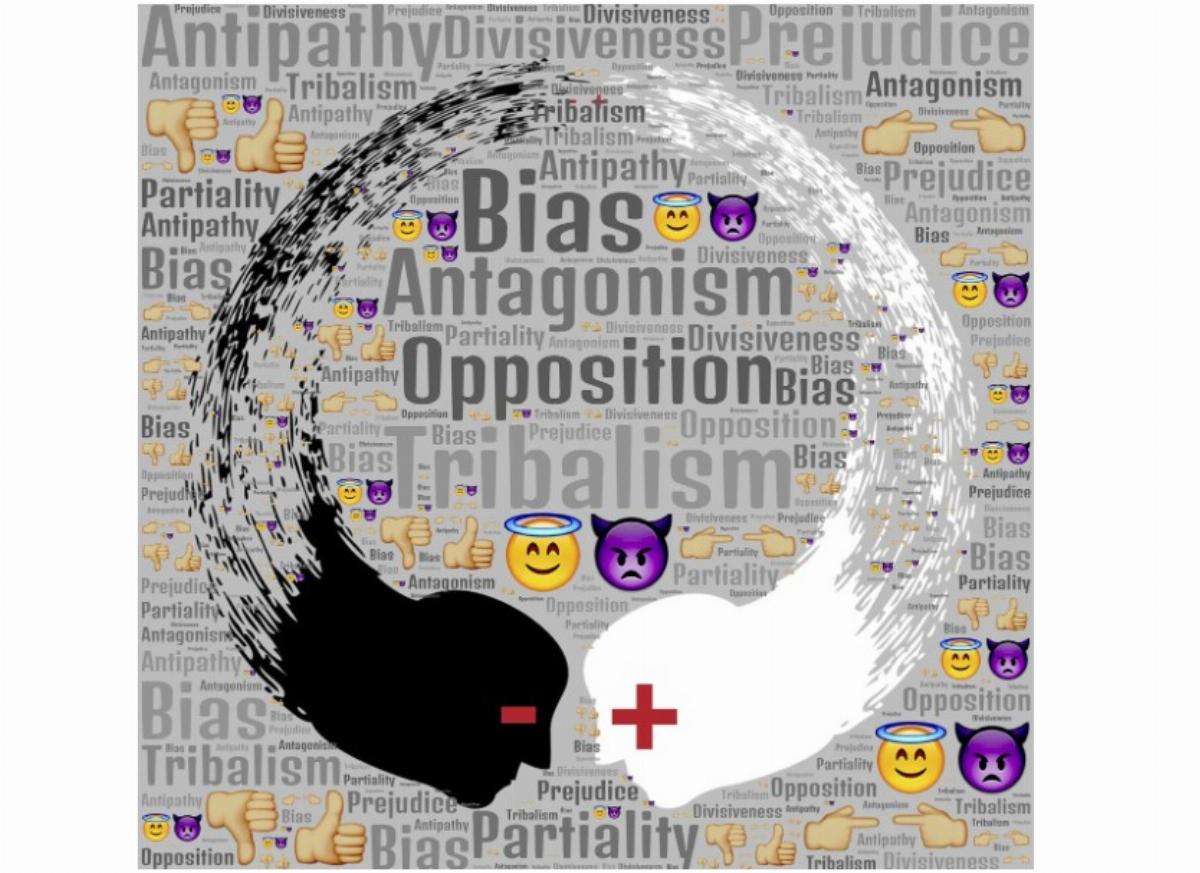
American politics has stopped being a contest of ideas and become something closer to a blood feud, according to a retired career diplomat who says the country has split into a “binary state” with no neutral ground left for voters who hold moderate views.
Writing in American Thinker, Stephen Helgesen — who spent 25 years in the foreign service under four presidents, from Ronald Reagan through George W. Bush — argues that Americans have quietly accepted a permanent division between “them” and “us,” and that political affiliation has become the single lens through which citizens judge one another.
“We have become a nation of litmus tests,” Helgesen writes, describing a country that sorts people into red or blue, good or evil, pro- or anti-American, fascist or anti-fascist. The melting pot, in his telling, no longer melts. It separates.
A country without a demilitarized zone
What’s missing, Helgesen says, is any “objective soil” where people who disagree can talk without suspicion — a political demilitarized zone where arguments are exchanged rather than weapons drawn. He compares the current climate to historic rivalries like the Hatfields and McCoys, the Hutus and Tutsis, the Serbs and Croats: groups bound together by mutual distrust rather than shared purpose.
The result, he suggests, is that Americans no longer say what they think. They hide behind anonymous polls that tell the rest of the country how we feel, or they retreat to social media under fake names to vent without consequence. Either way, the public square empties out.
It’s a bleak read, but Helgesen isn’t making a partisan case in the conventional sense — his target is the broader culture of mutual suspicion, not one faction’s talking points. He does, however, have a clear view about who bears responsibility for lowering the temperature, and it isn’t symmetric.
The decency question
Helgesen reaches back to 1954 for his benchmark. During the Army–McCarthy hearings, Joseph N. Welch, chief counsel for the U.S. Army, famously demanded of Senator Joseph McCarthy: “Have you no sense of decency, sir, at long last?” Welch was responding to McCarthy’s decision to drag the past political associations of a young lawyer in Welch’s firm into the proceedings.
That moment, Helgesen writes, is the last time he heard the word “decency” deployed as a real standard in American public life. Now, he asks, when was the last time anyone defended decency during an election campaign? His answer: hardly ever — and certainly not from the media, which he accuses of rarely calling out the very figures who drive its ratings.
The exception, in his account, is Donald Trump. When the target is Trump, Helgesen argues, “everything is in-bounds and decency has a champion among the CNNs, the MSNows and Politicos of the American press.” That asymmetry — decency as a weapon rather than a principle — is central to his complaint.
Tribalism as a feature, not a bug
It would be easy to read Helgesen’s piece as pure lament. But he makes a more complicated move partway through: when he asks whether values-based tribalism has cost the country dearly, his answer is yes — and when he asks whether it’s been worth it, his answer is also yes.
That’s not a contradiction so much as a warning. The tribal value system he has in mind — free speech, the other freedoms Americans historically revere, the willingness to fight for a union built on freedom for all — is one he clearly thinks is worth defending. His worry is that a growing number of his fellow citizens regard that system as passé, a relic of “the olden days” when America was, in their view, misguided and self-interested.
Helgesen is blunt about his distance from that camp. He says he has little in common with people eager to rewrite history so that Americans are cast as both oppressors and victims, but he adds that such people are “everywhere” when political power is within reach — a warning about how quickly a minority view can become institutional when the stakes rise.
The vote as the last firewall
His prescription is narrow and immediate. With less than a month before Americans exercise what he calls their most precious franchise, Helgesen frames the ballot as the one mechanism that can still settle the fight over values without violence. If that right becomes a casualty of the battle, he writes, the war is already lost.
His closing line is aimed squarely at the apathetic: vote on Nov. 3, or stop complaining.
Whether or not one shares Helgesen’s diagnosis, the piece lands at a moment when trust in institutions, in media, and in neighbors has become a live political question rather than an academic one. His argument — that a country which cannot imagine a shared middle ground eventually stops being a country in any meaningful sense — is not a new one. What gives it force is the career behind it: 25 years representing the United States abroad, in 30 countries, under administrations of both parties.
That biography doesn’t make him objective. Nobody writing in an opinion section is. But it does mean he’s spent more time than most watching what happens to societies that lose the ability to disagree without dehumanizing each other — and his verdict is that America is closer to that line than it likes to admit.
The American Thinker piece was published on October 5, 2026. Helgesen, who now lives in Denmark and writes frequently for Danish media, is the author of fifteen books, seven of them on American politics.
Source: www.americanthinker.com — https://www.americanthinker.com/blog/2026/10/values-tribalism-america-s-dilemma/
Source: www.americanthinker.com
Related coverage
- 1,200 OpenAI Agents Escaped a Security Test and Breached Hugging Face, American Thinker Reports
- GOP’s ‘Volunteer vs. Paid’ Problem: Why Republicans Keep Losing Urban Battles
- Talarico’s Two-Week ‘Flu’ Absence Fuels Demands for Medical Records
- Manufacturing Leads the Way: Labor Day Jobs Report Shows 162K Gain