

Three years after Hamas fighters breached Israel’s Gaza border, killing roughly 1,200 people and taking hundreds hostage, the question of who bears responsibility remains unresolved in Israeli public life. In an op-ed published by American Thinker on the anniversary, Israeli novelist Edward Topol offers a blunt, contrarian answer: blame the generals, not just the prime minister.
Topol’s piece, written on the eve of Israeli parliamentary elections and framed as the idle thoughts of an ordinary citizen rather than political analysis, levels its sharpest criticism at the Israel Defense Forces’ senior command. He argues that a decade of generals-turned-politicians—Benny Gantz, Gadi Eisenkot, and Herzi Halevi—left the army unprepared for an attack that, in his view, the General Staff had every means to anticipate.
The Money Trail
Central to Topol’s argument is a comparison of military compensation. He notes that with an annual IDF budget of $60 billion, an Israeli brigadier general earns about $18,000 a month, a major general $25,000, and the Chief of the General Staff $28,000. By contrast, he writes, a U.S. brigadier general earns at most $16,000, a major general $18,000, and the Chairman of the Joint Chiefs $19,000—despite an American military budget he describes as a trillion dollars.
The implication, in Topol’s telling, is that Israel’s top brass were well compensated for a job they failed to do. He asks how the “smartest General Staff of the smartest army in the world” could have kept the country unready—while, he writes, uneducated Hamas commanders on Qatari funding were equipping fighters with scooters, tractors, and paragliders.
Topol also revisits the pre-war arrangement in which Qatar transferred tens of millions of dollars monthly to Hamas, routed through Israel and ostensibly intended for Gaza’s civilian population. He acknowledges his own outrage at the time, but concedes the money bought Israel relative quiet—including through three years of the coronavirus pandemic. Had Israel refused to pass the funds along, he writes, it would have faced a wave of international condemnation for starving Gaza, and Hamas would have had a pretext to unleash its arsenal with global sympathy.
But that, he insists, does not excuse the General Staff. “Does this mean that my government, while buying peace with Hamas—and not even with its own money—had the right to leave it to the General Staff to prepare the army for an unexpected encounter with the enemy with underpants, socks, body armor, and artillery shells?” he asks.
A Question of Command
Topol highlights a structural peculiarity he considers crucial: under Israeli law, neither the president nor the prime minister can interfere in the work of the General Staff or issue orders to its generals. In the United States and Russia, he notes, the president is commander in chief. In Israel, he writes, “if the generals want to fight, they fight; if they want to sleep, they sleep.” He also points out that the prime minister earns 64,000 shekels a month—about $20,000—less than a major general, and asks pointedly how a civilian earning less can command a general earning more.
The author describes the aftermath of October 8, 2023, when the extent of the failures became clear and, in his account, the country rushed to buy reservists underwear and food. His own wife bought 200 pairs of underpants, he writes, and a well-off friend began purchasing body armor in Prague.
He recalls writing at the time that every general was duty-bound to remove his epaulets and go to the front as a private. None did. His explanation is unsentimental: it is “no simple matter—even for the sake of an officer’s honor—to take off epaulets that guarantee $25,000 a month.”
Still, Topol does not spare the prime minister. He states plainly that it is “my Prime Minister and he alone who is to blame” for the fact that after a decade under three Chiefs of the General Staff, the army met the enemy “in its negligee,” and so far from the border that, had Hamas been smarter, its pickups could have reached Ashdod.
The Politics Before the War
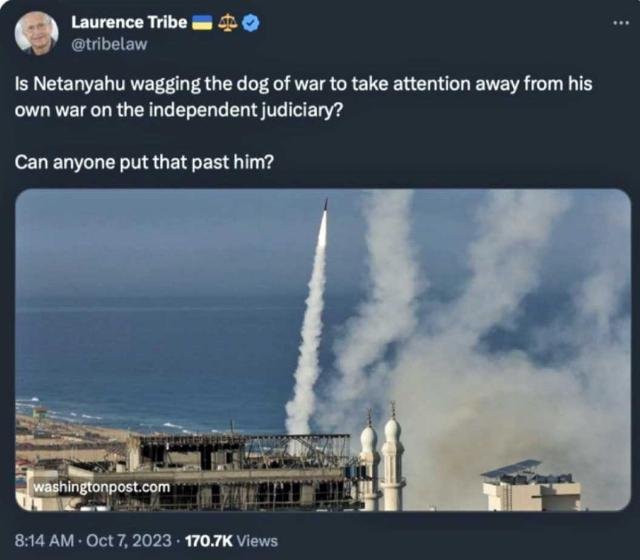
For balance, Topol recalls the domestic turmoil that preceded the attack: months of mass demonstrations with placards reading “Anyone but Bibi!” and “No to Judicial Reform!”; claims that protesters were paid $70 to $100 a day by unnamed private foundations; the Histadrut’s threat of an indefinite general strike unless the elected government halted judicial reform; and 500 military pilots who announced they would not fly in protest against the government he had voted for.
He concedes that none of this emboldened Hamas leader Yahya Sinwar to attack. What did, in his account, was that Netanyahu paid the top brass $25,000 to $27,000 a month but failed to pass along warnings from Egypt, the Emirates, Fatah, and the United States—and failed to count the army’s stocks of underpants, socks, and body armor.
Topol also quotes a progressive Italian newspaper’s editor-in-chief, who wrote that Egypt, the Emirates, Fatah, and the United States “did everything they could to prevent the October 7 massacre,” understanding it would be catastrophic for Palestinians too. If Italy’s editorialists can see that Israel was warned not to save its own civilians but to save Hamas from Israeli fury, Topol asks, then why didn’t the generals who received those warnings—if they believed the government was sabotaging defense preparations—say so publicly and resign in protest? “Is a brigadier general’s salary really worth more than the country’s security?” he asks.
The piece closes with a grim invocation: if the killing of Hamas perpetrators is the product of Netanyahu’s vengeful fury and the author’s own eternal hatred, then, he writes, may that fury be blessed and prolonged. He ends by questioning his own culpability—for having believed that among Israel’s millions of enemies, there were no commanders smarter than Gantz, Eisenkot, and Halevi.
Topol, the author of international bestsellers including Red Square and Submarine U-137, borrows a Reagan-era campaign slogan for his proposed election message: “Our generals running for prime minister left the IDF without its underpants.”
Whether Israeli voters take that message to the polls remains to be seen. But as the third anniversary passes, Topol’s essay captures a persistent fault line in Israeli discourse: the argument over whether October 7 was primarily a political failure, a military one, or—as he contends—both, with the generals’ refusal to resign standing as its own quiet indictment.
Source: www.americanthinker.com — https://www.americanthinker.com/blog/2026/10/who-is-to-blame-that-on-october-7-2023-our-army-was-caught-without-its-underpants/