

When The Athletic published a column calling on the Indiana Fever to move on from guard Sophie Cunningham, the outlet likely expected agreement from a readership that has spent years being told Cunningham is a problem. Instead, according to the American Thinker’s Mike McDaniel, what followed was a public pile-on the likes of which the sports media rarely sees — and one that reveals a widening gap between the people who cover women’s basketball and the people who actually pay to watch it.
McDaniel, writing in an October 10 opinion piece, frames the episode as the moment the WNBA’s paying customers finally had enough. His argument isn’t subtle, but it is specific: the column, by Candace Buckner, described Cunningham as a “combustible” figure whose “turbulent” opinions amounted to a distraction for the Fever. Buckner’s solution was for the franchise to part ways with her so it could “go back to being a basketball team.” McDaniel’s rejoinder is that the stance Buckner calls a distraction is one held by the overwhelming majority of the country, and that treating it as disqualifying is a tell about the people doing the treating.

What Cunningham actually said
Strip away the noise and the underlying controversy is narrow. Cunningham’s most publicized position — that biological males should not compete in women’s sports — came in response to a question during an ESPN interview. McDaniel points out that this is a view shared by most Americans, which is precisely why, in his telling, it drives her critics to distraction. He also notes that tennis great Martina Navratilova has agreed with Cunningham on the issue.
Cunningham’s other offense, per McDaniel, is her willingness to defend Caitlin Clark — the player whose arrival transformed the league’s attendance, television ratings and, consequently, its players’ paychecks. McDaniel argues that the same constituencies that resent Clark resent Cunningham, and for many of the same reasons: popularity, visibility, and a refusal to apologize for either.

He places the broader fight in the context of the WNBA’s refusal to state plainly whether men can play in the league. Former NBA players Enes Kanter Freedom and Royce White, McDaniel writes, declared themselves trans women and entered their names for the WNBA draft specifically to force the league to answer the question. In McDaniel’s account, the league would rather absorb external criticism than endure internal blowback, and that calculation is what keeps the controversy alive.
The Kaepernick comparison
McDaniel leans on commentary from Stephen L. Miller, who attacked the media’s inconsistency on athlete activism. Colin Kaepernick, Miller notes, deliberately inserted himself into the political fray; Cunningham, by contrast, simply answered a question that was put to her. The objection from pundits, in Miller’s framing, isn’t that Cunningham holds big opinions — it’s that she holds the wrong ones.
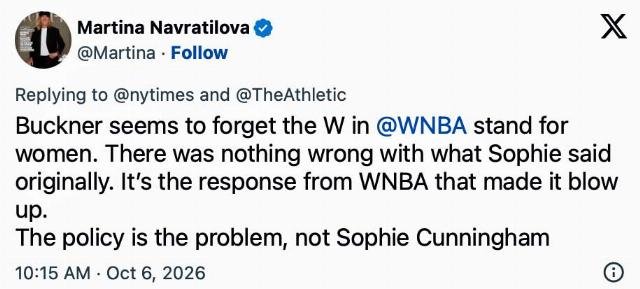
That asymmetry is the column’s central charge. Athletes who align with progressive causes are treated as courageous; athletes who don’t are treated as distractions to be managed. McDaniel extends the argument beyond opinion pages, pointing to claims from players including Angel Reese and Brittney Griner that Fever fans and the league’s newer followers have directed racist abuse at them. His assessment is blunt: no evidence has surfaced that any of it happened. He cites an X post from the account Veritas Explorer that compared the allegations to the Jussie Smollett affair — a reference that will read as pointed to some and inflammatory to others, but which captures the suspicion with which McDaniel and likeminded commentators view the claims.
The jealousy thesis
Where does McDaniel land after all of this? On a single, uncomfortable explanation: jealousy. He argues that Clark and Cunningham have done something their predecessors, coaches and league officials could not — made the WNBA more profitable and more watched — and that this achievement is resented rather than celebrated. The phrase he reaches for is self-defeating: people cutting off their noses to spite their face.
It’s worth being clear about what this piece is and isn’t. McDaniel is not a neutral observer; he’s a conservative commentator writing for a conservative outlet, and his characterization of Cunningham’s critics — he describes the league’s players in terms that many readers will find gratuitously harsh — is advocacy, not reportage. But the underlying dynamic he identifies is real enough to have played out in public: a major sports outlet published a column urging a team to shed a player over her political views, and a substantial slice of the audience reacted as if it had been insulted.
Whether that reaction reflects a 95-5 consensus, as McDaniel claims, or simply the loudest corner of social media is an open question. What isn’t in dispute is that the WNBA’s audience has grown dramatically in the Clark era, that much of that growth is politically heterodox relative to the league’s established fan base and press corps, and that the two groups do not share a set of assumptions about what Cunningham represents.
For the Fever, the practical question is whether a player’s willingness to answer a question honestly is a locker-room problem or a media-relations one. Buckner’s column suggests the former. The reaction McDaniel chronicles suggests a lot of paying customers see it as the latter — and that they are tired of being told otherwise by people who, in their view, wouldn’t have jobs covering the league if not for the very players they’re lecturing.
Source: www.americanthinker.com — https://www.americanthinker.com/blog/2026/10/sophie-cunningham-drives-the-woke-crazy-which-is-a-good-thing/