
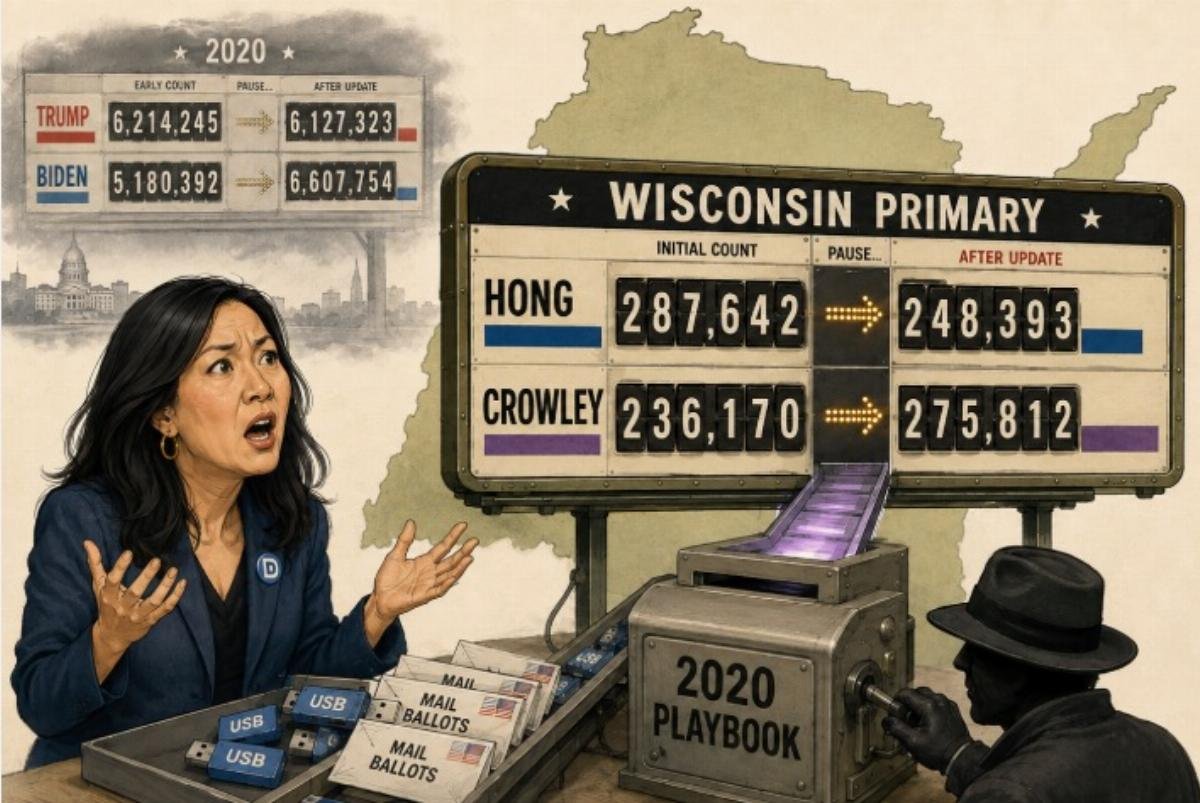
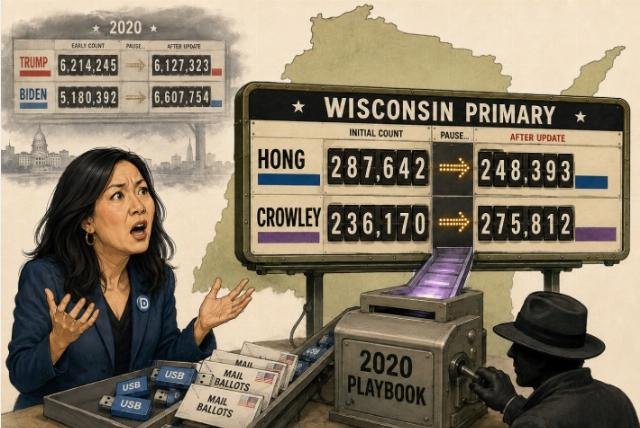
In the hours before Wisconsin’s Democratic gubernatorial primary, Francesca Hong appeared to be cruising. Polls had her up by 30 points over David Crowley. Prediction markets agreed. Then, according to a series of social media posts cited by American Thinker’s Andrea Widburg, the votes on five of nine USB cards arriving at Milwaukee election headquarters were missing—attributed to “human error.” Suddenly, Hong was losing.
Widburg, writing for the conservative outlet American Thinker, argues the pattern is eerily familiar to what she calls the “2020 Donald Trump treatment”—a scenario in which a candidate appears to be winning, vote counting mysteriously pauses, and then late ballot dumps reverse the outcome.
“Yesterday, Hong was winning until, magically, she was losing,” Widburg writes. “It was a familiar story.”
The comparison rests on a set of contested claims about the 2020 presidential election, which Democrats and mainstream observers have consistently rejected as baseless. Widburg, however, defends the parallel, pointing to data circulating on social media that showed Trump leading in Pennsylvania, Georgia, Michigan, Wisconsin, North Carolina, and other swing states just before counting stopped—only for Biden to take the lead after a long pause and the arrival of additional ballots.
“Just before swing states suddenly stopped counting, Trump led in PA by 682,000 votes (15.2%), GA by 311,000 (7.5%), MI by 307,000 (9.6%), WI by 128,000 (4.9%), NC by 77,000 (1.4%),” one tweet cited in the piece reads. “Then vans showed up full of ballots and counting continued in secret.”
Widburg acknowledges that the official explanation—that mail-in ballots in those states were simply late and could only be counted after a lengthy pause—was “possible but certainly not probable.” She notes that since Trump returned to office and began what she describes as “turning over rocks,” the matter has drawn renewed scrutiny, though no evidence has been produced to substantiate claims of systematic fraud.
The Hong-Crowley race and the USB drive claims
The current controversy centers on the Wisconsin Democratic primary, where Hong, a state representative aligned with the Democratic Socialists of America, was widely expected to win the nomination for governor. Instead, David Crowley, a candidate who polling suggested was trailing significantly, emerged victorious after election officials reported irregularities with USB cards containing vote data.
One tweet included in the American Thinker piece claims: “ELECTION INTEGRITY? The prediction market and the pollsters BOTH predicted that Francesca Hong would win the Democrat primary for Wisconsin Governor. At the last minute, the necessary votes were found on USB drives, and David Crowley, a candidate that no one thought had a…”
Another post referenced in the article states: “BREAKING: 5 of 9 USB Cards Arrive at Milwaukee Election Headquarters with NO Election Vote Totals, Claiming ‘Human Error.'” The tweet goes on to note Hong’s double-digit polling lead and asks, “We’ve heard this all before.”
Widburg does not provide independent verification of these claims, nor does she name the officials responsible for the alleged errors. Instead, she frames the incident as part of a broader political pattern: the Democratic Party, she argues, would have strong motivation to prevent a “crazed communist” like Hong from representing the party in a general election where moderate voters might be alienated.
“Ordinary Americans are not thrilled with the hard left, and Hong would have damaged the brand even more,” Widburg writes.
A familiar accusation: ‘election denier’
If Hong contests the result, Widburg predicts she will face the same treatment she says Trump endured after 2020: being branded an “election denier” or worse. “My take: Hong won yesterday, just as Trump won in 2020,” she writes. “But if she fights back, she’ll find herself in the same boat as Trump, being called an election denier or worse.”
The piece stops short of offering concrete evidence of fraud in the Hong-Crowley race. It relies instead on the structural similarity between 2020 and 2026—the timing of the vote count interruption, the appearance of late ballots, and the political stakes for the party in control.
Widburg also invokes the phrase “the Donald Trump treatment” as a shorthand for what she sees as a coordinated effort by Democrats to use election administration to their advantage in states they control. She cites mail-in voting, ballot harvesting, and the abandonment of voter ID requirements as tactics that, in her view, “legalized election fraud”—a claim that election officials and courts have repeatedly rejected.
As of this writing, no official investigation has been announced into the Wisconsin primary irregularities. Hong has not publicly commented on the USB card reports, and Crowley’s campaign has not responded to requests for comment.
Whether the similarities between 2020 and 2026 are coincidence or something more sinister, Widburg leaves little doubt about her conclusion: “The Democrat party could not let Trump have a second term, and it cannot risk the blowback from having a crazed communist like Hong representing the Democrat party on the Wisconsin gubernatorial ballot this November.”
For now, the election integrity questions linger—and the ghost of 2020 looms large over Wisconsin’s latest political shock.
Source: www.americanthinker.com — https://www.americanthinker.com/blog/2026/08/did-francesca-hong-get-the-2020-donald-trump-treatment/