

The Jefferson County Public Schools in Golden, Colorado, have become the latest frontline in the national fight over transgender athletes, and American Thinker’s Mike McDaniel thinks the district has picked a losing hill to die on. In an October 18 column, McDaniel frames the dispute as a test of what he calls the “Trans Superiority Narrative”—a set of assumptions he says Democrats treat as articles of faith, including the idea that there are no meaningful athletic differences between boys and girls, and that transgender inclusion never displaces female athletes.
The Jeffco case, he argues, undercuts both claims at once.
The Volleyball Roster That Started the Fight
The flashpoint came at Dakota Ridge High School, where four parents of student-athletes demanded answers after a transgender player was allowed to join the girls’ junior varsity volleyball team while, by their account, eight girls were cut from the roster. One mother, who spoke to Fox News Digital on condition of anonymity, said her daughter had made the sophomore team as a freshman and was devastated to be cut this season.
According to that reporting, the coach explained in writing that other athletes had “demonstrated more consistency in the areas needed” and that the mother’s daughter “was beat out.” The family later learned that an athlete selected as setter on the girls’ team is transgender, which prompted questions about whether that inclusion affected her daughter’s opportunity. The mother told Fox News Digital that roughly 35 or more girls, including her daughter, didn’t make the team while a transgender player did.
McDaniel concedes the obvious: sports are meritocratic by nature, and some kids make the team while others don’t. He notes the irony that the same political coalition pushing to dismantle gifted and talented programs over hurt feelings has no comparable concern for athletes who fail to make varsity—because that’s simply how competition works. What makes this case different, in his telling, is that it exposes the gap between the rhetoric used to defend transgender inclusion and the practical results.
Two Arguments, One Roster Spot
The columnist takes aim at two recurring arguments. The first is that men and women are physically equivalent and that athletic differences are negligible. McDaniel says he already addressed that in an earlier piece about a male runner who transitioned and began winning girls’ races, taking second in one competition—a finish that, he says, would have been 137th had the athlete competed against boys at the same event.
The second argument is that transgender girls don’t displace female athletes, because trans girls are girls. The Jeffco situation, McDaniel writes, shows a trans boy denying a girl a place on the volleyball team. He attributes that outcome to a competitive calculation: the district and its coach, he argues, want to win badly enough to ignore the girls in front of them, and a biological male on the court offers an advantage.
That framing is contested territory, and the column doesn’t pretend otherwise—it’s an opinion piece built around a single district’s controversy. But the underlying facts it cites are drawn from public reporting and federal findings, not speculation.

The Federal Warnings
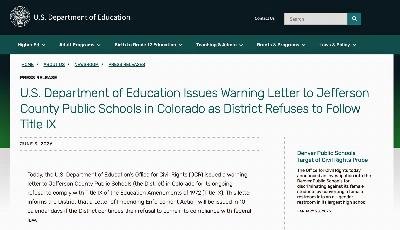
In March, the Department of Education’s Office for Civil Rights moved against the district after it refused to comply with federal law, referring the matter to the Department of Justice. McDaniel quotes the OCR’s announcement directly: the office “concluded that Jefferson County’s policies allowing access to intimate facilities and participation in sports based on ‘gender identity’ discriminates against females by denying them safety, dignity, and equal access to educational programs and activities.”
The most striking number in the release is one the columnist returns to more than once. According to the OCR, athletic rosters received from the district indicated that male students could occupy up to 61 roster positions on girls’ sports teams. For McDaniel, that figure is the case in miniature—proof, in his view, that the district’s competitive ambitions and its ideological commitments are colliding with the stated goals of the policy’s defenders.
The OCR has reportedly opened a second Title IX investigation, this one centered on allegations that district employees sexually harassed students.
A National Battleground, Local Stakes
McDaniel is careful to note that Jeffco isn’t unique. School districts, states, and universities across the country are navigating the same terrain, with some blue jurisdictions opting to follow federal law rather than risk losing federal funding. What sets Jefferson County apart, in his account, is its willingness to absorb the consequences rather than change course—hence the “die on that hill” framing of his headline.
The Trump administration, he writes, doesn’t recognize the narrative he’s describing at all, and the March warning gave the district ten days to comply. Whether it does, and what happens to the 61 roster spots and the families behind those cut lists if it doesn’t, is the question the column leaves hanging.
For readers sympathetic to McDaniel’s position, the Jeffco story is a clean illustration: a girl loses a spot, a district digs in, and a federal agency supplies the numbers. For critics, the column flattens a complicated policy debate into a single narrative and leans heavily on one anonymous parent’s account. Either way, the dispute in Golden is no longer just about a junior varsity volleyball roster—it’s a test case for how far a school district can go in resisting federal civil rights enforcement, and what that resistance costs the female athletes caught in the middle.
Source: www.americanthinker.com — https://www.americanthinker.com/blog/2026/10/jeffco-public-schools-ready-to-die-on-the-trans-hill/