

Joni Mitchell spent more than six decades living in the United States on legal terms, and this week she made it official: she is an American citizen. According to American Thinker’s Mike McDaniel, the Canadian-born songwriter announced the news herself on social media, posting a short video of her name being called at what appeared to be a small naturalization ceremony at a Department of Homeland Security office, along with a photo of her holding a small American flag in front of larger U.S. and DHS banners.
The reaction, McDaniel writes, split sharply — congratulations from Americans happy to welcome a new citizen, and a barrage of criticism from those who saw the decision as a political statement, a betrayal, or both.
A lifetime of living here, finally formalized
McDaniel opens his commentary by grounding the story in personal affection. “Both Sides Now” was part of the soundtrack of his youth, and he recalls playing it and taking it to heart without worrying about social commentary or hidden meaning. Lines like “they paved paradise and put up a parking lot” struck him as witty and delightful. He admits he knew little about Mitchell’s life offstage and says that didn’t matter — until he learned she had become an American citizen after living in the country legally for 62 years.

That detail is the hinge of his piece. Mitchell’s decision, he argues, was not impulsive. It came after a long lifetime spent comparing two countries, and McDaniel reads it as a considered choice rather than a casual one.
He also draws on his own experience attending naturalization ceremonies, describing each one as a moment when his “heart swelled with pride.” The people he watched take the oath, he writes, came from all over the world because they recognized America as the best nation on Earth. They learned English, learned American history better than many native-born Americans ever will, and waved little flags through tears — grateful, in his telling, because they understood they had won “life’s lottery.”
The backlash
Not everyone saw it that way. McDaniel reports that Mitchell’s announcement drew immediate hostility online, and he quotes several responses to illustrate the point. One user wrote, “Willingly applying for American citizenship at this moment in history…oh MAGA Mitchell.” Another called the move “tone deaf.” A third declared, “Off my playlist!”

Some of the sharpest reactions invoked Canadian nationalism directly. “Haha traitor elbows up!” one commenter wrote — a reference to the “elbows up” slogan that circulated in Canada during recent trade tensions with the United States. Another sniffed, “I don’t think many Canadians are happy for you on this achievement,” before conceding, “Though we still love your music.”
McDaniel’s framing of this reaction is pointed. He writes that Democrats “always eat their own” and hold a special rage for foreigners who become American, as though naturalization were “a special kind of treason.” He acknowledges he doesn’t know Mitchell’s politics and says he doesn’t care, though he notes the source material he reviewed suggests — without confirming — that she is no Republican.
The case for choosing America
The heart of McDaniel’s argument is a comparison between the two countries Mitchell has known. As a Canadian, he writes, she experienced free health care for all — and, like many Canadians, chose to pay for what he calls the best health care in the world in America. She experienced Canadian taxes, which he argues reveal that the country’s health care “isn’t free after all.” And she experienced what he describes as a lack of freedom of speech and other liberties in Canada, choosing instead a country where, in his view, people are not persecuted for speaking freely — “despite the worst efforts of Democrats.”
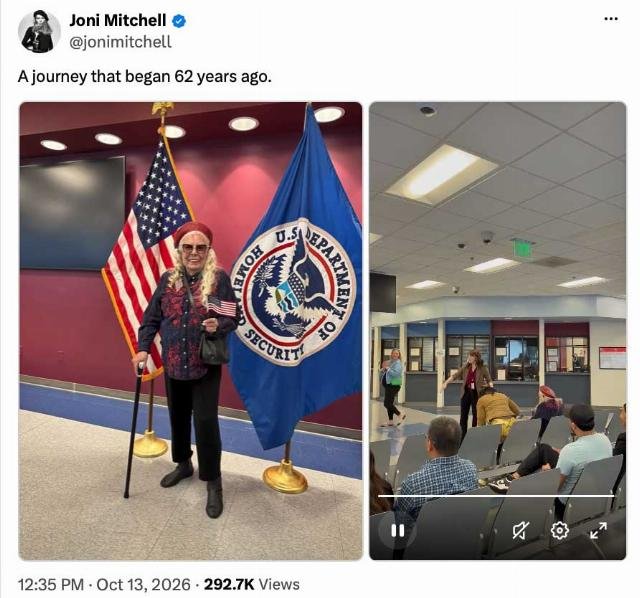
Whatever her political leanings, McDaniel concludes, the choice to live and die American after 62 years suggests at least some appreciation for the country, its people, and the opportunities and comforts it provides. That, he suggests, should be more than enough.
Plenty of welcome, too
The picture McDaniel paints is not uniformly hostile. He notes that congratulatory messages poured in as well, from Americans happy to welcome her regardless of ideological differences. In his view, an immigrant who is glad to be here and who followed the correct legal process to obtain citizenship is something worth celebrating these days — and many did exactly that.
Even Mitchell’s ex-boyfriend Graham Nash weighed in, offering a cheerful “Congrats, Joan! Just in time to vote!” — a reminder that the singer, born Roberta Joan Anderson, has been known by many names across a career that made her one of the defining voices of her generation.
McDaniel closes with a welcome and a warning in the same breath: “Welcome to America, Joni. We’re glad to have you, and don’t worry. Normal Americans don’t eat their own. Don’t vote to turn America into Canada if you want to keep it that way.”
The piece lands at a moment when questions of citizenship, immigration, and national identity are sharply contested in American politics. Mitchell’s case is unusual chiefly for its timeline — six decades of legal residence before taking the oath — and for the fact that a decision so personal became, almost instantly, a proxy argument about politics. For McDaniel, the lesson is simple: a new citizen who is happy to be here deserves a welcome, not a playlist purge.
Whether Mitchell intended her naturalization as a statement or simply as a culmination of a life lived largely in California is something she has not said publicly, at least not in the material McDaniel cites. What is clear is that a 62-year wait ended this week at a DHS office, with a small flag and a name called out — and that the internet, as usual, had opinions.
Source: www.americanthinker.com — https://www.americanthinker.com/blog/2026/10/joni-mitchell-looks-at-citizenship-from-both-sides-now/