
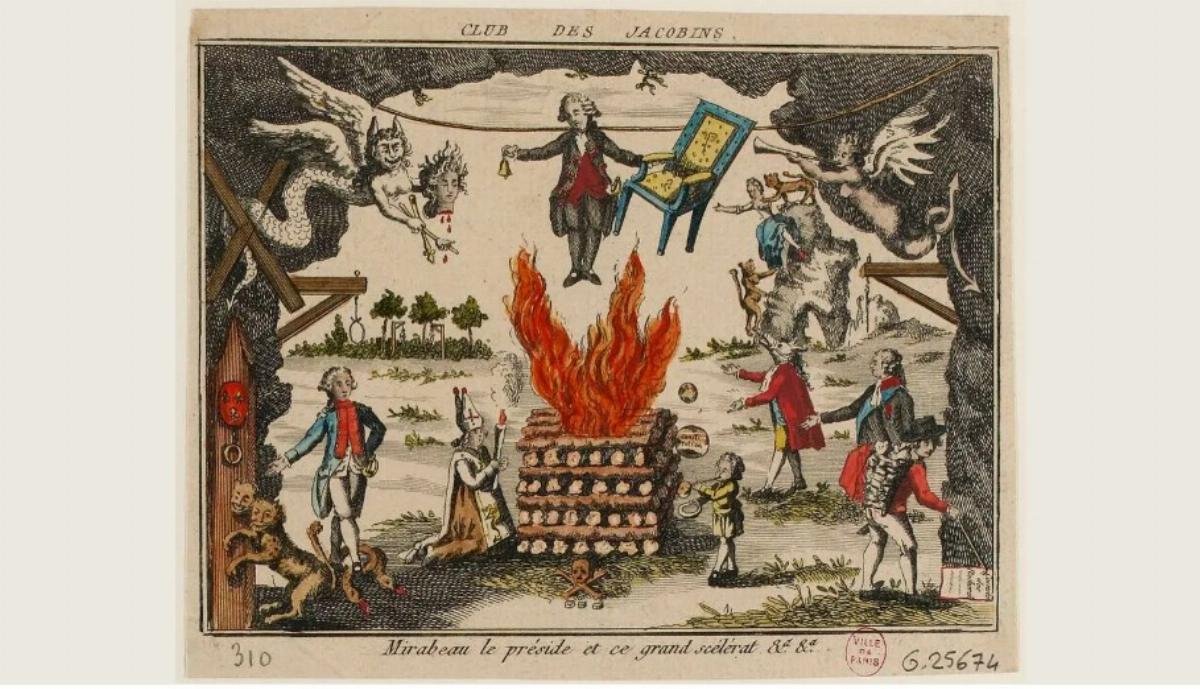
Eric Utter is not hedging. In an October 20 commentary for American Thinker, he opens with the guillotines — noting there aren’t any this time — and then declares that Paris, once again, is “on the brink of falling.” What follows is a sprawling, furious essay that treats the unrest in France as the front line of an existential struggle, and that, whatever one makes of its conclusions, is worth reading as a window into how one strand of conservative commentary is framing events in Western Europe.
The piece, headlined “France falling to the new Jacobins?” and filed under the outlet’s Foreign Policy/France vertical, draws on reporting he attributes to Fox News. According to Utter, a Fox News investigation found that 54 radical groups were involved in the disturbances, “very few of them ‘students’ as the media has been reporting.” That tally is the piece’s central evidentiary hook — the one concrete, sourced number in an argument otherwise built on historical analogy and cultural alarm.
Who he blames, and who he doesn’t
Utter describes those attacking Paris and other major French cities as “a mix of leftists/communists, disaffected youth, antifa, and Muslims” — and tells readers to emphasize the first and last of those categories. He insists the attacks are “anything but spontaneous,” describing them as “fomented, planned, and funded by various subversive groups that are determined to bring about the destruction of the Western democracies.” He does not name those groups, and the source material provides no further detail on them.
The historical frame is explicit throughout. Utter invokes the Jacobins of the French Revolution in his title, asks how long the Fifth Republic can last, and raises the specter of “a new version of Vichy France” — a comparison he reaches quickly and without much qualification. He says that “things couldn’t get much worse for Jews in France as it is,” though he offers no data or specifics to support that claim in the piece.
The wider argument widens further still. “There is simply no doubt that Europe and America are under assault,” he writes, adding that some politicians “don’t appear to realize it” while others “embrace it.”
The prescription: three steps, no small print
Utter lays out what he calls the necessary response in a series of points, and he is careful to claim it can be done without catastrophe. The New Jacobins, as he calls them, are “determined, well-funded, and crazy,” but he argues that “we can still save our societies without need of massive bloodshed or truly large-scale suffering” — a concession followed almost immediately by a warning: “the same could’ve been said in 1937 or 1938.”
First, he writes, “we must see clearly and think rationally and soberly about what lies ahead if we stay on our current path of appeasement.” He defines that path as “worshiping only at the altars of political correctness, multiculturalism and tolerance of everything but standards and tradition,” which he says “will inevitably lead to our demise.” Second, he urges readers to accept that “earth isn’t a utopia” — that nothing is free, and that pain and confrontation are at times unavoidable. “When we choose to do nothing, pain will find us,” he writes. Third, he insists that “evil exists … and always will,” and that “decent people only add to this evil when they consciously refuse to judge it so.” His conclusion to that sequence is blunt: it is time to “put down our smartphones and stare reality in its face … or reality will slap us in the face ala 1939.”
Demography as destiny
The essay’s argument about immigration is its most expansive and its most contentious. Utter asserts flatly that “Europe cannot possibly survive the continued onslaught of Muslim immigrants,” reasoning that higher fertility rates will eventually “simply subsume existing European cultures.” He extends the claim to Canada, writing that when Prime Minister Carney says “Muslim values” are “Canadian values,” he is “simply informing Canadians what their future holds.”
He cites changing numbers of Muslim-majority states — roughly five in 1900, about 22 in 1955, and 53 today — as evidence of a long historical arc, and asks whether the “City of Lights” or Western Civilization itself will “go dark again.”
He argues that Western nations have “bent over backward to accommodate- and not offend- Muslim minorities,” in some cases changing their own behavior to avoid appearing “rigid or superior,” and asks what happens when Muslims become majorities. His answer: anyone who has read the Koran and knows “even a little about Sharia law” understands it is “utterly and absolutely incompatible with a free and open society.” He anticipates the charge of bigotry and rejects it in advance — “That isn’t racism, intolerance, or bigotry, it is a simple fact” — calling it instead “the defining issue of our time.”
The rhetorical peak comes as a catalog of what he says is at stake: the countries that produced the Enlightenment, the Magna Carta, the Sistine Chapel, Beethoven and the Louvre, and that discovered America. Both “historic Christendom and modern secular Europe,” he warns, “will be eviscerated if they cannot find the will to defend themselves.”
He closes with a direct address to Europeans — “toughen up” — and a dismissal of accusations of racism as “projection.” So-called “progressives,” he writes, are “the biggest threat to Europe, Australia, Canada … and the U.S.,” intolerant of dissent even as they “glory in the decline and fall of the countries they infest. And attack.” The essay ends on a call for free speech, which he calls “crucial to the republic we cherish.”
What the piece is, and what it isn’t
It should be said plainly: this is a commentary, not a dispatch. The only piece of outside reporting it leans on is the Fox News figure of 54 radical groups; the rest is assertion, analogy and prescription. Readers looking for a factual account of events in France will not find one here, and the essay names no specific groups, offers no dates or casualty figures, and provides no citations for its demographic claims or its assertions about anti-Semitism in France.
What it does offer is a clear statement of a position that is increasingly audible on the right — that Europe’s unrest and its demographics are one story, that appeasement is the enemy, and that the moment for decisive action is now. Utter’s answer to his own closing question, about whether the City of Lights will go dark, is left implicit. His readers are clearly meant to supply it.
Source: www.americanthinker.com — https://www.americanthinker.com/blog/2026/10/france-falling-to-the-new-jacobins/