
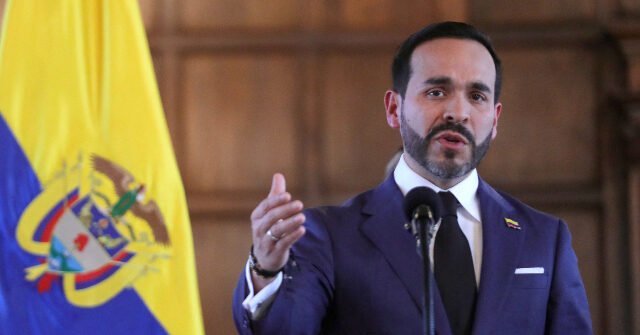
Colombian President Abelardo de la Espriella declared a state of economic emergency Wednesday night, invoking constitutional powers to accelerate the nation’s recovery from a devastating earthquake that struck earlier this week. The move, announced alongside First Lady Ana Lucía Pineda, comes as the country grapples with mounting casualties and widespread infrastructure damage.
The magnitude 7.4 earthquake hit Colombia on Monday morning, and according to the latest official figures cited by the president, it has affected 53,816 individuals across 25,872 families. At least 265 people have been confirmed dead, with nearly 3,500 injured and 496 still listed as missing. De la Espriella emphasized that search-and-rescue operations remain focused on locating all missing persons.
Scope of Destruction
The president detailed the sheer scale of the destruction during his Wednesday night address. More than 11,000 households were completely destroyed, and over 53,000 suffered damage. The quake toppled 140 buildings and inflicted damage on 1,819 educational centers, 631 community centers, and 179 healthcare facilities. Roads, aqueducts, and five airports also sustained structural damage.
According to Noticias RCN, the cities of Cali, Pereira, Quindío, Manizales, and Armenia are the hardest hit, with most confirmed deaths occurring in Cali and Pereira. As of Thursday morning, 335 people had been rescued across the country since the quake struck.
Fiscal Crisis Complicates Response
De la Espriella, who took office just last Friday, stressed that the natural disaster arrives at a precarious economic moment. He described Colombia as facing the “most complex” fiscal crisis in its republican history, characterized by high debt levels, dwindling treasury resources, and an “absolutely underfunded” public budget.
That backdrop makes the emergency declaration—a power granted under Article 215 of Colombia’s constitution—particularly significant. The provision allows the president to issue law-like decrees to address emergency-specific matters, provided they are temporary and ultimately subject to review by Congress and the Constitutional Court. Each declaration can last up to 30 days, with a maximum of 90 days per year.
De la Espriella first used those powers to propose the creation of a “Miracle Fund,” a dedicated entity designed to channel national and international contributions toward rebuilding hospitals, schools, roads, and airports damaged by the quake.
Temporary Relief Measures
In addition to the fund, the administration is weighing a series of temporary relief measures. These include exceptions on public utility payments for affected families, rent subsidies for those who lost their homes, tax relief, and economic assistance for households and small businesses. The president also said the emergency declaration would include measures to stimulate investment, streamline project development, and create jobs in affected areas.
“By declaring a state of emergency, the national government sends a clear message of commitment to prioritizing and effectively addressing the needs of the victims and rebuilding the territories struck by the disaster that has plunged the nation into mourning,” he said. “Our hearts and our solidarity are with the victims; you are not alone. Here is a government that will help you and lend you a hand.”
Precedent and Time Constraints
The emergency declaration follows a recent precedent. According to Argentine outlet Infobae, the previous administration of Marxist President Gustavo Petro used the same constitutional provision for 30 days in February to deal with an emergency caused by intense rains. That usage matters because it reduces the time available to de la Espriella this year—from the full 90 days to just 60.
Lorena Gutiérrez, dean of the Faculty of Economic and Administrative Sciences at the University of San Buenaventura in Bogotá, told Infobae that the constraint forces prioritization. “Thirty days are enough for immediate response and arranging financing, but reconstruction will have to proceed through standard channels, involving a budget and legislation,” she reportedly said.
The declaration marks a defining early test for de la Espriella, whose administration is only days old. How effectively he can leverage the emergency powers—and how quickly the Miracle Fund can mobilize resources—will likely shape public perception of his government’s ability to lead the country through both a natural disaster and an economic crisis.
Source: www.breitbart.com — https://www.breitbart.com/latin-america/2026/08/13/abelardo-de-la-espriella-declares-economic-emergency-colombia-over-earthquake/