
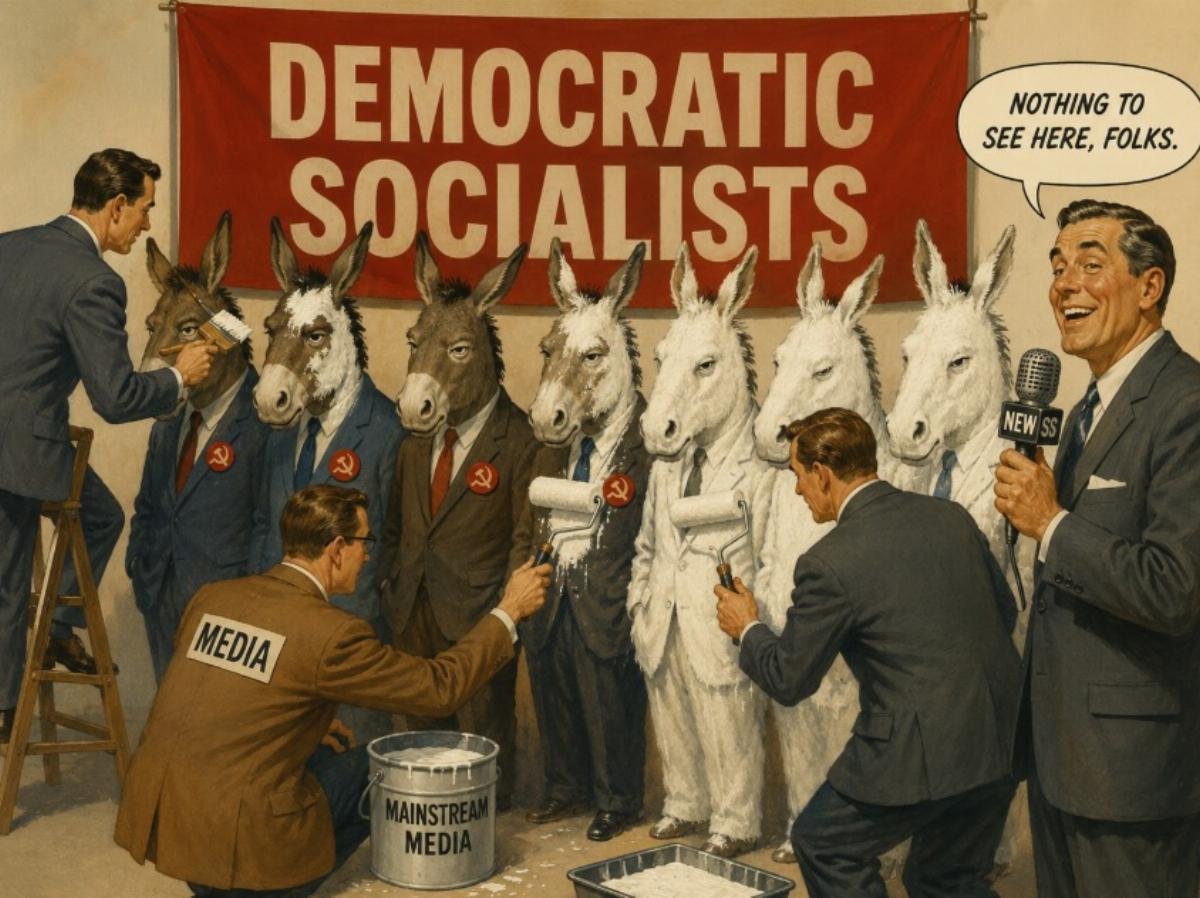
In the run-up to the midterm elections, the media and Democratic leaders are working hard to draw a bright line between mainstream Democrats and the Democratic Socialists of America. But a recent episode on Capitol Hill suggests that line is getting awfully blurry.
According to a report from American Thinker, centrist House Democrats circulated a “Promise to America” that included a simple declaration: “We are capitalist, not socialist.” The result was striking — only 10 of the 212 House Democrats signed it. That leaves 202 Democrats who declined to affirm their capitalist bona fides.
To be clear, declining to sign a pledge doesn’t prove those 202 lawmakers are socialists. But it does raise an obvious question: Why would nearly every House Democrat refuse to state plainly that they are not socialist?
The DSA’s Blueprint for Government
Part of the answer may lie in the overlap between the DSA’s platform and policies championed by many Democrats. The DSA itself is explicit about its goals. Its current program calls for universal health care “at no cost” to individuals, free education from pre-K through college, cancellation of all student debt, a 32-hour work week with full pay and benefits, a federal jobs guarantee, massive publicly owned energy and transit infrastructure, and a phase-out of fossil fuels.
These proposals would require an enormous expansion of government and carry a substantial price tag — a fact that articles explaining democratic socialism often gloss over in favor of touting the promised benefits.
The DSA also advocates for sweeping changes to the justice system, including demilitarizing police departments and redirecting police funding as steps toward “fully abolishing the police and prison system.” It calls for abolishing ICE detention and deportations, granting amnesty to all undocumented immigrants regardless of status, ending visa caps and quotas, extending voting rights to all permanent residents, and restoring voting rights to incarcerated individuals.

But perhaps the most radical proposals concern the structure of American government itself. The DSA wants to abolish the Electoral College, abolish the Senate, and replace the president and the Supreme Court with an executive and judiciary chosen by and subordinate to Congress.
It’s worth pausing on that for a moment. Imagine the media reaction if a Republican organization published a platform calling for eliminating the Senate, gutting the presidency, and making the Supreme Court answerable to Congress. The response would be swift and harsh. Yet when the DSA says these things, the coverage tends to be more forgiving.
Media’s Soft Pedal
The media’s approach was on display in a recent USA Today article titled “Democratic Socialism: What it is, what it isn’t,” which American Thinker highlighted. The piece opened by attacking Republicans for using the terms “socialist” and “communist” to describe Democratic Socialists, even comparing such rhetoric to McCarthyism.
The authors then reassured readers that Democratic Socialists aren’t authoritarians, citing the DSA’s own rejection of “authoritarian visions of socialism.” But as American Thinker notes, asking the DSA whether the DSA is authoritarian may not be the most reliable test. A more useful approach is to look at what the organization actually wants — which includes dismantling core institutions of American democracy.
That doesn’t stop the media from describing DSA supporters as “progressives” and insisting their ideas aren’t radical. Meanwhile, the same outlets spend considerable energy calling President Trump an authoritarian, a fascist, a dictator, and a king.
Policy Overlap
While not every Democrat supports every DSA position, there is significant overlap on key issues. Democrats have pushed for greater government involvement in health care, massive subsidies for green energy, student loan forgiveness, higher taxes, more regulation of the economy, expanded benefits, and restrictions on fossil fuels. Many Democrats support sanctuary jurisdictions, and the party’s left wing has repeatedly sought to reduce immigration enforcement.
On the electoral front, Democrats claim to support the little guy, but a substantial portion of the party wants to eliminate the Electoral College — a system that gives voters in smaller states some protection against being dominated by the largest population centers. The DSA goes further, calling for abolishing the Senate entirely.
On climate, the DSA’s Green New Deal envisions a government-directed transformation of the economy and the end of fossil fuels. Democrats may disagree on pace and implementation, but restricting fossil fuels and heavily subsidizing favored energy sources have become mainstream positions in the party.
Democrats also increasingly talk as though government can make college, daycare, and health care “free.” But these things aren’t free — the costs are simply shifted to taxpayers. Government subsidies tend to distort prices, separating the person receiving a service from its actual cost.
There are also tensions with the party’s stated support for poor and working-class families. Despite that rhetoric, the party remains closely allied with teachers’ unions that fight school-choice programs, which would give poor parents alternatives to failing public schools. And on social issues like abortion and men in women’s sports, the party’s left wing holds positions well outside the views of much of the public.
What It Adds Up To
The point isn’t that every Democrat has joined the DSA or endorses every line of its platform. They haven’t. The more interesting question — the one American Thinker raises — is why the differences between Democratic Socialists and supposedly mainstream Democrats keep shrinking. And why did nearly every House Democrat just decline an opportunity to say, plainly, “We are capitalist, not socialist”?
The media certainly knows what the DSA platform says. Yet the coverage tends to treat democratic socialism as a benign label rather than a radical agenda. The irony is hard to miss: a party that claims to defend democracy is increasingly open to abolishing the Senate and the Electoral College, while its leaders call the former president an authoritarian for advocating smaller government and lower taxes.
During Trump’s first term, before the pandemic disrupted the economy, median household income hit a record high and the official poverty rate fell to a record low in 2019 — evidence, American Thinker argues, of capitalism’s capacity to generate prosperity. Democratic Socialists want to replace that system with one giving government vastly greater control over economic life.
Whether that trade-off is worth it is a question voters will answer. But the media should stop pretending that those who walk and talk like socialists aren’t, in fact, socialists.
Source: www.americanthinker.com — https://www.americanthinker.com/articles/2026/08/if-democrats-walk-like-socialisst-and-talk-like-socialists-maybe-they-re-socialists/