
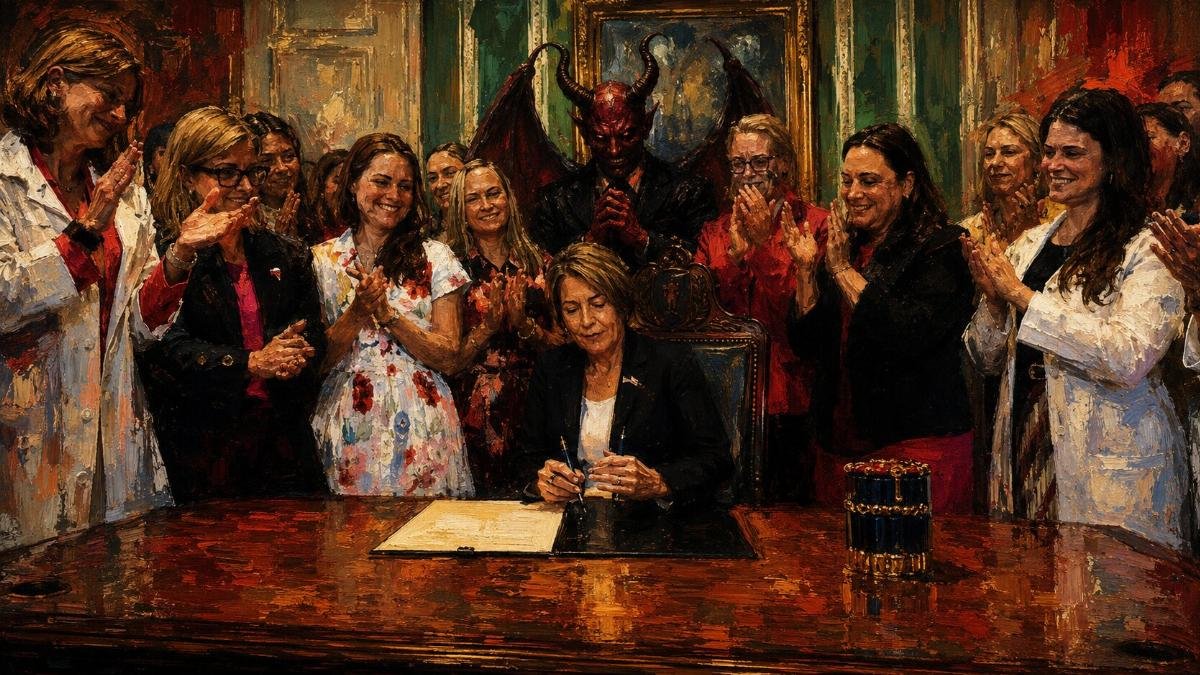
When Massachusetts Gov. Maura Healey signed a bill this month removing gestational age limits on abortion, the image of a cheering crowd of young women went viral. But for conservative commentator Thom Nickels, writing in American Thinker, the scene evoked something far darker: a “witches’ sabbath” and a resurrection of Salem’s demonic spirit.
Nickels, whose essay is titled “The witches of Salem are back, and they’re signing abortion bills,” draws a direct line from the 1692 witch trials to the state’s new law, which he calls “legalized baby murder.” The comparison is intentionally provocative, tying the state’s history of religious persecution to what he sees as a modern moral failing.
The law and its context
The bill in question, officially the Prioritizing Patient Access to Care Act, removes gestational age limits on abortion in Massachusetts, joining a growing list of states—Alaska, Colorado, Maryland, Michigan, Minnesota, New Jersey, New Mexico, Oregon, Vermont, and the District of Columbia—that allow abortion later in pregnancy. Under the new law, health care personnel will have greater discretion to determine whether to perform such procedures without facing legal penalties under the state’s previous restrictions.
Healey, the 73rd governor of Massachusetts and the first woman and open lesbian to hold the office, has framed the law as a matter of reproductive rights. In a 2024 interview with Politico, she said, “I’ve taken very strong positions when it comes to standing up for LGBTQ+ equality, to standing up for women’s access to reproductive health care, to supporting abortion rights in this country, and I believe very strongly in all of those. To me, it doesn’t make me any less of a Catholic or detract from my relationship to my faith.”
A Catholic governor under fire
Healey’s Catholicism is central to the controversy. She has described herself as a devout Catholic, citing her mother’s daily Mass attendance. But critics like Nickels argue that Healey is a “cafeteria Catholic,” picking and choosing which doctrines to follow. The law has prompted calls from some American Catholics for Healey to be excommunicated or at least barred from receiving Holy Communion.
Archbishop of Boston Richard Henning called Healey’s action “a grave offense against the sanctity and dignity of every person,” and Bishop Robert Barron also spoke out against the governor. Nickels argues that a stronger, united response from U.S. bishops is needed, though he doubts it will come. He notes that in 2024, Healey was invited to the Vatican to participate in a climate change summit, where she met Pope Francis and received a rosary—a gesture he suggests undermines any upcoming ecclesiastical penalty.
The Salem connection
The Salem thread runs throughout Nickels’ piece. Healey’s lieutenant governor, Kim Driscoll, was once mayor of Salem, serving from 2006 to 2023. During her tenure, Driscoll advocated for the official exoneration of Elizabeth Johnson Jr., the last remaining person convicted in the 1692 witch trials. Nickels uses this history to cast the state’s leadership as a modern-day matriarchy—or, as he puts it, “witchcraft.”
He also takes aim at Healey personally, describing her face as “resembling something of a dried parchment, or an arid map a world away from flesh and blood of birthing motherhood.” Healey is a stepmother to her partner’s children, a fact Nickels uses to question her authority on reproductive issues, arguing she has never experienced the “ethos of true motherhood.”
National implications
The law has also reignited a national debate over abortion policy. Marjorie Dannenfelser, president of SBA Pro-Life America, condemned Healey, stating that late-term abortions can involve dismemberment of the fetus. “It should shock the conscience that tens of thousands of unborn Americans are barbarically dismembered limb by limb and torn apart every single year,” Dannenfelser said. “Sadly, that number will only increase with Gov. Healey’s approval of the Abortion Up Until Birth Bill.”
Dannenfelser also called on the GOP to abandon its “leave it to the states” position, arguing that the Massachusetts law demonstrates the need for national protections for unborn children. That shift, if adopted, would represent a significant change in Republican strategy since the overturning of Roe v. Wade.
Reactions and pushback
Nickels’ essay is unapologetically polemical, and its tone has drawn both support and criticism. Some social media users echoed his description of the signing ceremony, noting that “these happy women were cheering and applauding as if they had won the lottery.” Others have condemned the piece as inflammatory and misogynistic, pointing out that the comparison to witches trivializes the real victims of the Salem trials.
The debate over Massachusetts’ new law is far from over. As Healey faces calls for excommunication and national Republicans debate their next steps, the question of who gets to decide the limits of abortion—and who gets to speak for the Catholic faith—remains as contentious as ever.
This article is based on an opinion piece by Thom Nickels published in American Thinker on August 14, 2026.
Source: www.americanthinker.com — https://www.americanthinker.com/blog/2026/08/the-witches-of-salem-are-back-and-they-re-signing-abortion-bills/