
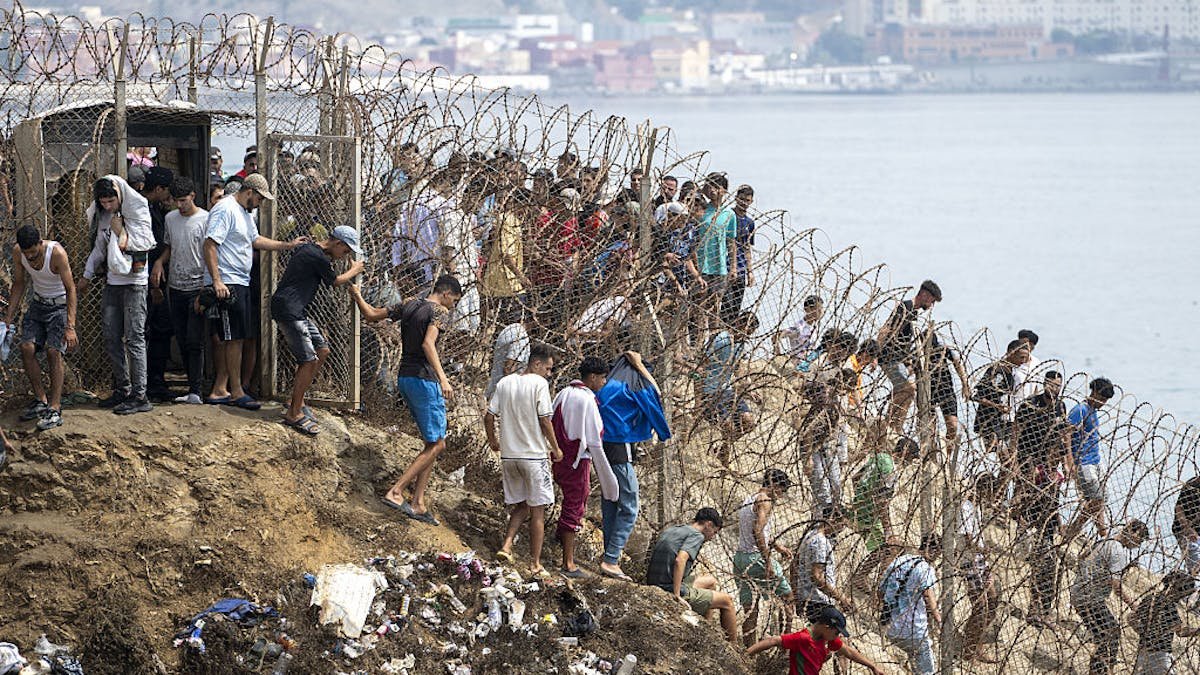
Spanish and Moroccan authorities have moved to shore up security around Ceuta, Spain’s North African enclave, after calls circulated on social media for another mass migrant crossing — just two weeks after a desperate border rush left at least 96 people dead.
According to Reuters, Spanish soldiers have been stationed to watch over commercial and government buildings in Ceuta, while police are patrolling the city’s main streets. On the Moroccan side, security personnel were seen on the beaches of Fnideq, a primary launching point for the earlier migration surge, Fox News reported.
The renewed tensions come after Moroccan authorities confirmed they had arrested multiple individuals accused of using social media to encourage another collective push into both Ceuta and Melilla, Spain’s two North African enclaves.

In a statement reported by Fox News, Morocco’s Ministry of the Interior said it had detected “the circulation of anonymous publications and messages on certain social networks inciting the organization of attempts at collective and illegal crossing to the cities of Ceuta and Melilla.” The ministry called such actions “practices which carry serious risks to the safety of people” and said they were “criminalized by law.”
Spain is still working to manage the aftermath of the earlier surge. Fox News reported that of the roughly 72,000 migrants who originally stormed into Ceuta in late July, about 5,000 remain in Spain. Spain has processed about 500 asylum applications, rejecting most of them.
That mass influx — mostly young men who swam, waded, or scaled border fences — quickly overwhelmed Ceuta, a city of roughly 85,000 people. The event was described by one local as an “apocalypse.” Video shared online showed migrants chanting “Bye Bye Morocco, hello Spain,” while another clip captured a man defecating in the street.

Local residents described the chaos in stark terms. “Businesses closed. Shops shut because if you open a business, it gets overrun. … We’re scared,” one restaurant owner told reporters at the time. “The streets are packed. There are no measures in place. It’s every man for himself. They’re not giving us any help.”
The crisis has also reignited a fierce political battle inside Spain. Spain’s Socialist Prime Minister Pedro Sánchez had earlier this year created a pathway to amnesty for up to one million migrants. But he condemned the late-July rush, saying it “deserves our full reproach, our condemnation at the strongest possible level of rejection, condemnation, and consideration as deplorable.”
Critics, however, are accusing Sánchez of inviting the situation. Santiago Abascal, leader of the right-wing Vox party, framed the event less as a humanitarian emergency and more as a deliberate move. “They’re not fleeing from war or poverty. It’s an invasion,” Abascal said. “They are military-aged men invited by Pedro Sanchez’s corrupt government to storm our borders so they can roam Spain’s streets shouting ‘Viva Pedro Sanchez.'”

Ceuta and Melilla: A Persistent Flashpoint
Ceuta and Melilla have long been pressure points for migration into the European Union. Both enclaves share land borders with Morocco, and the fences separating them from Moroccan territory have been breached repeatedly over the years, often with deadly results.
The latest episode appears to have cut deeper than usual, though. A death toll of at least 96 makes it one of the deadliest incidents in the history of the enclaves’ migration crises.
Even with the recent security crackdown, the underlying pressures that drive these mass crossings have not gone away. Morocco’s economy, the broader pull of Europe, and the political dynamics of migration policy all remain in play.
Spanish officials have not publicly announced how many additional troops have been deployed to Ceuta or for how long. The Moroccan arrests suggest authorities are taking the threat of another surge seriously, though the anonymous nature of the social media campaigns means it is not always clear how credible the calls are.
Meanwhile, the roughly 5,000 migrants who remain in Spain are creating a slow-burning administrative and public order challenge. The Spanish asylum system is not equipped to process hundreds of thousands of applications quickly, and the rejections have raised legal questions about how many of the migrants will ultimately be returned to Morocco.
Morocco’s interior ministry has made clear it intends to treat future incitement as criminal, signaling that it will crack down hard on anyone using social media to organize a repeat of the late-July rush. But the fact that the call went out at all — and that authorities felt the need to respond with arrests, patrols, and soldiers — suggests the threat is not purely hypothetical.
Source: www.dailywire.com — https://www.dailywire.com/news/calls-for-another-migrant-border-invasion-force-spain-and-morocco-to-take-action