
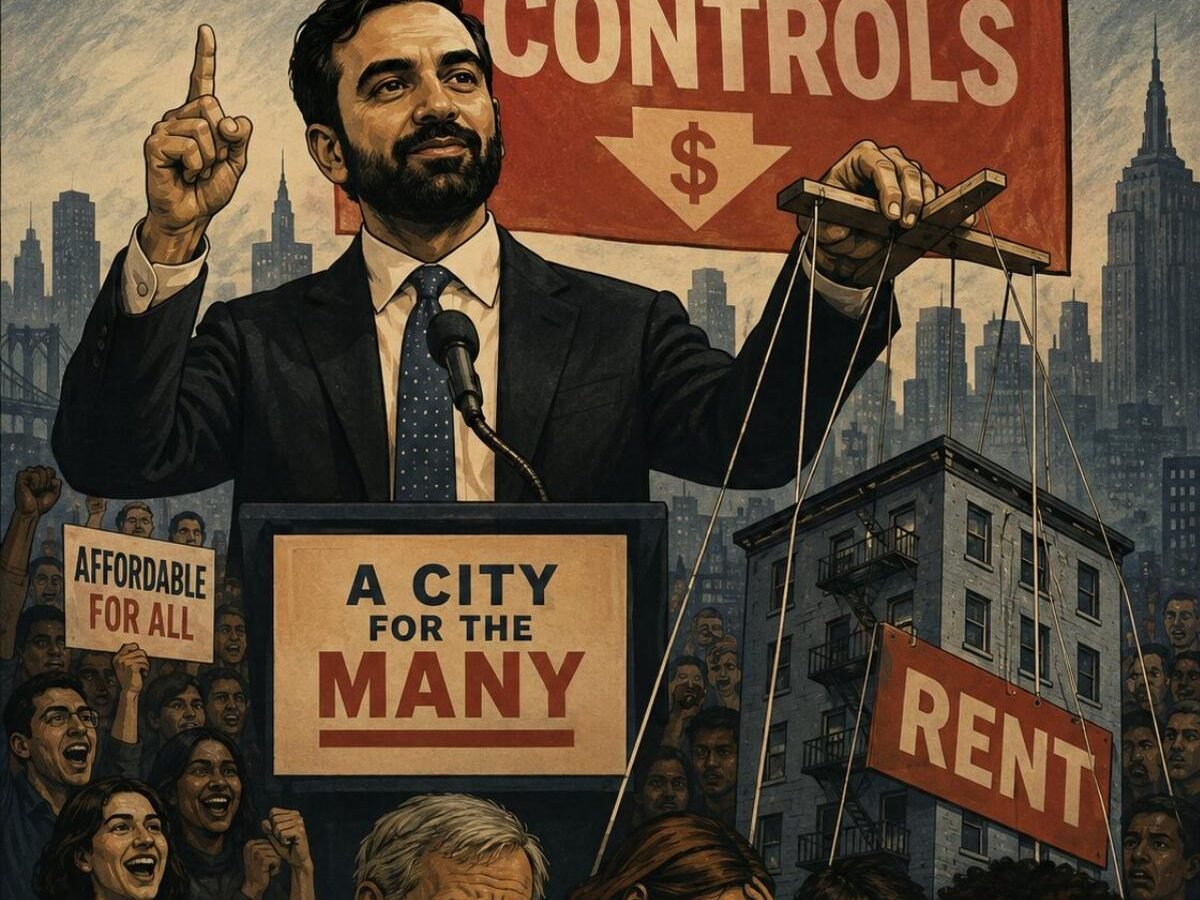
In the simmering debate over rent control in New York City, a familiar refrain is rising again: greedy landlords gouging vulnerable tenants. But as the political temperature climbs, a new American Thinker column by Bill Ponton digs into the city’s eight-decade experiment with rent regulation — and the results are not pretty.
Ponton, writing under the playful epithet “Zohran the Magnificent” for likely mayoral contender Zohran Mamdani, argues that the allure of something for nothing never loses its charm among voters who favor rent control. He traces the policy’s roots to 1943, when the federal government imposed emergency wartime rent ceilings under the Emergency Price Control Act of 1942. The Office of Price Administration was given broad authority to cap everything from wages to residential rents — a temporary measure that, Ponton notes, never really ended in New York.
The price system’s invisible hand
At the heart of Ponton’s critique is a simple economic lesson: prices convey information. In a free market, they tell producers what to build and consumers what to buy. When government distorts that signal, the result is misallocation — and in housing, that means the wrong people get the wrong apartments.
Ponton quotes a famous exchange between Mikhail Gorbachev and Margaret Thatcher, in which the Soviet leader asked how she ensured people got food. Her answer: she didn’t. Prices did. Britain, which hadn’t fed itself in over a century, imported food because prices made it possible. The Soviet Union, by contrast, starved its people under central planning.
Rent control, Ponton argues, is the same flawed logic applied to housing. When prices are artificially low, more people demand more space than they otherwise would. Some people hoard apartments they barely use — at the expense of others who can’t find any housing at all.
He cites famous examples: Mayor Ed Koch kept his rent-controlled apartment while living in Gracie Mansion for twelve years. Congressman Charles Rangel reportedly held four rent-regulated units. Hollywood celebrities have been known to maintain Manhattan pads for occasional visits. And Ponton recalls a personal anecdote — his sister’s in-laws held a controlled Manhattan apartment for over three decades after moving to the suburbs, using it only for Broadway shows and shopping trips.
These are not outliers, he insists. New York’s tenant turnover rate has been less than half the national average, while the share of tenants staying 20-plus years is more than double the national rate. Rent control, in other words, locks in place a system that benefits a lucky few while punishing everyone else.
Supply’s slow bleed
If demand-side distortion is the visible problem, supply-side decay is the quieter one. When rents are too low for landlords to cover maintenance, heating, taxes, and repairs, buildings deteriorate. In the worst cases, owners abandon them outright.
Ponton points to New York’s own history as a cautionary tale. During periods when regulated rents didn’t cover operating costs, landlords walked away from thousands of buildings — many of which sat vacant and boarded up, though they might have remained habitable with proper upkeep. The city eventually took possession of many of these properties, converting a private supply problem into a public burden.
The result, he says, is that rent control contributed to a long-term decline in the housing stock — undermining the very goal it was meant to achieve.
The political lure of something for nothing
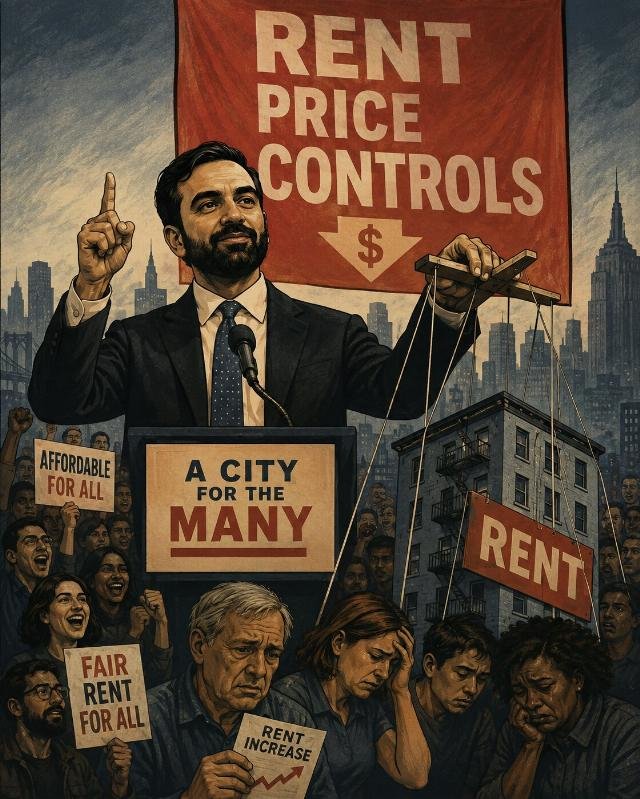
For Ponton, the persistence of rent control is less about economics than politics. “Zohran the Magnificent,” he writes, “will not reflect for one millisecond on the havoc he will sow with his rent control policy — which is the whole point anyway.” The strategy, he suggests, is to undermine functioning systems, create problems, then point to those problems as justification for even more government intervention.
It’s a cycle as old as the policy itself. New York’s rent control regime began as an emergency wartime measure, evolved into state and city systems, and only began unwinding in the deregulation era of the 1990s. According to Ponton, that deregulation helped revitalize New York’s flagging housing market — and, combined with Mayor Rudy Giuliani’s crime reduction, helped transform the city into a fashionable destination. He cites the popularity of ’90s sitcoms like Friends and Seinfeld as proof that the city was back.
But the political appeal of something for nothing endures. Subsidized rents, like subsidized everything, come with a hidden cost — one that is spread diffusely across the economy rather than borne transparently by the beneficiaries. Politicians, Ponton argues, know this. They just don’t care, because voters don’t see the bill.
As New York enters another rent control debate, the question is whether the city will learn from its own history. The evidence, Ponton suggests, is overwhelming: rent control has not produced more housing. It has produced hoarding, decay, and abandonment. It has benefited the connected and the lucky while leaving the rest to compete for a shrinking pool of affordable units.
And yet, as he notes, something for nothing never loses its charm with New York City voters.
Source: www.americanthinker.com — https://www.americanthinker.com/blog/2026/08/something-for-nothing-never-loses-its-charm-the-politics-of-rent-control-in-new-york-city/