
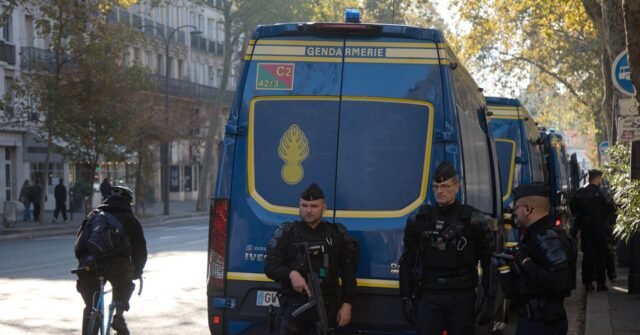
French authorities mobilized 70,000 police officers and gendarmes across the nation Saturday, preparing for what officials warned could be a volatile third weekend of youth-led protests that have now spread to neighboring European countries.
Interior Minister Laurent Nuñez issued a stark warning about the “very high risk” of disorder, particularly after nightfall on Halloween. The timing has heightened concerns among security officials who fear the holiday atmosphere could intensify an already charged situation.
Paris Clamps Down on Protest Routes
In an unprecedented move, Paris police banned all union and “yellow vest” marches through the city center, confining demonstrators to a single route along the capital’s outer boulevards stretching from Porte de Bagnolet to Porte de Charenton. The decision sparked immediate legal challenges from unions and student groups, but their appeals were rejected in last-minute court battles.
President Emmanuel Macron defended the restrictions Monday, stating that marches would be kept out of city centers to safeguard shops from potential looting and vandalism.
Additional security measures included barring entry to Place de la Republique and Les Halles—both sites of significant rioting and looting during the October 17 demonstrations—from 11 p.m. to 6 a.m. on both Saturday and Sunday nights.
Controversial Curfews on Minors
Authorities imposed a separate 9 p.m. curfew specifically targeting unaccompanied minors around the Champs-Elysees, one of Paris’s most iconic shopping districts. However, a Paris court dealt the government a setback Wednesday by suspending an earlier, broader curfew on minors, ruling it constituted a serious and illegal infringement on freedom of movement.
The back-and-forth over youth curfews underscores the delicate balance officials are attempting to strike between maintaining order and respecting civil liberties, particularly given that many protesters are high school students.
Movement Gains Momentum Despite Arrests
What began as high school students protesting deteriorating school conditions has rapidly evolved into a broader expression of anger over living costs affecting young people throughout France.
The numbers tell the story of a movement that shows little sign of abating. According to official counts, approximately 550,000 protesters turned out nationwide on October 17, when rioters looted hundreds of shops across multiple cities. Last Saturday saw roughly 410,000 demonstrators take to the streets. While those rallies were largely peaceful compared to the previous week, police still made more than 1,300 arrests.
Protests Jump Borders Across Europe
The youth movement has now transcended French borders, with similar demonstrations planned or underway in at least seven European countries this weekend.
In Germany, a youth initiative called “Gen Z regelt”—roughly translating to “Gen Z’s got this”—called for protests in approximately 30 cities. The movement’s demands include better education and healthcare, climate protection, affordable living, and opposition to any return of military conscription. Organizers reported that more than 140,000 people had signed up online to participate.
Berlin police anticipated about 10,000 people would gather at the Brandenburg Gate, prompting some shops along the Kurfuerstendamm boulevard to board up their windows as a precautionary measure, though authorities stated they had no specific intelligence suggesting violence was planned. Protests in Germany were scheduled to begin in the early afternoon.
Spain, Italy Brace for More Unrest
Barcelona’s Catalan police prepared to activate their highest-level alert after an anonymous TikTok network called Blocus urged new gatherings. Last Saturday’s rioting in the Spanish city resulted in approximately 130 arrests, with the majority involving minors.
Italian police remained on high alert following clashes in Milan, Turin, and Bologna. Meanwhile, calls to protest circulated on TikTok in Belgium, the Netherlands, Austria, Switzerland, and Portugal, suggesting the movement could expand even further.
The role of social media platforms, particularly TikTok, in organizing and coordinating these protests has emerged as a significant concern for European security officials. The decentralized nature of the organizing—often through anonymous accounts—makes it difficult for authorities to anticipate where demonstrations will occur or how large they might become.
Economic Pressures Fueling Youth Anger
The rapid spread of protests across multiple countries points to shared grievances among young Europeans. Rising living costs, concerns about educational quality and access, anxiety over climate change, and limited economic opportunities have created a combustible mix of frustrations.
Unlike previous European protest movements that were often organized by traditional unions or political parties, these demonstrations appear more spontaneous and youth-driven, organized primarily through social media rather than established institutional channels. This has made the movement both more unpredictable and harder for governments to negotiate with, as there are no clear leaders or organizational structures with which officials can engage.
As dusk falls Saturday across Europe, tens of thousands of police officers will be deployed in cities from Paris to Berlin to Barcelona, hoping to prevent the kind of widespread looting and violence that marred earlier demonstrations while attempting to respect the right to peaceful protest. How this weekend unfolds could determine whether the movement continues to grow or begins to lose momentum heading into November.
Source: www.breitbart.com — https://www.breitbart.com/europe/2026/10/31/france-prepares-for-third-weekend-of-youth-unrest-70000-police-officers-deployed/