
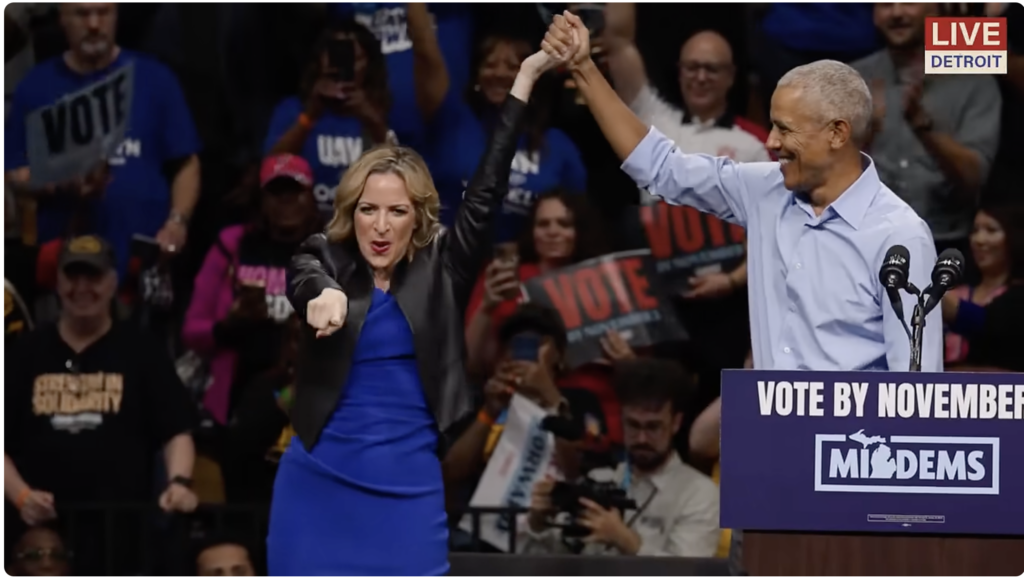
Michigan Secretary of State Jocelyn Benson’s controversial directive ordering the destruction of electronic pollbook records shortly after elections has been halted by a court order, raising fresh questions about election transparency as she campaigns for governor.
Michigan Court of Claims Judge Michael Riordan issued a temporary restraining order last week blocking Benson’s Administrative Rule 2025-14 ST, which requires local election officials to delete pollbook data from all devices by the seventh day following final canvass and certification. The rule appears to directly contradict federal election law mandating much longer record retention periods.
The lawsuit challenging Benson’s directive was originally filed by Bridgewater Township Clerk Michelle McQueer, with the Republican National Committee and Michigan GOP later intervening. McQueer argues the rapid deletion requirement violates federal code requiring election officers to “retain and preserve” election records for 22 months following any general, special, or primary election.
Federal Law Versus State Directive
At the heart of the legal dispute is a fundamental conflict between Benson’s state-level administrative rule and existing federal statutes. The directive issued on October 23, 2025, gives local officials just seven days after election certification to wipe electronic pollbook records from all devices, with exceptions only for recounts or post-election audits.

Republican National Committee Chairman Joe Gruters questioned the rationale behind destroying election records so quickly, particularly given Democratic officials’ frequent assertions about election security. “Jocelyn Benson tried to wipe out critical election records, and the RNC stopped her,” Gruters said in a statement. “Republicans are protecting the vote and demanding transparency for every American.”
The case first emerged following Michigan’s August 4 primary election, when Judge Riordan issued an initial temporary restraining order on August 27 directing the Michigan Department of State and elections officials to preserve electronic pollbooks from that primary pending a final ruling. That order remains in effect.
Expanded Protection for Midterm Records
On October 5, Judge Riordan granted the RNC and Michigan GOP’s request to intervene in the lawsuit but initially denied their motion for a statewide order preventing clerks from destroying records following this week’s midterm elections. However, recognizing the case wouldn’t be resolved before Tuesday’s election, Riordan reversed course and granted the motion to block implementation of Benson’s rule.
“Defendants are directed to instruct all local election officials to retain the EPBs from the November 3 General Election,” Judge Riordan wrote in his order. “The instructions must direct those officials to transfer the EPB from the precinct laptops onto the encrypted flash drives and then to securely store those flash drives until further order of this Court.”

A spokesperson from Benson’s office told Democracy Docket that the Court of Claims “did not rule on the merits or determine that the Bureau of Elections’ guidance conflicts with state or federal law.” The spokesperson added that the office is “reviewing the ruling to determine our next steps.”
Pattern of Controversial Directives
This isn’t the first time Benson has issued instructions to delete pollbook records shortly after elections. Following the disputed 2020 election, she issued a December 1, 2020 memo ordering clerks to delete electronic pollbook software and associated files “from all devices by the seventh calendar day following the final canvass and certification of the election,” with the same limited exceptions.
The current controversy adds to a series of legal challenges against Benson’s election-related directives. In 2024, a Michigan judge struck down her guidance advising local election clerks to presume all absentee ballots were valid, ruling the directive violated Michigan law.
“With apologies to Gertrude Stein, however, a presumption is a presumption is a presumption,” Judge Christopher P. Yates wrote in that ruling. “Whether the guidance manual includes a gentle nudge instead of a hip check, it’s still a foul under Michigan law.”

Election Integrity Concerns
Patrice Johnson, chairwoman of Pure Integrity Michigan Elections, which has been tracking Benson’s actions for years, told The Federalist that the Secretary of State “has promulgated all kinds of rules that undermine our elections.” Johnson noted that Benson is now running for governor while continuing to oversee Michigan’s elections and create rules that will have the force of law after she leaves office.
Johnson emphasized that election integrity watchdogs have used electronic pollbooks to track voters who were in line to vote long after polls were supposed to close, calling retention of local pollbooks “critical to election integrity.”
“Another election mess, another Jocelyn Benson blunder,” said Ally Triolo, communications director for the RNC’s Election Integrity Unit. “Benson tried to wipe away election records ahead of the midterms — and the RNC stopped her. Republicans will keep fighting to secure Michigan’s elections and protect the vote.”
The case remains pending, with the temporary restraining order ensuring electronic pollbook records from this week’s midterm elections will be preserved while the court considers the merits of the challenge to Benson’s administrative rule.
Source: thefederalist.com — https://thefederalist.com/2026/11/02/court-stops-michigans-leftist-elections-chief-from-destroying-pollbooks/