
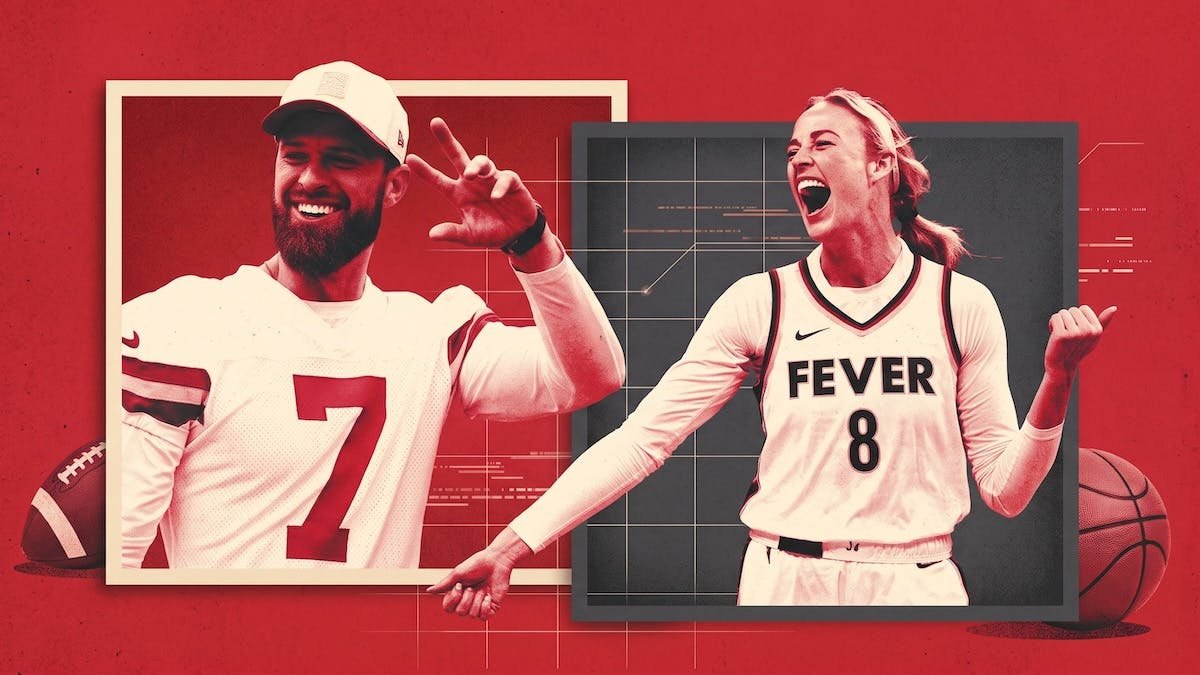
The image of the athlete-rebel—think Muhammad Ali refusing the draft, or Jim Brown speaking out on civil rights—has long occupied a hallowed place in American sports lore. But a recent incident in the WNBA has prompted a pointed question: What happens when the rebel is the culturally conservative athlete?
On Aug. 8, Chicago Sky guard DiJonai Carrington was ejected from a game after a flagrant foul on Indiana Fever’s Sophie Cunningham—a clothesline-style takedown as Cunningham drove for a layup. Sports Illustrated ran a headline framing the hit as payback: “Sophie Cunningham Got A Bitter Taste of Karma After Drawing Flagrant Foul.” The implication, left-leaning sports outlet Outkick surmised, was a callback to a late-July ESPN profile in which Cunningham spoke out against transgender participation in women’s sports. “I want to protect young girls in a locker room, or young girls in sport who shouldn’t have to go against biological men,” she told ESPN. The SI article itself pointed to an earlier retaliation foul by Cunningham, but the political subtext was hard to miss—and so was the media reaction.
Defector, a progressive sports site founded by former Deadspin staffers, responded with a piece titled “Sophie Cunningham Is About As Edgy as a Beach Ball,” dismissing her as a “straight blonde woman with tenuous political commitments.” The knives, it seemed, were out.
All of which raises an uncomfortable question for the sports media establishment: How did the conservative athlete—and there are many—become the rebel? And when did treating that rebellion as a character flaw become standard practice?
A closer look at history suggests the answer is more complicated than a simple reversal. Sportswriters, it turns out, have long sided with the establishment—whatever that establishment happened to be at the time.
The Old Guard’s Conservatism
In the mid-20th century, the sports press was overwhelmingly conservative. “They just wanted to cover sports their way, and a lot of them were highly conservative,” Washington Post columnist Robert Lipsyte recalled of the sportswriters he came up with in the 1960s.
That conservatism often translated into active resistance to social change. In 1942, J.G. Taylor Spink, publisher of The Sporting News—then known as America’s “Sports Bible”—spoke out against integrating baseball, warning that integrationists “run the risk of damaging their own game.” (In 2021, amid a broader reckoning, the publication supported removing Spink’s name from a prestigious baseball writing award.)
In 1964, celebrated New York columnist Jimmy Cannon said of Muhammad Ali’s name change after his conversion to Islam: “I pity Clay and abhor what he represents.” Four years later, Red Smith, another icon of the craft, called Ali’s anti-Vietnam War protests “as sorry a spectacle as those unwashed punks who picket and demonstrate against the war.” And when Jim Brown spoke out on civil rights in 1965, Cleveland sportscaster John Fitzgerald told the running back to “pipe down and stick to football.”
The old sports press enforced the dominant cultural order. But at some point, that order changed—and the media changed with it.
The Shift at ESPN
The pivotal date, according to many observers, was Jan. 1, 2012, when John Skipper became president of ESPN. Skipper’s tenure accelerated trends already underway—the network had launched Bill Simmons’ Grantland in 2011 and had long featured columnist Jemele Hill, who in 2008 wrote that “rooting for the Celtics is like saying Hitler was a victim” (a remark that got her suspended).
Under Skipper, ESPN embraced “unique points of view,” boosted Grantland and Nate Silver’s FiveThirtyEight, launched espnW and the “Nine for IX” documentary series, and, in 2015, gave Caitlyn Jenner the Arthur Ashe Courage Award—a major institutional statement on transgender acceptance. In 2016, it launched The Undefeated, focused on the “intersection of sports, race, and culture.”
The shift did not go unnoticed inside the building. In 2016, ESPN public editor Jim Brady wrote about a “perceived move leftward,” quoting one staffer as saying: “If you’re a Republican or conservative, you feel the need to talk in whispers. There’s even a fear of putting Fox News on a TV [in the office].” Brady followed up in 2017 with a column headlined “Like it or not, ESPN isn’t sticking to sports.” Skipper pushed back, insisting that “ESPN is not a political organization… we consider this human, not political.”

Skipper resigned at the end of 2017, citing substance-abuse issues—later revealing an extortion attempt related to cocaine use. His successor, Jimmy Pitaro, moved quickly to steer the network back toward the political center. At 2018 Football Media Day, Pitaro said plainly: “When people tune into ESPN, they are not looking for political commentary from us.”
But the genie was already out of the bottle. The internet had permanently altered the sports media landscape.
The Rise of the Progressive Sports Blog
In 2005, Gawker Media launched Deadspin, a sports website with no “favor, access, or discretion.” It was snarky, irreverent, and a welcome corrective to a sports media too deferential to owners and advertisers. “We were consciously fashioning an alternative to ESPN,” founding editor Tommy Craggs later said.
Over time, Deadspin’s snark acquired a distinctly left-wing political edge. “Deadspin’s already venomous bite was imbued with a political sensibility,” a retrospective later noted. After Gawker’s collapse, a private equity firm took over, fired editor Barry Petchesky, and ordered the staff to “stick to sports.” Everyone quit. Writer Drew Magary, the site’s most prominent voice, declared: “There is no sticking to sports.”
Those refugees founded Defector, which developed progressive sports snark into, as one critic put it, “a fetishistic art form.” To Defector, ESPN had become the man—refusing to speak truth to power. And conservative athletes became fair game. The site dismissed Giants quarterback Jaxson Dart as an “enthusiastic MAGA freak” after he introduced Donald Trump at a rally. It mocked Chiefs kicker Harrison Butker’s new political PAC, saying its “coffers were as empty as his head.” It described 49ers defensive end Nick Bosa as having “preened like a jackass” when he wore a MAGA hat after a postgame interview.
Would Defector run equally snarky language about a progressive athlete’s racial, feminist, or LGBT politics? Unlikely, critics say.

Pride Caps and Bible Verses
The double standard is perhaps nowhere more visible than in the recent Pride Night cap controversies in Major League Baseball. When Dodgers pitchers Blake Treinen—so openly conservative that fans nicknamed him “MAGA”—and Alex Call chose to wear their regular caps instead of the rainbow-flag Pride Night version, the gay sports site Outsports acknowledged the “continued presence of anti-LGBTQ sentiments amongst pro athletes” but ultimately counseled leaving the players alone.
A more strident tone emerged when three San Francisco Giants players wore Bible verses on their Pride caps. The Giants blog McCovey Chronicles ran a headline declaring them “Bad and bigoted: The Giants told fans exactly who they are on Friday.”
As a Dodgers fan, I can attest that the Giants are indeed bad. But are they really “bigoted”? Is it plausible that the San Francisco Giants—an organization in one of America’s most progressive cities—tolerates hatred toward LGBTQ people? It seems hard to imagine.
A Pendulum Swinging Back
What is striking about these episodes is how rare they are in the broader context of sports media. The SI “karma” headline, while cruel, was an outlier—SI is no longer the cultural force it once was. And the broader arc of sports media may be shifting again. Gawker is gone, Defector is subscriber-only, and conservative sports sites like Outkick are thriving, with a growing audience of athletes and fans who feel alienated by a media establishment they see as uniformly progressive.
The story of American sports media has never been a simple tale of rebels versus the establishment. It is a story of establishments changing, of power shifting, and of who gets to be called a rebel at any given moment. For now, the culturally conservative athlete—a figure once comfortably aligned with the mainstream—has found themselves on the outside looking in, cast as the new iconoclast.
Whether that label sticks depends on how long the current cultural winds continue to blow.
Source: www.dailywire.com — https://www.dailywire.com/news/the-rebels-of-american-sports-have-changed-sides