
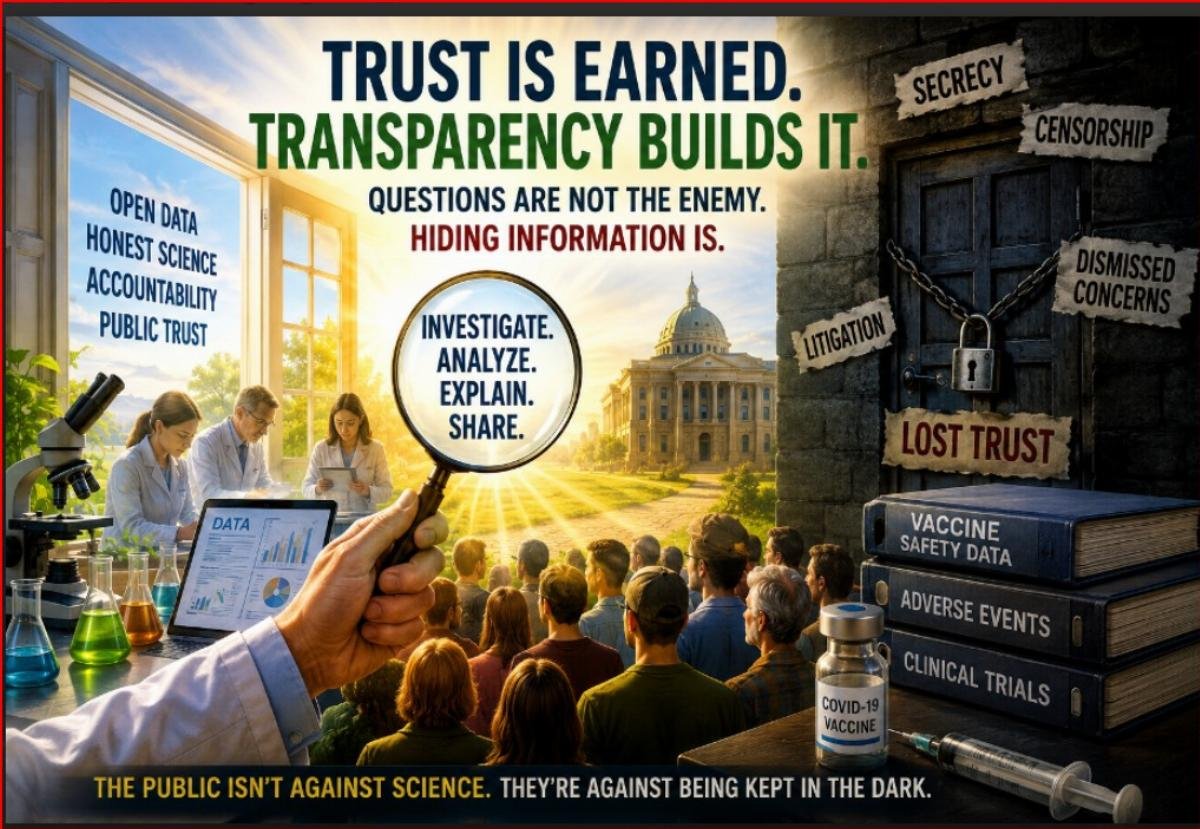
When public health officials repeatedly insisted Americans should “trust the science” during the pandemic, they may have inadvertently achieved the opposite effect. According to recent polling data and a new analysis by a Colorado-based physician, the erosion of public confidence in health institutions stems not from excessive skepticism among citizens, but from a fundamental breakdown in the transparency that scientific inquiry requires.
Writing in American Thinker, Dr. Brian C. Joondeph points to recent Rasmussen Reports surveys showing that nearly half of Americans now believe COVID vaccines likely caused a significant number of unexplained deaths, while roughly one-quarter say they personally knew someone who died because of a vaccine. Joondeph emphasizes these polls “prove nothing about vaccine safety”—public opinion isn’t scientific evidence—but they reveal something potentially more consequential for the future of public health.
“Millions of Americans no longer believe their government has been fully transparent,” Joondeph writes. “That should concern every physician, scientist, and public health official alike.”
The Scientific Method Requires Openness, Not Obedience
At the heart of Joondeph’s argument is a fundamental principle of scientific practice: advancement happens through questioning, not through deference to authority. He notes that every legitimate scientific paper includes a Materials and Methods section specifically so other researchers can reproduce the work, validate findings, or identify errors. This isn’t a formality—it’s the mechanism by which science self-corrects.
Throughout the pandemic, according to Joondeph’s account, independent researchers examining population-level mortality data, adverse-event reporting systems, and insurance databases sometimes identified statistical patterns they believed warranted further investigation. The appropriate scientific response to such observations would be examination and explanation, not dismissal.
“If it lands heads ten times in a row, that’s unusual but entirely possible,” Joondeph writes, using the analogy of a coin flip. “No honest scientist immediately concludes that the coin is weighted. Neither does an honest scientist ridicule anyone who asks questions.”
Yet according to Joondeph, questions were frequently labeled as misinformation before being debated, critics were marginalized before their analyses were reviewed, and requests for underlying government records sometimes escalated into prolonged legal battles rather than routine scientific exchanges.
The Problem With Projecting Certainty
Joondeph contrasts the public health messaging during COVID with the intellectual humility he learned from a mentor at the Bascom Palmer Eye Institute, widely regarded as a leading authority on macular diseases. When faced with puzzling clinical findings, this expert’s response was often three simple words: “I don’t know.”
“It wasn’t an admission of ignorance,” Joondeph explains. “It was an expression of intellectual honesty. The more we know, the more we recognize the uncertainty that remains.”
Public health recommendations did evolve during the pandemic—vaccines that were initially promoted for preventing infection were later emphasized for reducing severe illness and hospitalization. The virus’s origin story shifted from certainty about a wet market to acknowledgment that a laboratory origin was a legitimate possibility. These changes themselves weren’t necessarily problematic, Joondeph argues. Medicine always involves updating understanding based on new evidence.
“What damaged public confidence wasn’t the change in recommendations,” he writes. “It was the unwillingness to acknowledge uncertainty while those recommendations were changing.”
Secrecy Breeds Suspicion
Joondeph employs a domestic analogy to illustrate how opacity itself creates distrust. When one spouse suddenly locks a phone, deletes messages, changes passwords, and insists there’s nothing to discuss, suspicion becomes inevitable—”not because wrongdoing has been proven, but because transparency has vanished.”
The parallel to public health institutions is clear in his analysis: many Americans now believe something important has been hidden from them. Whether that belief is justified is almost beside the point. The perception itself has consequences for future public health responses.
The Stakes for the Next Pandemic
Looking ahead, Joondeph warns that the next pandemic “will almost certainly occur.” When it does, public health officials will again need to ask Americans to accept extraordinary recommendations. Those recommendations may be fully justified, he acknowledges, but they will succeed only if the institutions making them have credibility.
“Trust cannot be rebuilt through fact-checking,” Joondeph argues. Instead, he calls for a different approach: if available evidence supports vaccine safety, publish the data. If statistical anomalies have reasonable explanations, provide them. If independent researchers have made methodological errors, demonstrate them openly.
“Don’t simply label those asking questions as ‘conspiracy theorists,’ ‘deniers,’ or ‘kooks,'” he writes. “Make it make sense rather than telling those asking questions to shut up and move along.”
The Rasmussen surveys Joondeph cites don’t prove that COVID vaccines caused widespread harm, he reiterates. But they do prove that millions of Americans no longer consider official assurances sufficient on their own.
His conclusion is sobering: until public health institutions embrace transparency with the same enthusiasm they once embraced certainty, the crisis of confidence will persist long after COVID itself has faded into history. For a physician whose career has been built on evidence-based medicine, the prescription is straightforward—more openness, less insistence on unquestioning trust, and a return to the fundamental principle that scientific claims gain strength through scrutiny, not through protection from it.
Source: www.americanthinker.com — https://www.americanthinker.com/articles/2026/07/the-more-they-said-trust-us-the-less-america-did/