
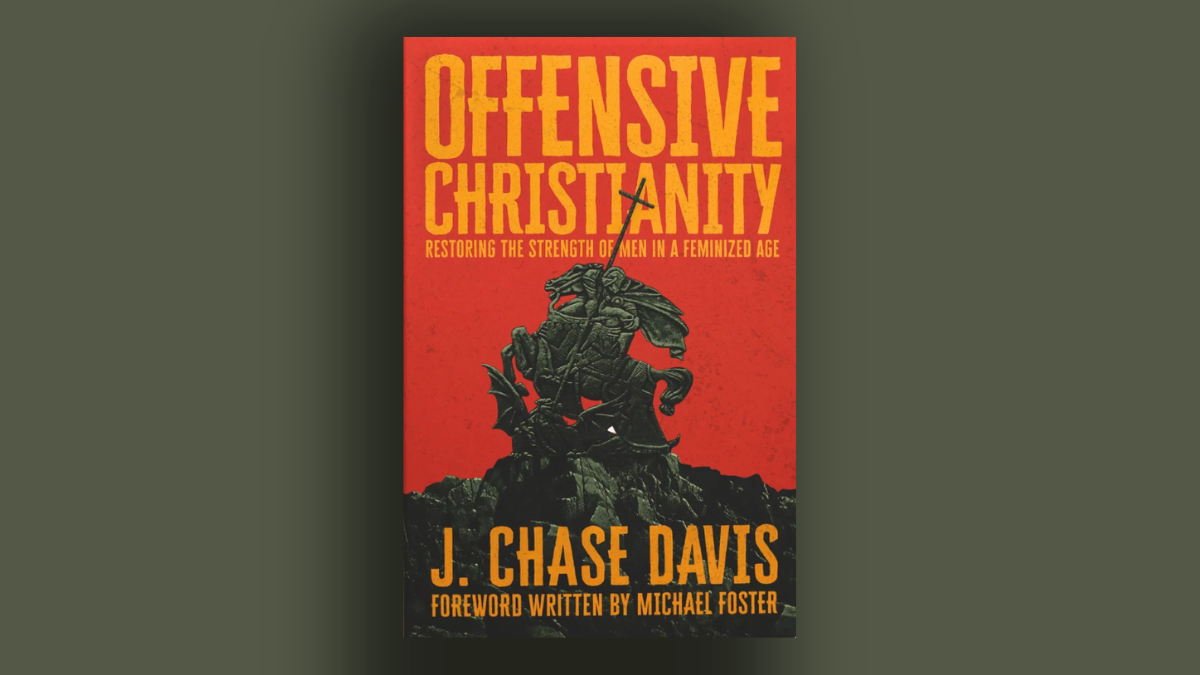
A new book is wading into the ongoing debates over masculinity and faith, arguing that too many Christian churches have traded strength for niceness—and that men are paying the price. In Offensive Christianity: Restoring the Strength of Men in a Feminized Age, pastor and writer J. Chase Davis contends that the modern church has largely abandoned a biblical vision of manhood, leaving younger generations of men adrift in a culture that labels their very nature as toxic.
As reviewed by The Federalist, Davis’s book is a direct response to what he sees as a crisis among men—especially younger white millennials and Zoomers—who have been “submerged by the cultural current of feminism” and are now “drowning in a sea of ‘niceness.’” According to Davis, too many men have responded to the pressure by retreating into “virtual reality numbing distractions, easy pornography, and a thousand other distractions” rather than striving for glory, protecting and providing for their families, and advancing humanity.

Churches as a Source of the Problem
While many conservatives prescribe church attendance and virtue cultivation as the antidote to male malaise, Davis argues that most Christian communities have themselves become feminized—places where being as inoffensive as possible has replaced Jesus’ command to love God and neighbor. He contends that weak, effeminate, and socially progressive men are promoted while their opposites are equated with evil.
Davis traces this development not to the Bible but to a long intellectual march away from orthodox Christianity. As The Federalist summarizes, the book points to the Enlightenment for reducing an embodied worldview to a set of preferences, Romanticism and Pietism for turning faith into mere sentiment, 19th-century German critics for undermining biblical authority, and Nietzsche for casting Christian ethics as a “slave morality” opposed to masculine strength. The result, Davis argues, is a watered-down “moralistic therapeutic deism” that exalts tolerance above all else.

Scripture’s Manly Paragons
Against this backdrop, Davis points to biblical figures who did not simply get along with everyone. Adam, David, Jesus, and St. Paul were “confrontational, fearless, and triumphant,” he writes. Paul’s call to boast in one’s infirmities—often misread as an invitation to wallow in fragility—is instead, in Davis’s view, a call to glory in the sufficiency of Christ.
The book stresses that Christian men are meant to be active: to compete, exert themselves, and use their bodies. Davis emphasizes physical health and real human interaction, warning against a disembodied existence lived out online. He also encourages men to form deep bonds with other men—what he calls finding a “phalanx”—and to seek a shared mission, a recommendation The Federalist notes is countercultural in churches that prioritize “emotional intelligence and emotional health.”

Conflict as a Christian Virtue
Davis urges men to embrace conflict and go on the offensive, which he frames as seeking truth above consensus, winning glory through real achievement, and welcoming discipline. This inevitably collides with social pressures to protect feelings and minimize disagreement. As Davis puts it, “when a man stands up and speaks the truth, he is accused of being offensive, even brutal.” Yet silence, he warns, harms both organizations and the men within them who are forced to deny their own nature.
The Federalist review praises Davis for not sugar-coating the difficulty of this path. Being a man today is hard, Davis admits, and success requires God’s grace. Without faith, the advice risks becoming incoherent: men may free themselves from imposed emasculation, but to what end? The book challenges men to use their freedom not for self-indulgence but to protect and provide for others.
Criticism: More Manosphere Than Theology?
While generally sympathetic, the review also offers a pointed critique. Davis assumes his readers are Christian Protestant men who are already fed up with the feminization of culture, and he sometimes seems more intent on Christianizing the manosphere than on recovering a deeper masculinity within Christianity. The result, the reviewer writes, can feel like listening to Christian rock music—a genre that famously prompted Hank Hill’s exasperated line, “Can’t you see you’re not making Christianity better. You’re just making rock music worse.”
Still, the review concludes that Offensive Christianity is a “good, efficient” book (150 pages) that speaks to a larger issue plaguing many organizations. “All men, not just Christian ones, would do well to heed its advice and put this age-old yet continually fresh wisdom into practice,” the review states.
The book arrives amid long-running debates over masculinity, dating, and the role of faith in public life—debates that show no signs of fading.
Source: thefederalist.com — https://thefederalist.com/2026/08/18/christianity-is-not-an-excuse-to-be-an-effeminate-wimp/