
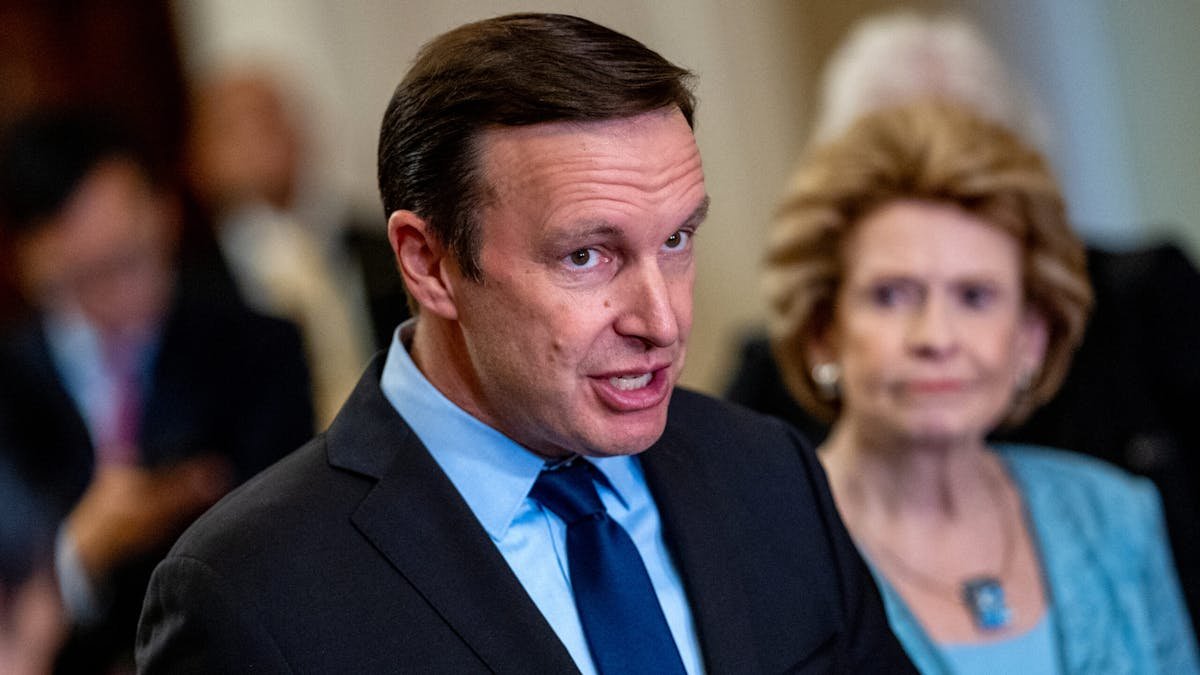
Senator Chris Murphy (D-CT) and a group of congressional allies have introduced the Living Wage For All Act, a proposal that would set a federal minimum wage of $25 per hour—more than triple the current $7.25 rate that has remained unchanged since 2009. While Murphy frames the bill as a necessary response to stagnant wages, economic analysis paints a more complicated picture, warning of significant job losses and inflationary pressure.
“If you work full time in this country, you should be able to afford to live,” Murphy said in introducing the legislation. “But wages are so low that parents work 60 hours a week and still aren’t sure if they’ll have lunch money for their kids. Our economy is not working for people, and we have to put forward solutions that are as big as the problems American families are facing.”
The proposed phase-in would gradually raise the federal minimum wage to $25, a level that Murphy and his co-sponsors argue is a long-overdue correction. However, economic modeling based on Congressional Budget Office (CBO) data suggests the consequences could be severe.
5 Million Jobs at Risk
The Employment Policies Institute (EPI) estimates that a nationwide $25 minimum wage would cost the U.S. economy approximately 5 million jobs. “The majority of research over three decades finds minimum wage increases reduce employment,” the group noted, citing a body of evidence that challenges the assumption that wage hikes can be absorbed without workforce reductions.
EPI’s analysis specifically highlights the hospitality sector, tipped restaurant workers, and teenagers as the most vulnerable. “EPI estimates the federal $25 proposal will cost 5.01 million jobs nationally, significantly impacting the hospitality sector, tipped restaurant workers, and teens,” the organization stated.
Entry-level workers and those in retail and food services would bear the brunt of the layoffs, as businesses would need to cut costs to survive the sudden jump in labor expenses.

Small Businesses Hit Hardest
While large corporations might have the financial cushion to weather the increase—or accelerate automation to replace human workers—small businesses would face a far more dire situation. Many would have no choice but to close their doors permanently. Others would slash employee hours, strip away health and retirement benefits, or scale back hiring altogether.
The impact would be uneven across the country, with states that have lower costs of living feeling the pinch most acutely. A uniform federal mandate would force employers in regions where $25 is far above the local market wage to make drastic adjustments, potentially devastating local economies that rely heavily on small businesses.
Inflationary Spiral
Beyond job losses, the proposal could exacerbate the very inflation it claims to fight. Businesses would inevitably pass elevated labor costs on to consumers through higher prices. Any wage gains for workers would be neutralized by the skyrocketing cost of living, hitting lower-income households the hardest.

Economists warn that this dynamic could create a cycle where the minimum wage hike leads to price increases, which then erode the purchasing power of those same workers, necessitating further wage demands—a spiral that could destabilize the broader economy.
The proposal comes as the federal minimum wage has remained frozen for over a decade and a half, a point Murphy and his allies emphasize. But the path forward is fraught with trade-offs that could undermine the very families the legislation aims to help.
As the debate unfolds, policymakers will have to weigh the moral imperative of a livable wage against the empirical realities of employment destruction and inflationary pressures. For now, the $25 minimum wage remains a bold—and controversial—proposal with potentially far-reaching consequences.
Source: www.dailywire.com — https://www.dailywire.com/news/dem-senator-wants-a-25-minimum-wage-heres-what-it-could-cost-america