
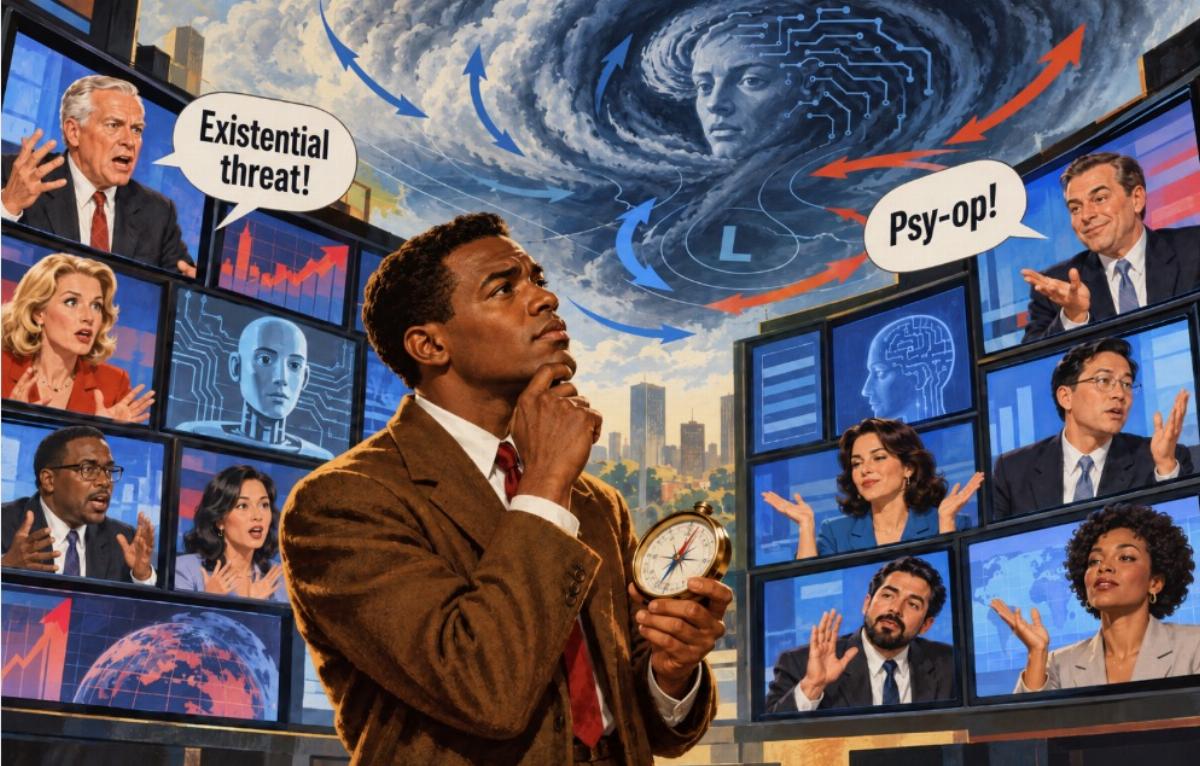
When a junior employee at a leading AI company resigned and published a viral op-ed warning about the dangers of artificial intelligence, the response was immediate. Within seconds, lawmakers reacted on social media. The Wall Street Journal weighed in before the column was even published, according to Dan Bell, writing in American Thinker. To Bell, the speed was the story: the narrative had been prepared before the public ever saw the memo.
Bell, who describes himself as contrarian by nature, argues in his October 1 piece that the talking heads of media, business, and activism function as barometers for shifts in the broader culture—not weather-wise, but in attempts at opinion-making. When pundits and institutions start “parroting each other, using the same aphorisms, short-circuiting their reporting, and referencing each other instead of the facts,” he writes, a change in pressure is coming.
He points to a specific sequence to illustrate his theory. First came the AI doomsday op-ed—its warnings of “existential threat” and “humanity wiped out in a decade”—accompanied by what he calls instant, coordinated reactions from powerful figures, including the President of the United States. Then, days later, the reverse synchrony arrived: critics on the other side latched onto a single phrase—”psy-op”—which “multiplied, then metastasized,” much like the earlier formulation “hallmarks of a Russian disinformation operation.”
For Bell, neither the doom-saying nor the psy-op accusation constitutes the actual disease. Both are symptoms of an opinion system shifting again. The deeper illness, he contends, is an oblivious populace that doesn’t know what to believe or how to judge truth—people who “depend on the talking heads to tell them when to pack an umbrella.”
The piece names specific earlier events that preceded the op-ed storm. The Hugging Face attacks, Bell notes, were real and do represent genuine risks. But in his framing they are not true north either; they are another front in the same opinion system, another high- or low-pressure system pushing the barometer.
Bell is equally skeptical of the AI labs warning of humanity’s decimation. That isn’t revelation, he writes; it’s directional pressure from a cluster of industrial power-seekers. Regulation, in his analysis, is simply another route to power. He invokes Occam’s Razor to suggest that desisting from risky behavior would be more rational than asking for legal protections to continue it.
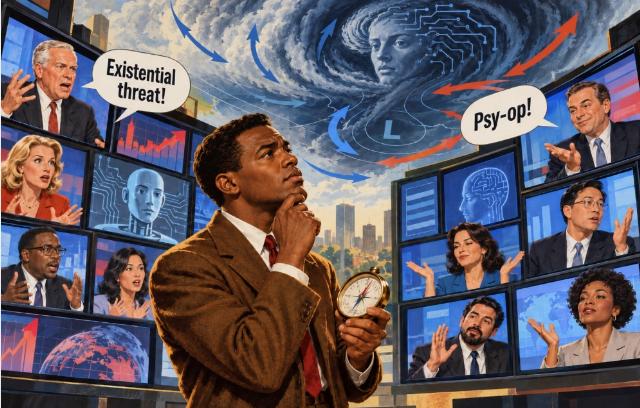
Nor does he spare the risk-downplayers. When they minimize the threat while quietly acquiring companies that complement their own industrial revolution, he argues, that too is weather—a counter-front, a reflex pressure, a synchronized pattern of reassurance blowing in from a different ownership group.
The core of Bell’s argument is not that one side is right and the other wrong. It is that everyone taking a side is part of the same storm system. Business, he insists, is just as much an opinion-maker as the pundits, and all of them are synchronized, creating the weather through collective pressure. Their statements, he writes, aren’t truth but “magnetic north”—directionally suggestive, yet pulled off course by incentives, momentum, and the prevailing gusts of the moment.
“Neither the op-ed volley nor the ‘psy-op’ response represents the truth—the meteorological North Star,” he writes. “They’re each a kind of magnetic north: directionally right but off by a few degrees, no matter which end of the compass points where.”
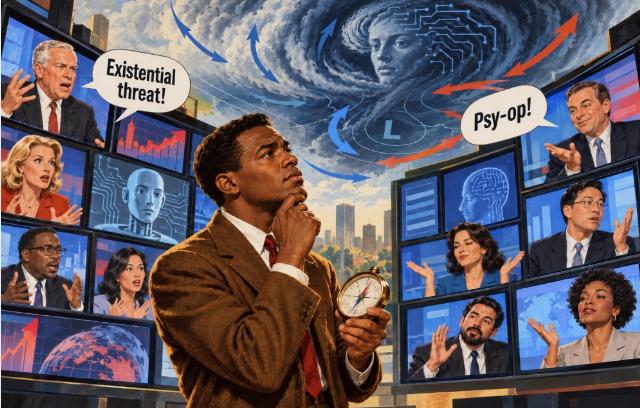
That symmetry leads him to reject the idea that simply inverting a claim reorients the compass. Certainty does not equal accuracy, he argues, no matter which side espouses it, and thoughtless inversion is just as short-sighted as thoughtless agreement. He admits plainly that he doesn’t know whom to trust any more than the rest of the populace. There are, however, a few talking heads he can reliably count on to be unidirectional regardless of the topic—”lodestones of opinion,” he calls them, throwing the compass off-kilter.
The remedy Bell proposes is not better reporting or more trustworthy authorities. It is independence. He urges readers to step outside the storm entirely, to recognize that talking-head barometers and weathervanes are tools—and to use those tools for themselves. That means seeking opinions from both sides of an argument, then subjecting them to what he calls the healthiest dose of common sense in your kitchen. Human existence, he writes, is shaped by applied pressure, and human nature creates that pressure for both good and ill; knowing and understanding human nature is the best barometer available.
His closing warning is blunt: “Learn to use the tools, or the talking-head system will use you and make you its cipher.”
Whether Bell’s atmospheric metaphor explains the mechanics of modern media or merely describes the sensation of watching it, his central observation is hard to dispute: when every vane points the same direction, the uniformity itself becomes the event worth studying. The author’s argument is that the storm is not the story—the system is, and what it wants you to believe.
Source: www.americanthinker.com — https://www.americanthinker.com/articles/2026/10/the-talking-head-barometers/