
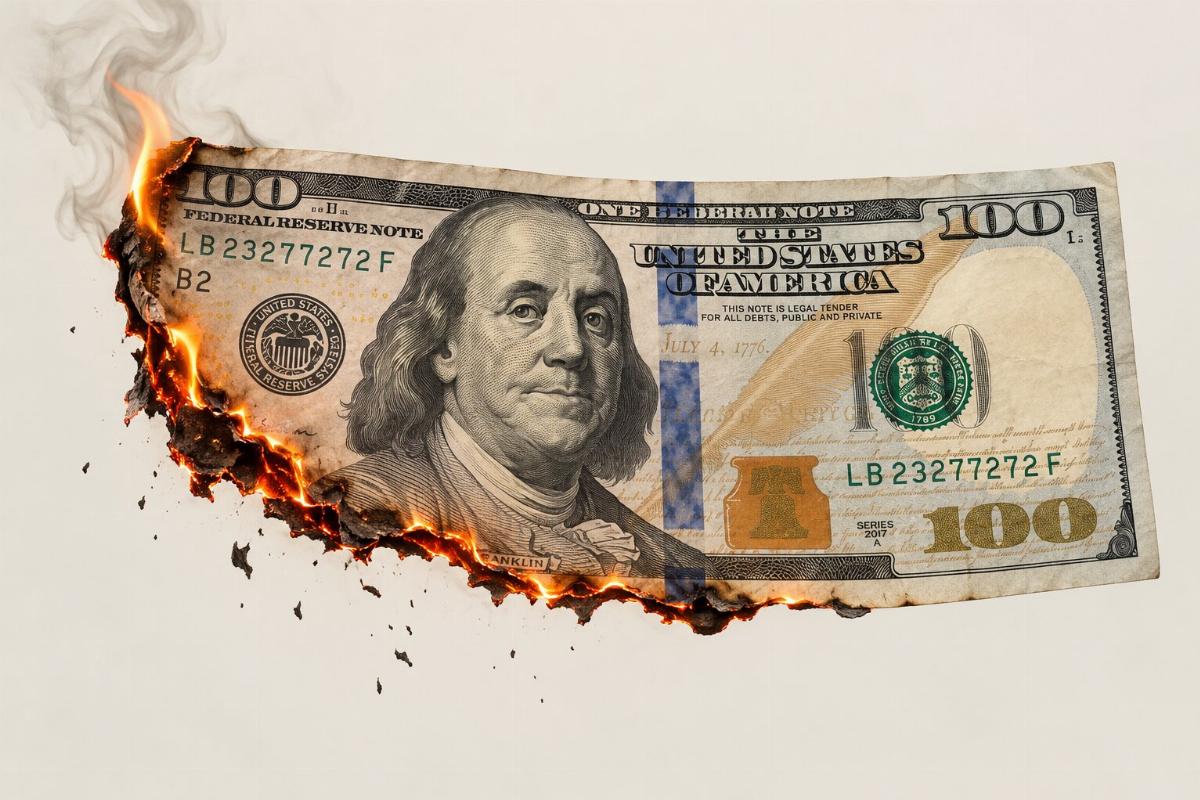
While much of the political press corps stays fixed on the daily maneuverings of the Trump administration, a slower and arguably more consequential drama is playing out in the bond market. Writing in American Thinker, Jason Rivers argues that the mechanics of U.S. sovereign debt have entered territory that no longer resembles a distant theoretical worry. The numbers, he suggests, have begun to speak for themselves.
The most immediate figure is the cost of carrying the debt itself. More than $1 trillion is now spent annually on interest payments alone. Ray Dalio, the founder of Bridgewater Associates, has been blunt about what that implies: a government that spends 40 percent more than it collects in taxes is running a model that cannot persist indefinitely. If Dalio’s forecasts hold, Rivers writes, a debt crisis could arrive within three to five years.
Markets, according to the piece, have already started to price in some of that anxiety. September auctions pushed yields on 30-year Treasuries to 5.501 percent and 10-year notes to 5.211 percent — levels not seen since 2001 and 2007, respectively. Rates kept climbing into Tuesday’s trading. Rivers reads this not as routine volatility but as evidence that confidence in U.S. debt instruments is eroding.
A Crowded Field for Investor Dollars
Part of what makes this moment different from earlier episodes of fiscal stress is the competition for capital. The Treasury Department is no longer the only large-scale borrower in town. Technology companies building data centers have issued more than $200 billion in bonds, a sum far beyond their historical norms. With net national savings in the U.S. close to nil, that borrowing competes directly with government paper for a limited pool of funds — and that competition, Rivers argues, pushes Treasury yields higher and ushers in an era of expensive money.
Foreign central banks appear to be making their own judgments about where safety lies. In 2025, global central bank reserves held in gold exceeded those held in U.S. Treasuries — long treated as the benchmark risk-free asset — by 20 percent. India cut its dollar holdings by 15 percent, China by 7 percent, and Japan by 5 percent. To Rivers, the message is unambiguous: central bank leaders, including those in allied nations, have less faith in the dollar’s long-term ability to preserve capital, and they are returning to gold as a store of value.
The refinancing calendar sharpens the problem. More than $8 trillion in old debt comes due within the next year, carrying an average coupon of 2.9 percent — well below where rates sit today. That gap between what the Treasury must pay now and what it pays on existing obligations creates a squeeze. It also collides with the Federal Reserve’s ongoing reduction of its government bond holdings, a runoff totaling $6.8 trillion. Rivers warns that any appearance of discord between the two agencies could be read by markets as a loss of regulatory independence, which would only accelerate the climb in borrowing costs.
Unprecedented Interventions
The administration, according to the piece, has already turned to measures without recent precedent. The federal treasury intervened in currency markets to support the Japanese yen for the first time in 30 years. Between January and June 2026, the Bank of Japan sold $108 billion in U.S. securities to stabilize its own economy, reducing assets held by the Federal Reserve Bank of New York to $2.7 trillion — the lowest since 2012. Those steps may have calmed conditions, Rivers concedes, but they amount to a warning shot.
Meanwhile, European partners — described as “friendly” — are pitching Europe as a safe haven for nervous investors. It appears to be working. Capital has been shifting toward EU debt and away from U.S. Treasuries, the asset class that once served as the default resting place for risk-averse money.
The Treasury’s own attempt to buy long-term bonds by issuing bills drew a negative initial reaction, read by many as a sign of weakness rather than strength. The department has accumulated roughly $950 billion, but whether that war chest is enough to arrest the decline remains an open question.
If stabilizing the bond market fails, Rivers contends, Washington will be left with essentially one lever: devaluing its debt by weakening the dollar. Indirect signs of that path are already visible, he writes, pointing to Washington’s effective tolerance of the Chinese yuan’s appreciation and its intervention in favor of the yen. The imperative to preserve the existing financial architecture, in this reading, may ultimately require sacrificing the strength of the American currency — ideally in a managed way rather than through a prolonged financial storm.
Dollar Dominance, for Now
There is a counterweight to the gloom. Despite what Rivers characterizes as President Trump’s shock therapy and ongoing friction with the Federal Reserve, the dollar remains the world’s dominant currency for the foreseeable future. It makes up an average of 60 percent of global central bank reserves and, according to recent Bank for International Settlements data, is used in 89 percent of international foreign exchange transactions.
For now. Rivers’s conclusion is not that the dollar collapses tomorrow, but that the United States should prepare for a slow erosion of its role in global transactions — and brace for a debt crisis looming within three to five years, one that will have to be met in an era of expensive money rather than cheap credit.
The argument sits within a broader genre of fiscal-warning commentary that has grown louder as deficits have widened and rates have risen. What distinguishes Rivers’s version is its emphasis on the convergence of pressures: record interest costs, a historic refinancing wall, competition from corporate borrowers, gold’s rise in central bank reserves, and interventions in currency markets that were once unthinkable. Each element on its own might be manageable. Taken together, they form the case for what his headline calls an inevitable descent.
Whether that descent proves gradual or abrupt is, by his own admission, the unresolved question. But the bond market, he suggests, has begun to render its preliminary verdict.
Source: www.americanthinker.com — https://www.americanthinker.com/blog/2026/10/the-inevitable-descent/